

94
3 – Transport in ionic solids
[
(
S
Ɛ
¨ P *
] L )( ±
Ɛ
] L )(±
¨ P *
Ɛ
¨ P *<] L )( ±
Ɛ
<] L )(±
Ɛ
[<±
Ɛ
[
±
[
UHYHUVHKRS
LQLWLDOSRVLWLRQ
IRUZDUGKRS
QRH[WHUQDOHOHFWULFILHOG
DSSOLFDWLRQRIDQHOHFWULFILHOG(LQWKH[GLUHFWLRQ
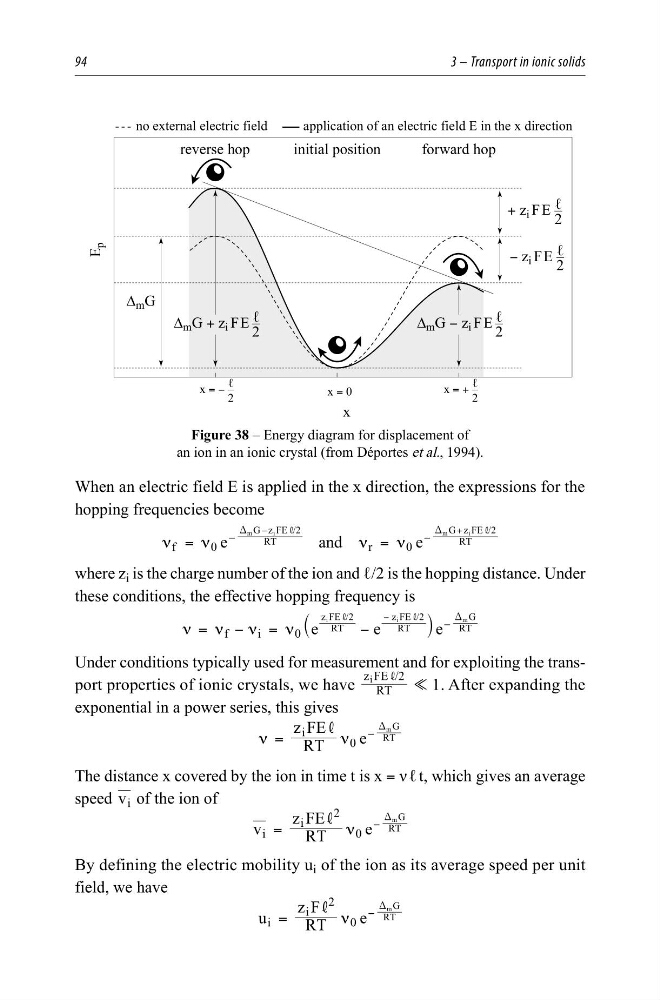
Figure 38 – Energy diagram for displacement of
an ion in an ionic crystal (from Déportes et al., 1994).
When an electric field E is applied in the x direction, the expressions for the
hopping frequencies become
e
a nd
e
f
0
r
0
RT
G z FE /2
RT
G z FE /2
m
i
m
i
ν
ν
ν
ν
=
=
−
−
,
,
D
D
−
+
where z i is the charge number of the ion and ℓ/2 is the hopping distance. Under
these conditions, the effective hopping frequency is
e
e
e
f
i
0
RT
z FE /2
RT
z FE /2
RT
G
i
i
m
ν ν
ν
ν
=
−
=
−
−
,
,
D
−
`
j
Under conditions typically used for measurement and for exploiting the transport properties of ionic crystals, we have
/
RT
z FE 2
i
,
% 1. After expanding the
exponential in a power series, this gives
RT
z FE
e
i
0
RT
G
m
,
ν
ν
=
−
D
The distance x covered by the ion in time t is x = ν ℓ t, which gives an average
speed v i of the ion of
v
RT
z FE
e
i
i
2
0
RT
G
m
, ν
=
−
D
By defining the electric mobility u i of the ion as its average speed per unit
field, we have
u
RT
z F
e
i
i
2
0
RT
G
m
, ν
=
−
D
3 – Transport in ionic solids
[
(
S
Ɛ
¨ P *
] L )( ±
Ɛ
] L )(±
¨ P *
Ɛ
¨ P *<] L )( ±
Ɛ
<] L )(±
Ɛ
[<±
Ɛ
[
±
[
UHYHUVHKRS
LQLWLDOSRVLWLRQ
IRUZDUGKRS
QRH[WHUQDOHOHFWULFILHOG
DSSOLFDWLRQRIDQHOHFWULFILHOG(LQWKH[GLUHFWLRQ
Figure 38 – Energy diagram for displacement of
an ion in an ionic crystal (from Déportes et al., 1994).
When an electric field E is applied in the x direction, the expressions for the
hopping frequencies become
e
a nd
e
f
0
r
0
RT
G z FE /2
RT
G z FE /2
m
i
m
i
ν
ν
ν
ν
=
=
−
−
,
,
D
D
−
+
where z i is the charge number of the ion and ℓ/2 is the hopping distance. Under
these conditions, the effective hopping frequency is
e
e
e
f
i
0
RT
z FE /2
RT
z FE /2
RT
G
i
i
m
ν ν
ν
ν
=
−
=
−
−
,
,
D
−
`
j
Under conditions typically used for measurement and for exploiting the transport properties of ionic crystals, we have
/
RT
z FE 2
i
,
% 1. After expanding the
exponential in a power series, this gives
RT
z FE
e
i
0
RT
G
m
,
ν
ν
=
−
D
The distance x covered by the ion in time t is x = ν ℓ t, which gives an average
speed v i of the ion of
v
RT
z FE
e
i
i
2
0
RT
G
m
, ν
=
−
D
By defining the electric mobility u i of the ion as its average speed per unit
field, we have
u
RT
z F
e
i
i
2
0
RT
G
m
, ν
=
−
D