

Solutions to exercises
85
anodic reaction corresponds to a release of fluorine F 2 at the total working
pressure:
2 F
#
F $ 2 V
•
F + F 2(g) + 2e ′
2. This behavior indicates that the variation in current I does not lead to a modification of the crystal and, in particular, of the anodic reaction. Applying
the relation for t c , to CaF 2 gives
t
2F M
I
S x
c
ρ
τ
Δ
=
#
#
#
#
This shows that, for a given electrolysis time τ, any variation in I is accompanied by a variation in the ratio x τ
Δ
such that the ratio x I # τ
Δ ^
h and,
consequently, t c , remains constant.
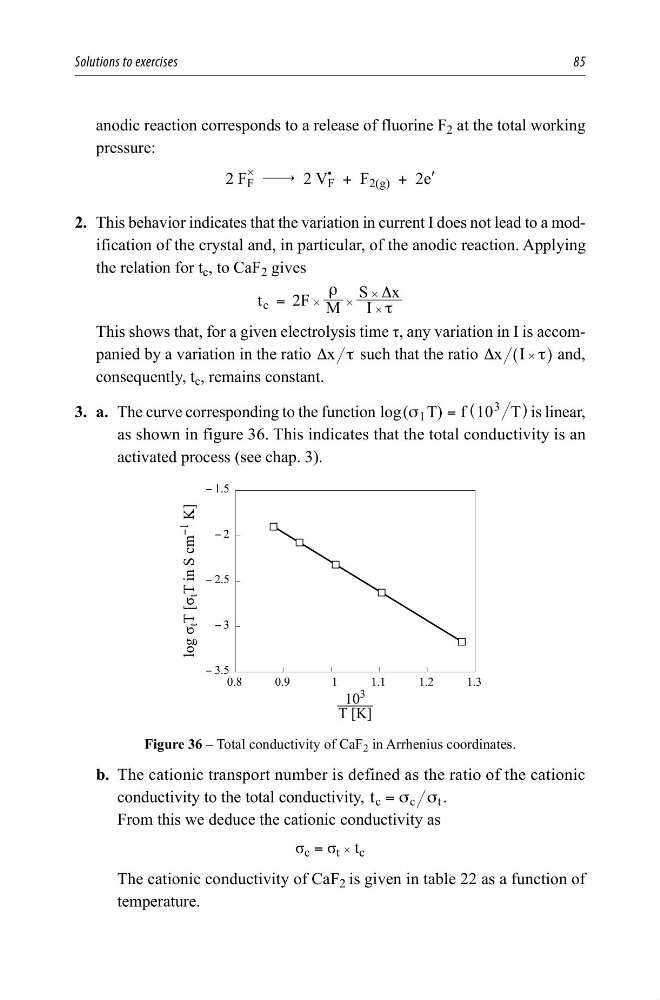
3. a. The curve corresponding to the function log( T) f 10 T
1
3
σ
= ^
h is linear,
as shown in figure 36. This indicates that the total conductivity is an
activated process (see chap. 3).
—
7>.@
ORJı
W 7>ı
W 7LQ6FP
<
.@
<
<
<
<
<
Figure 36 – Total conductivity of CaF 2 in Arrhenius coordinates.
b. The cationic transport number is defined as the ratio of the cationic
conductivity to the total conductivity, t
.
c
c
t
σ σ
=
From this we deduce the cationic conductivity as
σ c = σ t # t c
The cationic conductivity of CaF 2 is given in table 22 as a function of
temperature.
85
anodic reaction corresponds to a release of fluorine F 2 at the total working
pressure:
2 F
#
F $ 2 V
•
F + F 2(g) + 2e ′
2. This behavior indicates that the variation in current I does not lead to a modification of the crystal and, in particular, of the anodic reaction. Applying
the relation for t c , to CaF 2 gives
t
2F M
I
S x
c
ρ
τ
Δ
=
#
#
#
#
This shows that, for a given electrolysis time τ, any variation in I is accompanied by a variation in the ratio x τ
Δ
such that the ratio x I # τ
Δ ^
h and,
consequently, t c , remains constant.
3. a. The curve corresponding to the function log( T) f 10 T
1
3
σ
= ^
h is linear,
as shown in figure 36. This indicates that the total conductivity is an
activated process (see chap. 3).
—
7>.@
ORJı
W 7>ı
W 7LQ6FP
<
.@
<
<
<
<
<
Figure 36 – Total conductivity of CaF 2 in Arrhenius coordinates.
b. The cationic transport number is defined as the ratio of the cationic
conductivity to the total conductivity, t
.
c
c
t
σ σ
=
From this we deduce the cationic conductivity as
σ c = σ t # t c
The cationic conductivity of CaF 2 is given in table 22 as a function of
temperature.