

38
Chapter 2. Geometrical optics
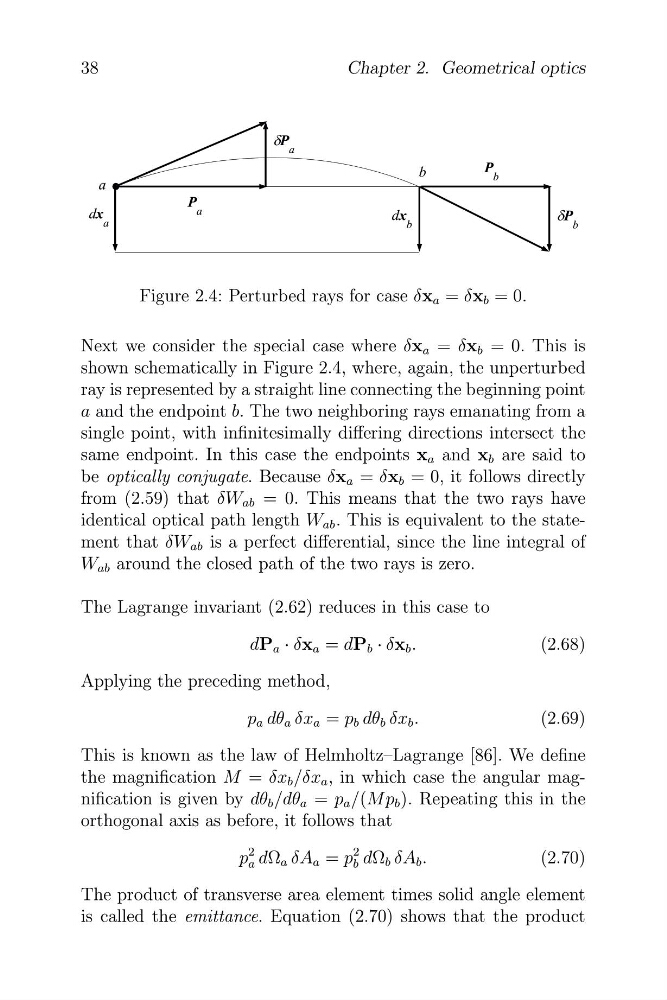
Figure 2.4: Perturbed rays for case δx a = δx b = 0.
Next we consider the special case where δx a = δx b = 0. This is
shown schematically in Figure 2.4, where, again, the unperturbed
ray is represented by a straight line connecting the beginning point
a and the endpoint b. The two neighboring rays emanating from a
single point, with infinitesimally differing directions intersect the
same endpoint. In this case the endpoints x a and x b are said to
be optically conjugate. Because δx a = δx b = 0, it follows directly
from (2.59) that δW ab = 0. This means that the two rays have
identical optical path length W ab . This is equivalent to the statement that δW ab is a perfect differential, since the line integral of
W ab around the closed path of the two rays is zero.
The Lagrange invariant (2.62) reduces in this case to
dP a · δx a = dP b · δx b .
(2.68)
Applying the preceding method,
p a dθ a δx a = p b dθ b δx b .
(2.69)
This is known as the law of Helmholtz–Lagrange [86]. We define
the magnification M = δx b /δx a , in which case the angular magnification is given by dθ b /dθ a = p a /(M p b ). Repeating this in the
orthogonal axis as before, it follows that
p
2
a dΩ a δA a = p
2
b dΩ b δA b .
(2.70)
The product of transverse area element times solid angle element
is called the emittance. Equation (2.70) shows that the product
Chapter 2. Geometrical optics
Figure 2.4: Perturbed rays for case δx a = δx b = 0.
Next we consider the special case where δx a = δx b = 0. This is
shown schematically in Figure 2.4, where, again, the unperturbed
ray is represented by a straight line connecting the beginning point
a and the endpoint b. The two neighboring rays emanating from a
single point, with infinitesimally differing directions intersect the
same endpoint. In this case the endpoints x a and x b are said to
be optically conjugate. Because δx a = δx b = 0, it follows directly
from (2.59) that δW ab = 0. This means that the two rays have
identical optical path length W ab . This is equivalent to the statement that δW ab is a perfect differential, since the line integral of
W ab around the closed path of the two rays is zero.
The Lagrange invariant (2.62) reduces in this case to
dP a · δx a = dP b · δx b .
(2.68)
Applying the preceding method,
p a dθ a δx a = p b dθ b δx b .
(2.69)
This is known as the law of Helmholtz–Lagrange [86]. We define
the magnification M = δx b /δx a , in which case the angular magnification is given by dθ b /dθ a = p a /(M p b ). Repeating this in the
orthogonal axis as before, it follows that
p
2
a dΩ a δA a = p
2
b dΩ b δA b .
(2.70)
The product of transverse area element times solid angle element
is called the emittance. Equation (2.70) shows that the product