

�
�
�
�
34
Chapter 2. Geometrical optics
We obtain an expression (2.42, 2.52, 2.53, 2.54) for the integrand
in (2.48) as
d
d
δn + n (δs) = (v x n) · δx + P · (δx).
(2.55)
ds
ds
The chain rule gives
d
d
dP
(P · δx) = P · (δx) +
· (δx),
(2.56)
ds
ds
ds
from which it follows (2.47, 2.55, 2.56)
x b
x b
dP
δW ab = P · δx
+
δx · v x n −
ds.
(2.57)
xa
xa
ds
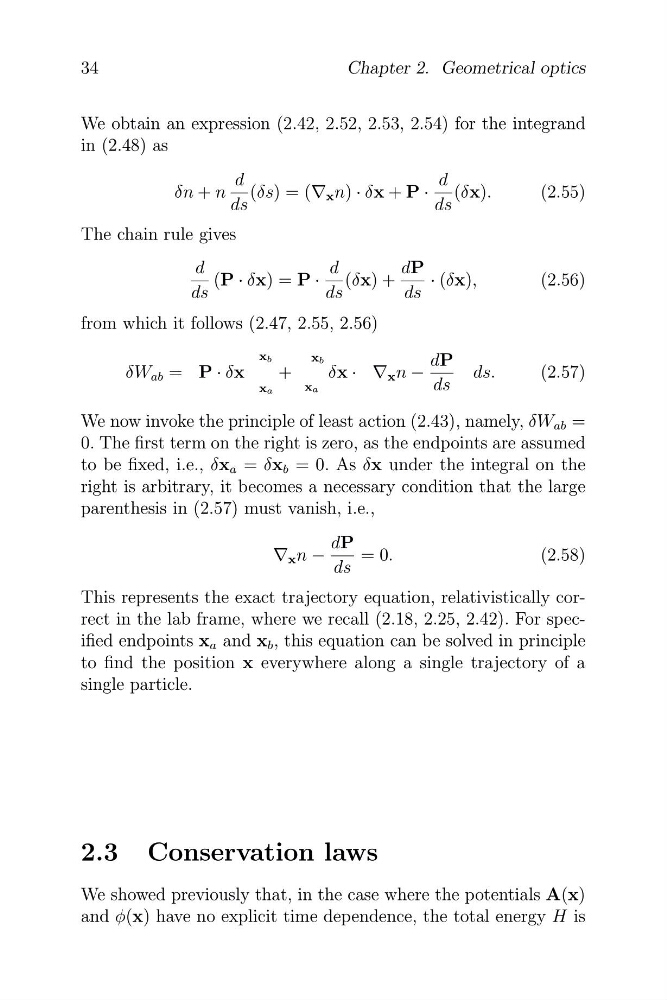
We now invoke the principle of least action (2.43), namely, δW ab =
0. The first term on the right is zero, as the endpoints are assumed
to be fixed, i.e., δx a = δx b = 0. As δx under the integral on the
right is arbitrary, it becomes a necessary condition that the large
parenthesis in (2.57) must vanish, i.e.,
dP
v x n −
= 0.
(2.58)
ds
This represents the exact trajectory equation, relativistically correct in the lab frame, where we recall (2.18, 2.25, 2.42). For specified endpoints x a and x b , this equation can be solved in principle
to find the position x everywhere along a single trajectory of a
single particle.
2.3 Conservation laws
We showed previously that, in the case where the potentials A(x)
and φ(x) have no explicit time dependence, the total energy H is
�
�
�
34
Chapter 2. Geometrical optics
We obtain an expression (2.42, 2.52, 2.53, 2.54) for the integrand
in (2.48) as
d
d
δn + n (δs) = (v x n) · δx + P · (δx).
(2.55)
ds
ds
The chain rule gives
d
d
dP
(P · δx) = P · (δx) +
· (δx),
(2.56)
ds
ds
ds
from which it follows (2.47, 2.55, 2.56)
x b
x b
dP
δW ab = P · δx
+
δx · v x n −
ds.
(2.57)
xa
xa
ds
We now invoke the principle of least action (2.43), namely, δW ab =
0. The first term on the right is zero, as the endpoints are assumed
to be fixed, i.e., δx a = δx b = 0. As δx under the integral on the
right is arbitrary, it becomes a necessary condition that the large
parenthesis in (2.57) must vanish, i.e.,
dP
v x n −
= 0.
(2.58)
ds
This represents the exact trajectory equation, relativistically correct in the lab frame, where we recall (2.18, 2.25, 2.42). For specified endpoints x a and x b , this equation can be solved in principle
to find the position x everywhere along a single trajectory of a
single particle.
2.3 Conservation laws
We showed previously that, in the case where the potentials A(x)
and φ(x) have no explicit time dependence, the total energy H is