

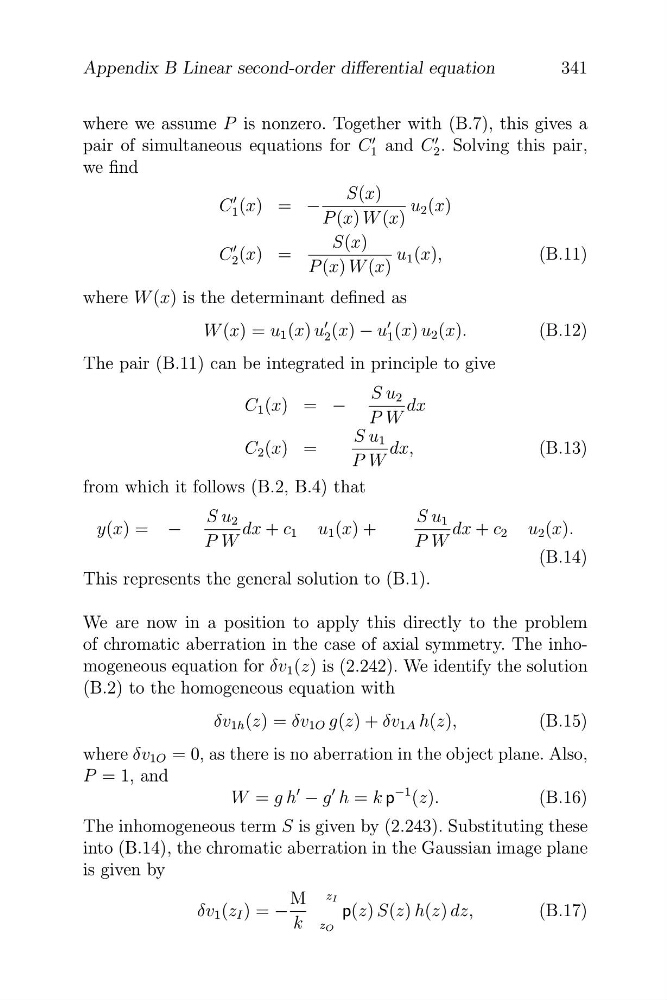
where we assume P is nonzero. Together with (B.7), this gives a
pair of simultaneous equations for C 1
� and C 2
� . Solving this pair,
we find
S(x)
C 1
� (x) = −
u 2 (x)
P (x) W (x)
S(x)
C
�
2 (x) =
u 1 (x),
(B.11)
P (x) W (x)
where W (x) is the determinant defined as
W (x) = u 1 (x) u 2
� (x) − u 1
� (x) u 2 (x).
(B.12)
The pair (B.11) can be integrated in principle to give
S u 2
C 1 (x) = −
dx
P W
S u 1
C 2 (x) =
dx,
(B.13)
P W
from which it follows (B.2, B.4) that
S u 2
S u 1
y(x) = −
dx + c 1 u 1 (x) +
dx + c 2 u 2 (x).
P W
P W
(B.14)
This represents the general solution to (B.1).
We are now in a position to apply this directly to the problem
of chromatic aberration in the case of axial symmetry. The inhomogeneous equation for δv 1 (z) is (2.242). We identify the solution
(B.2) to the homogeneous equation with
δv 1h (z) = δv 1O g(z) + δv 1A h(z),
(B.15)
where δv 1O = 0, as there is no aberration in the object plane. Also,
P = 1, and
W = g h
� − g
� h = k p
−1 (z).
(B.16)
The inhomogeneous term S is given by (2.243). Substituting these
into (B.14), the chromatic aberration in the Gaussian image plane
is given by
M z I
δv 1 (z I ) = −
p(z) S(z) h(z) dz,
(B.17)
k z O
341
Appendix B Linear second-order differential equation
pair of simultaneous equations for C 1
� and C 2
� . Solving this pair,
we find
S(x)
C 1
� (x) = −
u 2 (x)
P (x) W (x)
S(x)
C
�
2 (x) =
u 1 (x),
(B.11)
P (x) W (x)
where W (x) is the determinant defined as
W (x) = u 1 (x) u 2
� (x) − u 1
� (x) u 2 (x).
(B.12)
The pair (B.11) can be integrated in principle to give
S u 2
C 1 (x) = −
dx
P W
S u 1
C 2 (x) =
dx,
(B.13)
P W
from which it follows (B.2, B.4) that
S u 2
S u 1
y(x) = −
dx + c 1 u 1 (x) +
dx + c 2 u 2 (x).
P W
P W
(B.14)
This represents the general solution to (B.1).
We are now in a position to apply this directly to the problem
of chromatic aberration in the case of axial symmetry. The inhomogeneous equation for δv 1 (z) is (2.242). We identify the solution
(B.2) to the homogeneous equation with
δv 1h (z) = δv 1O g(z) + δv 1A h(z),
(B.15)
where δv 1O = 0, as there is no aberration in the object plane. Also,
P = 1, and
W = g h
� − g
� h = k p
−1 (z).
(B.16)
The inhomogeneous term S is given by (2.243). Substituting these
into (B.14), the chromatic aberration in the Gaussian image plane
is given by
M z I
δv 1 (z I ) = −
p(z) S(z) h(z) dz,
(B.17)
k z O
341
Appendix B Linear second-order differential equation