

�
�
�
��
��
�
�
��
��
�
�
��
��
��
��
��
�
�
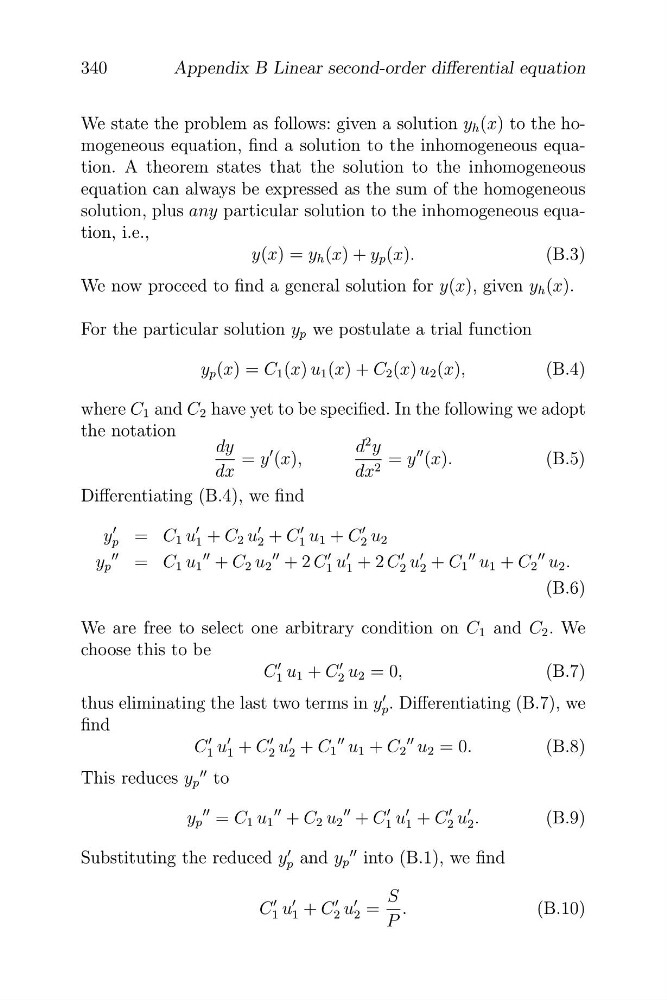
We state the problem as follows: given a solution y h (x) to the homogeneous equation, find a solution to the inhomogeneous equation. A theorem states that the solution to the inhomogeneous
equation can always be expressed as the sum of the homogeneous
solution, plus any particular solution to the inhomogeneous equation, i.e.,
y(x) = y h (x) + y p (x).
(B.3)
We now proceed to find a general solution for y(x), given y h (x).
For the particular solution y p we postulate a trial function
y p (x) = C 1 (x) u 1 (x) + C 2 (x) u 2 (x),
(B.4)
where C 1 and C 2 have yet to be specified. In the following we adopt
the notation
dy
d
2 y
�� (x).
= y
� (x),
= y
(B.5)
dx
dx 2
Differentiating (B.4), we find
y p = C 1 u 1 + C 2 u 2 + C 1
� u 1 + C 2
� u 2
y p = C 1 u 1 + C 2 u 2
�� + 2 C 1
� u 1 + 2 C 2
� u 2 + C 1 u 1 + C 2 u 2 .
(B.6)
We are free to select one arbitrary condition on C 1 and C 2 . We
choose this to be
C 1
� u 1 + C 2
� u 2 = 0,
(B.7)
thus eliminating the last two terms in y p
� . Differentiating (B.7), we
find
C 1
� u 1 + C 2
� u 2 + C 1 u 1 + C 2 u 2 = 0.
(B.8)
This reduces y p
�� to
y p = C 1 u 1 + C 2 u 2 + C 1
� u 1 + C 2
� u 2 .
(B.9)
Substituting the reduced y p
� and y p
�� into (B.1), we find
C 1
� u 1
� + C 2
� u 2
� =
S .
(B.10)
P
340
Appendix B Linear second-order differential equation
�
�
��
��
�
�
��
��
�
�
��
��
��
��
��
�
�
We state the problem as follows: given a solution y h (x) to the homogeneous equation, find a solution to the inhomogeneous equation. A theorem states that the solution to the inhomogeneous
equation can always be expressed as the sum of the homogeneous
solution, plus any particular solution to the inhomogeneous equation, i.e.,
y(x) = y h (x) + y p (x).
(B.3)
We now proceed to find a general solution for y(x), given y h (x).
For the particular solution y p we postulate a trial function
y p (x) = C 1 (x) u 1 (x) + C 2 (x) u 2 (x),
(B.4)
where C 1 and C 2 have yet to be specified. In the following we adopt
the notation
dy
d
2 y
�� (x).
= y
� (x),
= y
(B.5)
dx
dx 2
Differentiating (B.4), we find
y p = C 1 u 1 + C 2 u 2 + C 1
� u 1 + C 2
� u 2
y p = C 1 u 1 + C 2 u 2
�� + 2 C 1
� u 1 + 2 C 2
� u 2 + C 1 u 1 + C 2 u 2 .
(B.6)
We are free to select one arbitrary condition on C 1 and C 2 . We
choose this to be
C 1
� u 1 + C 2
� u 2 = 0,
(B.7)
thus eliminating the last two terms in y p
� . Differentiating (B.7), we
find
C 1
� u 1 + C 2
� u 2 + C 1 u 1 + C 2 u 2 = 0.
(B.8)
This reduces y p
�� to
y p = C 1 u 1 + C 2 u 2 + C 1
� u 1 + C 2
� u 2 .
(B.9)
Substituting the reduced y p
� and y p
�� into (B.1), we find
C 1
� u 1
� + C 2
� u 2
� =
S .
(B.10)
P
340
Appendix B Linear second-order differential equation