

These seemingly esoteric relationships are very useful in the theory of small angle plural scattering.
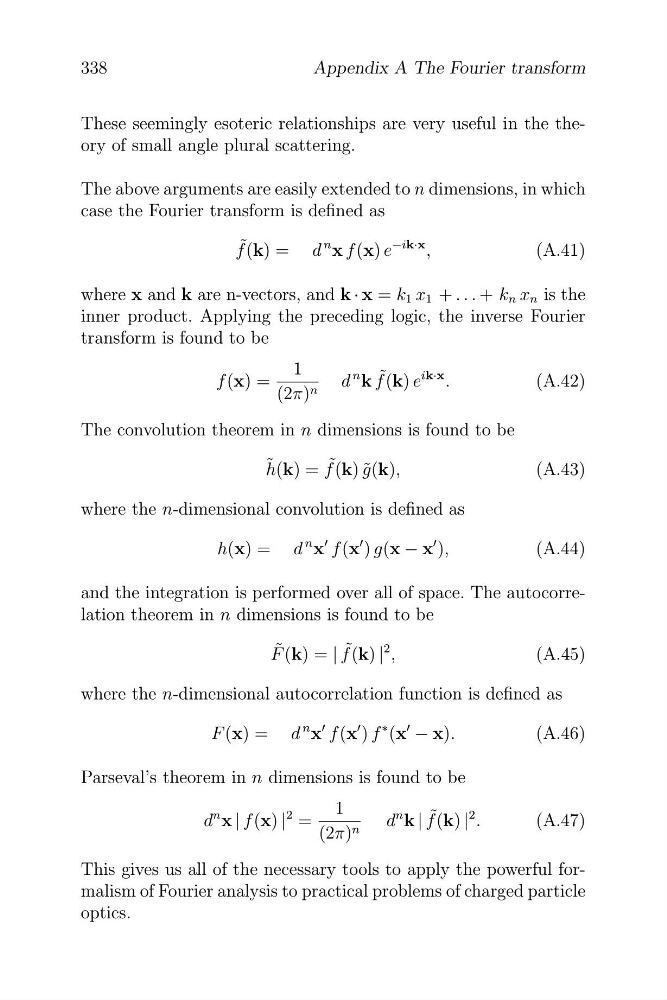
The above arguments are easily extended to n dimensions, in which
case the Fourier transform is defined as
−ik·x
f ˜ (k) = d
n x f (x) e
,
(A.41)
where x and k are n-vectors, and k · x = k 1 x 1 + . . . + k n x n is the
inner product. Applying the preceding logic, the inverse Fourier
transform is found to be
1
d
n k f ˜ (k) e
ik·x
f (x) =
.
(A.42)
(2π) n
The convolution theorem in n dimensions is found to be
h ˜ (k) = f ˜ (k) ˜
g(k),
(A.43)
where the n-dimensional convolution is defined as
h(x) = d
n x
� f (x
� ) g(x − x
� ),
(A.44)
and the integration is performed over all of space. The autocorrelation theorem in n dimensions is found to be
˜
F (k) = | f ˜ (k) |
2 ,
(A.45)
where the n-dimensional autocorrelation function is defined as
F (x) = d
n x
� f (x
� ) f
∗ (x
� − x).
(A.46)
Parseval’s theorem in n dimensions is found to be
1
d
n x | f (x) |
2 =
d
n k | f ˜ (k) |
2 .
(A.47)
(2π) n
This gives us all of the necessary tools to apply the powerful formalism of Fourier analysis to practical problems of charged particle
optics.
338
Appendix A The Fourier transform
The above arguments are easily extended to n dimensions, in which
case the Fourier transform is defined as
−ik·x
f ˜ (k) = d
n x f (x) e
,
(A.41)
where x and k are n-vectors, and k · x = k 1 x 1 + . . . + k n x n is the
inner product. Applying the preceding logic, the inverse Fourier
transform is found to be
1
d
n k f ˜ (k) e
ik·x
f (x) =
.
(A.42)
(2π) n
The convolution theorem in n dimensions is found to be
h ˜ (k) = f ˜ (k) ˜
g(k),
(A.43)
where the n-dimensional convolution is defined as
h(x) = d
n x
� f (x
� ) g(x − x
� ),
(A.44)
and the integration is performed over all of space. The autocorrelation theorem in n dimensions is found to be
˜
F (k) = | f ˜ (k) |
2 ,
(A.45)
where the n-dimensional autocorrelation function is defined as
F (x) = d
n x
� f (x
� ) f
∗ (x
� − x).
(A.46)
Parseval’s theorem in n dimensions is found to be
1
d
n x | f (x) |
2 =
d
n k | f ˜ (k) |
2 .
(A.47)
(2π) n
This gives us all of the necessary tools to apply the powerful formalism of Fourier analysis to practical problems of charged particle
optics.
338
Appendix A The Fourier transform