

�
�
We consider an arbitrary complex function f (x), defined over the
range −∞ < x < +∞. We define the Fourier transform f ˜ (k) as
f ˜ (k) =
∞
dx e
−ikx f (x),
(A.1)
−∞
where k is called the transform variable, and in general −∞ < k <
+∞. We assume that the function f (x) is such that the integral
is finite. This is true for most problems of physical interest, where
f is well-behaved in this sense. Operating on both sides from the
left by
1 ∞
dk e
ikx � ,
(A.2)
2π −∞
we obtain
∞
∞
∞
1
1
� )
dk e
ikx � f ˜ (k) =
dx f (x)
dk e
−ik(x−x
,
2π −∞
−∞
2π −∞
(A.3)
Appendix A
The Fourier transform
As a mathematical method, the Fourier transform provides a powerful, simplifying tool for a variety of physical problems. This derives from the fact that a Fourier transform of a function represents
the spectral density of the function in the frequency domain. It is
a special case in the general theory of Hilbert spaces. Rather than
attempt a complete description of this theory, we will confine our
attention here only to those aspects that are directly applicable to
the present study.
331
�
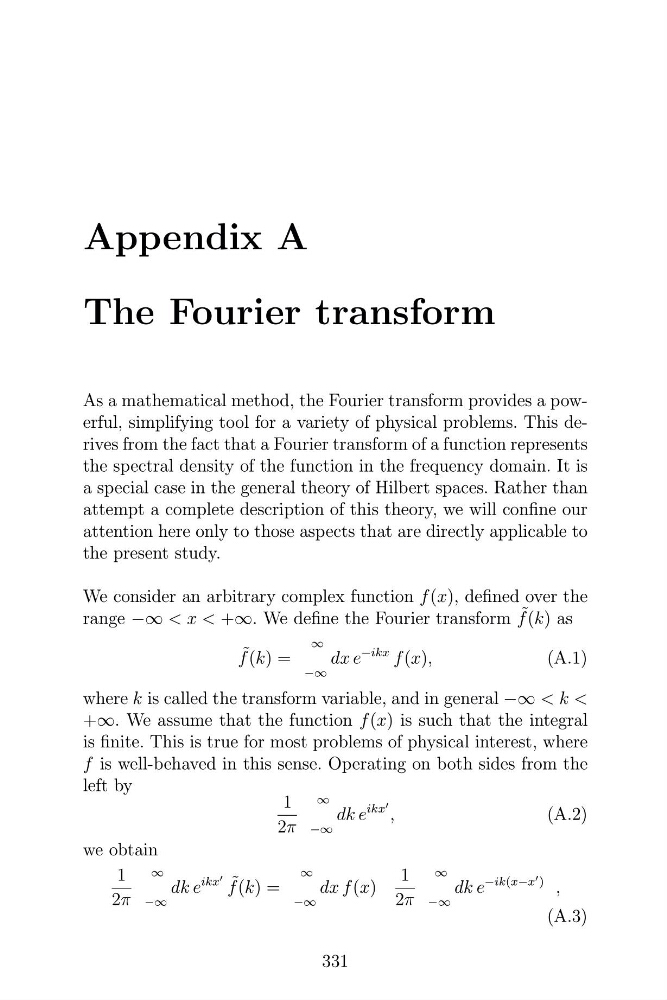
We consider an arbitrary complex function f (x), defined over the
range −∞ < x < +∞. We define the Fourier transform f ˜ (k) as
f ˜ (k) =
∞
dx e
−ikx f (x),
(A.1)
−∞
where k is called the transform variable, and in general −∞ < k <
+∞. We assume that the function f (x) is such that the integral
is finite. This is true for most problems of physical interest, where
f is well-behaved in this sense. Operating on both sides from the
left by
1 ∞
dk e
ikx � ,
(A.2)
2π −∞
we obtain
∞
∞
∞
1
1
� )
dk e
ikx � f ˜ (k) =
dx f (x)
dk e
−ik(x−x
,
2π −∞
−∞
2π −∞
(A.3)
Appendix A
The Fourier transform
As a mathematical method, the Fourier transform provides a powerful, simplifying tool for a variety of physical problems. This derives from the fact that a Fourier transform of a function represents
the spectral density of the function in the frequency domain. It is
a special case in the general theory of Hilbert spaces. Rather than
attempt a complete description of this theory, we will confine our
attention here only to those aspects that are directly applicable to
the present study.
331