

�
�
�
�
| a − |
2
j − (x < x 1 ) = − m
x 2
| b + |
2
2
j + (x > x 2 ) =
exp −
| p(ξ) | dξ . (5.101)
m
h ¯ x 1
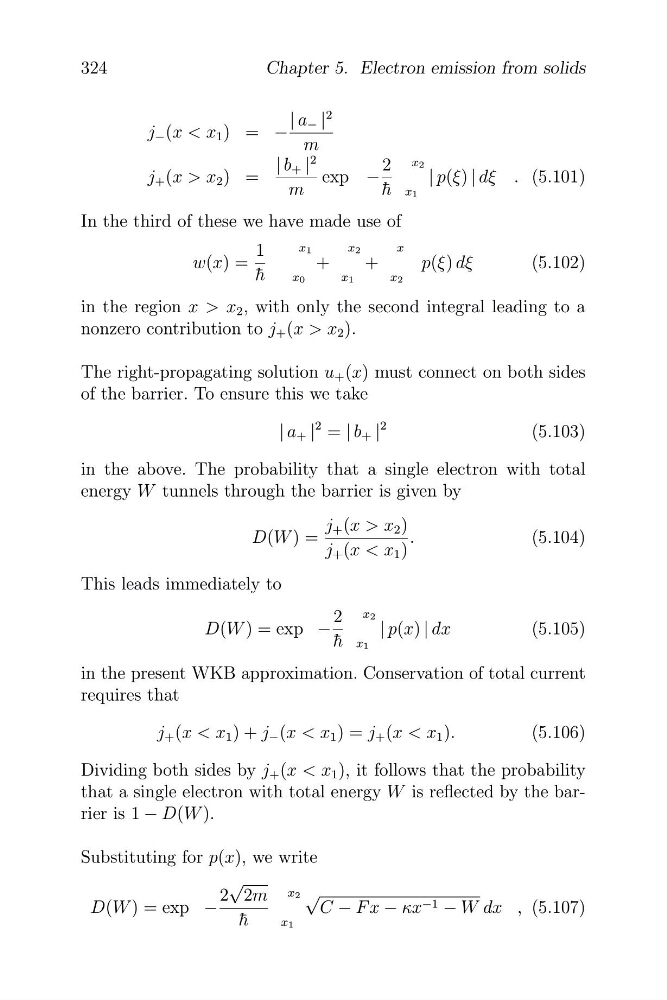
In the third of these we have made use of
x
1
x 1
x 2
w(x) =
+
+
p(ξ) dξ
(5.102)
h ¯
x 0
x 1
x 2
in the region x > x 2 , with only the second integral leading to a
nonzero contribution to j + (x > x 2 ).
The right-propagating solution u + (x) must connect on both sides
of the barrier. To ensure this we take
| a + |
2 = | b + |
2
(5.103)
in the above. The probability that a single electron with total
energy W tunnels through the barrier is given by
j + (x > x 2 )
D(W ) =
.
(5.104)
j + (x < x 1 )
This leads immediately to
2 x 2
D(W ) = exp −
| p(x) | dx
(5.105)
h ¯ x 1
in the present WKB approximation. Conservation of total current
requires that
j + (x < x 1 ) + j − (x < x 1 ) = j + (x < x 1 ).
(5.106)
Dividing both sides by j + (x < x 1 ), it follows that the probability
that a single electron with total energy W is reflected by the barrier is 1 − D(W ).
Substituting for p(x), we write
√
x 2 √
2 2m
D(W ) = exp −
C − F x − κx −1 − W dx , (5.107)
h ¯
x 1
324
Chapter 5. Electron emission from solids
�
�
�
| a − |
2
j − (x < x 1 ) = − m
x 2
| b + |
2
2
j + (x > x 2 ) =
exp −
| p(ξ) | dξ . (5.101)
m
h ¯ x 1
In the third of these we have made use of
x
1
x 1
x 2
w(x) =
+
+
p(ξ) dξ
(5.102)
h ¯
x 0
x 1
x 2
in the region x > x 2 , with only the second integral leading to a
nonzero contribution to j + (x > x 2 ).
The right-propagating solution u + (x) must connect on both sides
of the barrier. To ensure this we take
| a + |
2 = | b + |
2
(5.103)
in the above. The probability that a single electron with total
energy W tunnels through the barrier is given by
j + (x > x 2 )
D(W ) =
.
(5.104)
j + (x < x 1 )
This leads immediately to
2 x 2
D(W ) = exp −
| p(x) | dx
(5.105)
h ¯ x 1
in the present WKB approximation. Conservation of total current
requires that
j + (x < x 1 ) + j − (x < x 1 ) = j + (x < x 1 ).
(5.106)
Dividing both sides by j + (x < x 1 ), it follows that the probability
that a single electron with total energy W is reflected by the barrier is 1 − D(W ).
Substituting for p(x), we write
√
x 2 √
2 2m
D(W ) = exp −
C − F x − κx −1 − W dx , (5.107)
h ¯
x 1
324
Chapter 5. Electron emission from solids