

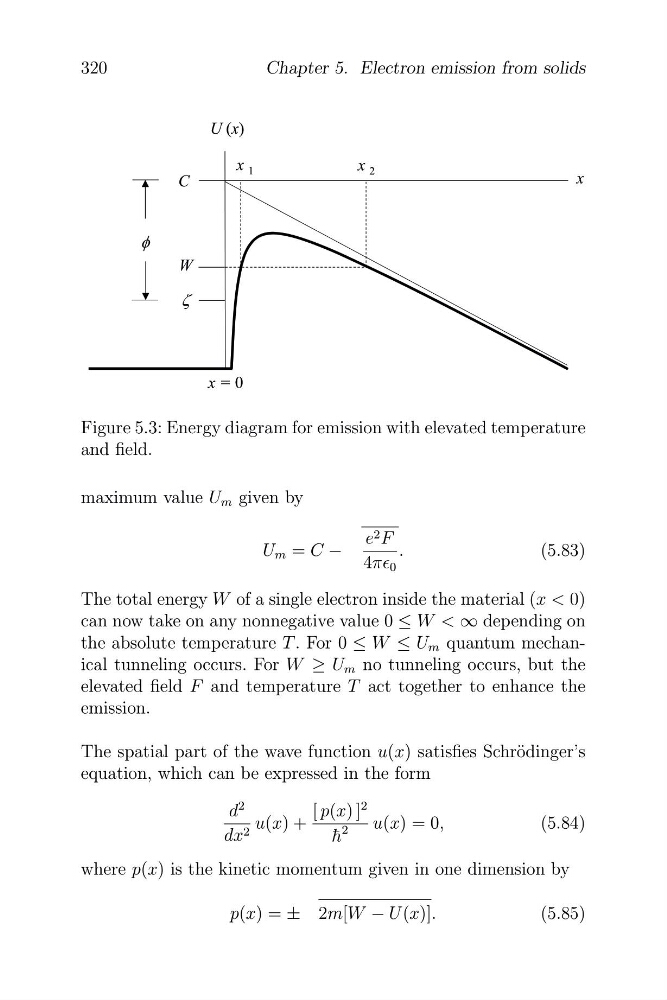
maximum value U m given by
e 2 F
U m = C −
.
(5.83)
4πf 0
The total energy W of a single electron inside the material (x < 0)
can now take on any nonnegative value 0 ≤ W < ∞ depending on
the absolute temperature T . For 0 ≤ W ≤ U m quantum mechanical tunneling occurs. For W ≥ U m no tunneling occurs, but the
elevated field F and temperature T act together to enhance the
emission.
The spatial part of the wave function u(x) satisfies Schr¨ odinger’s
equation, which can be expressed in the form
d
2
[ p(x) ]
2
u(x) +
u(x) = 0,
(5.84)
dx 2
h ¯
2
where p(x) is the kinetic momentum given in one dimension by
p(x) = ± 2m[W − U (x)].
(5.85)
320
Chapter 5. Electron emission from solids
x
x
x
U x
W
]
x =
I
C
Figure 5.3: Energy diagram for emission with elevated temperature
and field.
e 2 F
U m = C −
.
(5.83)
4πf 0
The total energy W of a single electron inside the material (x < 0)
can now take on any nonnegative value 0 ≤ W < ∞ depending on
the absolute temperature T . For 0 ≤ W ≤ U m quantum mechanical tunneling occurs. For W ≥ U m no tunneling occurs, but the
elevated field F and temperature T act together to enhance the
emission.
The spatial part of the wave function u(x) satisfies Schr¨ odinger’s
equation, which can be expressed in the form
d
2
[ p(x) ]
2
u(x) +
u(x) = 0,
(5.84)
dx 2
h ¯
2
where p(x) is the kinetic momentum given in one dimension by
p(x) = ± 2m[W − U (x)].
(5.85)
320
Chapter 5. Electron emission from solids
x
x
x
U x
W
]
x =
I
C
Figure 5.3: Energy diagram for emission with elevated temperature
and field.