

�
�
313
5.4. Field emission
The quantity F is the electron charge e times the applied electric
field, and has the dimension of force in nt. Equivalently we write
this as
d
2
2m
u(x) +
[ W − C + F x ] u(x) = 0.
(5.48)
dx 2
h ¯
2
We rewrite this as
d
2
u(x) + α
3 (x − β) u(x) = 0,
(5.49)
dx 2
where we have defined the constants
2mF
α
3 =
h
2
¯
C − W
β =
.
(5.50)
F
We define a new variable y(x) as
y(x) ≡ α (β − x).
(5.51)
The differential equation for u(x) is thus transformed into
d
2
− y Y (y) = 0,
(5.52)
dy 2
where we have defined the eigenfunction Y (y) according to
Y (y) ≡ u[x(y)].
(5.53)
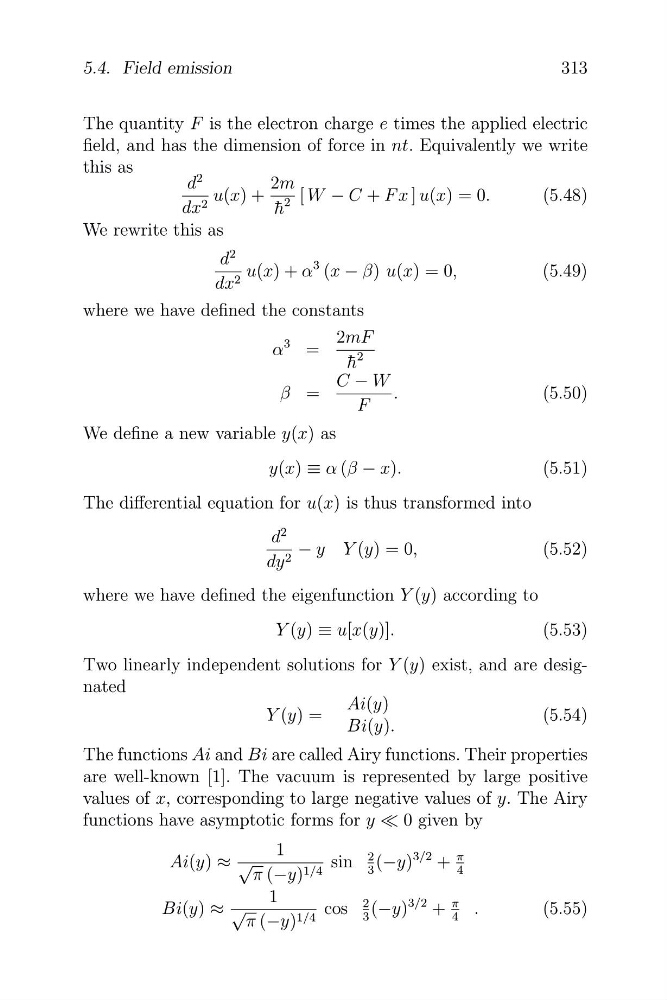
Two linearly independent solutions for Y (y) exist, and are designated
Ai(y)
Y (y) =
(5.54)
Bi(y).
The functions Ai and Bi are called Airy functions. Their properties
are well-known [1]. The vacuum is represented by large positive
values of x, corresponding to large negative values of y. The Airy
functions have asymptotic forms for y « 0 given by
1
2 (−y)
3/2
π
Ai(y) ≈ √
sin 3
+ 4
π (−y) 1/4
1
2 (−y)
3/2
π
Bi(y) ≈ √
cos 3
+ 4 .
(5.55)
π (−y) 1/4
�
313
5.4. Field emission
The quantity F is the electron charge e times the applied electric
field, and has the dimension of force in nt. Equivalently we write
this as
d
2
2m
u(x) +
[ W − C + F x ] u(x) = 0.
(5.48)
dx 2
h ¯
2
We rewrite this as
d
2
u(x) + α
3 (x − β) u(x) = 0,
(5.49)
dx 2
where we have defined the constants
2mF
α
3 =
h
2
¯
C − W
β =
.
(5.50)
F
We define a new variable y(x) as
y(x) ≡ α (β − x).
(5.51)
The differential equation for u(x) is thus transformed into
d
2
− y Y (y) = 0,
(5.52)
dy 2
where we have defined the eigenfunction Y (y) according to
Y (y) ≡ u[x(y)].
(5.53)
Two linearly independent solutions for Y (y) exist, and are designated
Ai(y)
Y (y) =
(5.54)
Bi(y).
The functions Ai and Bi are called Airy functions. Their properties
are well-known [1]. The vacuum is represented by large positive
values of x, corresponding to large negative values of y. The Airy
functions have asymptotic forms for y « 0 given by
1
2 (−y)
3/2
π
Ai(y) ≈ √
sin 3
+ 4
π (−y) 1/4
1
2 (−y)
3/2
π
Bi(y) ≈ √
cos 3
+ 4 .
(5.55)
π (−y) 1/4