

�
�
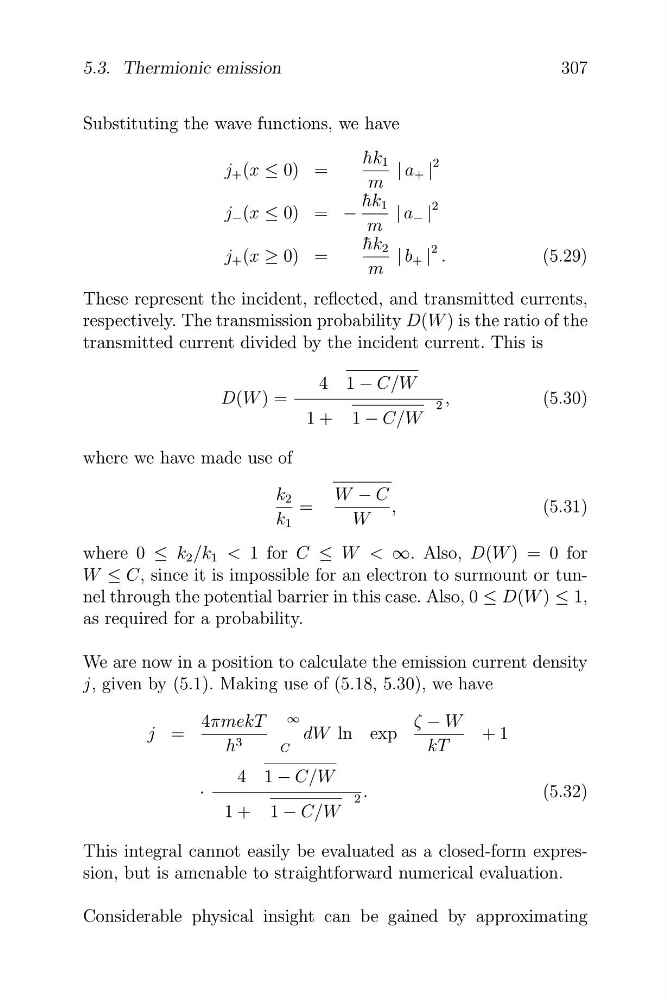
Substituting the wave functions, we have
¯
hk 1
j + (x ≤ 0) =
| a + |
2
m
¯
hk 1
j − (x ≤ 0) = −
| a − |
2
m
¯
hk 2
j + (x ≥ 0) =
| b + |
2 .
(5.29)
m
These represent the incident, reflected, and transmitted currents,
respectively. The transmission probability D(W ) is the ratio of the
transmitted current divided by the incident current. This is
4 1 − C/W
D(W ) =
2 ,
(5.30)
1 + 1 − C/W
where we have made use of
k 2
W − C
=
,
(5.31)
k 1
W
where 0 ≤ k 2 /k 1 < 1 for C ≤ W < ∞. Also, D(W ) = 0 for
W ≤ C, since it is impossible for an electron to surmount or tunnel through the potential barrier in this case. Also, 0 ≤ D(W ) ≤ 1,
as required for a probability.
We are now in a position to calculate the emission current density
j, given by (5.1). Making use of (5.18, 5.30), we have
4πmekT ∞
ζ − W
j =
dW ln exp
+ 1
h 3
C
kT
4 1 − C/W
·
2 .
(5.32)
1 + 1 − C/W
This integral cannot easily be evaluated as a closed-form expression, but is amenable to straightforward numerical evaluation.
Considerable physical insight can be gained by approximating
307
5.3. Thermionic emission
�
Substituting the wave functions, we have
¯
hk 1
j + (x ≤ 0) =
| a + |
2
m
¯
hk 1
j − (x ≤ 0) = −
| a − |
2
m
¯
hk 2
j + (x ≥ 0) =
| b + |
2 .
(5.29)
m
These represent the incident, reflected, and transmitted currents,
respectively. The transmission probability D(W ) is the ratio of the
transmitted current divided by the incident current. This is
4 1 − C/W
D(W ) =
2 ,
(5.30)
1 + 1 − C/W
where we have made use of
k 2
W − C
=
,
(5.31)
k 1
W
where 0 ≤ k 2 /k 1 < 1 for C ≤ W < ∞. Also, D(W ) = 0 for
W ≤ C, since it is impossible for an electron to surmount or tunnel through the potential barrier in this case. Also, 0 ≤ D(W ) ≤ 1,
as required for a probability.
We are now in a position to calculate the emission current density
j, given by (5.1). Making use of (5.18, 5.30), we have
4πmekT ∞
ζ − W
j =
dW ln exp
+ 1
h 3
C
kT
4 1 − C/W
·
2 .
(5.32)
1 + 1 − C/W
This integral cannot easily be evaluated as a closed-form expression, but is amenable to straightforward numerical evaluation.
Considerable physical insight can be gained by approximating
307
5.3. Thermionic emission