

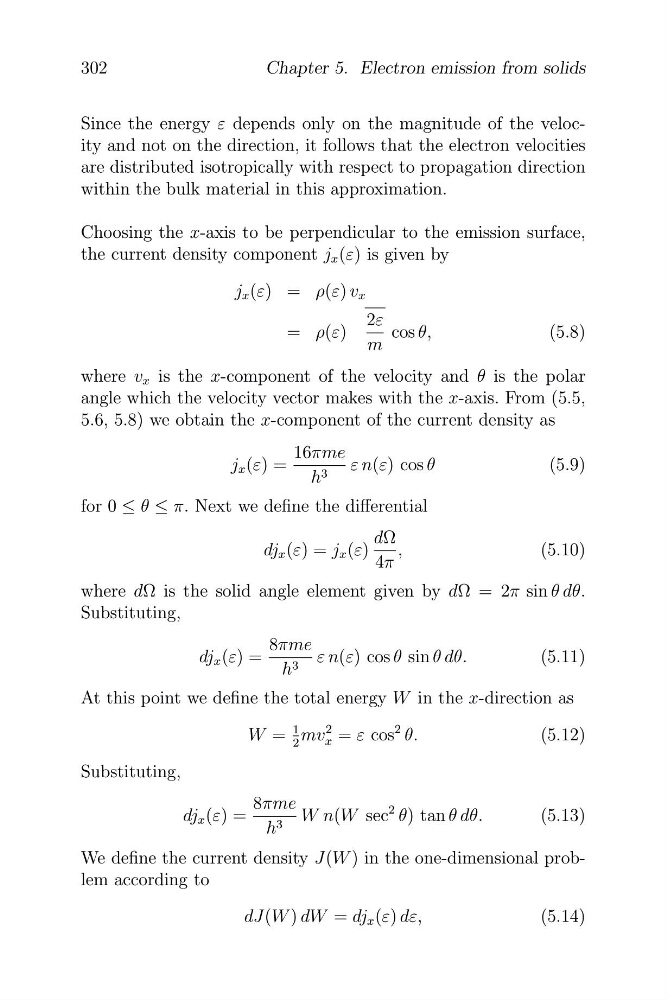
j x (ε) = ρ(ε) v x
= ρ(ε)
2ε
m
cos θ,
(5.8)
where v x is the x-component of the velocity and θ is the polar
angle which the velocity vector makes with the x-axis. From (5.5,
5.6, 5.8) we obtain the x-component of the current density as
16πme
j x (ε) =
ε n(ε) cos θ
(5.9)
h 3
for 0 ≤ θ ≤ π. Next we define the differential
dΩ
dj x (ε) = j x (ε)
,
(5.10)
4π
where dΩ is the solid angle element given by dΩ = 2π sin θ dθ.
Substituting,
8πme
dj x (ε) =
ε n(ε) cos θ sin θ dθ.
(5.11)
h 3
At this point we define the total energy W in the x-direction as
W = 2
1 mv x
2 = ε cos
2 θ.
(5.12)
Substituting,
dj x (ε) =
8πme W n(W sec
2 θ) tan θ dθ.
(5.13)
h 3
We define the current density J(W ) in the one-dimensional problem according to
dJ(W ) dW = dj x (ε) dε,
(5.14)
302
Chapter 5. Electron emission from solids
Since the energy ε depends only on the magnitude of the velocity and not on the direction, it follows that the electron velocities
are distributed isotropically with respect to propagation direction
within the bulk material in this approximation.
Choosing the x-axis to be perpendicular to the emission surface,
the current density component j x (ε) is given by
= ρ(ε)
2ε
m
cos θ,
(5.8)
where v x is the x-component of the velocity and θ is the polar
angle which the velocity vector makes with the x-axis. From (5.5,
5.6, 5.8) we obtain the x-component of the current density as
16πme
j x (ε) =
ε n(ε) cos θ
(5.9)
h 3
for 0 ≤ θ ≤ π. Next we define the differential
dΩ
dj x (ε) = j x (ε)
,
(5.10)
4π
where dΩ is the solid angle element given by dΩ = 2π sin θ dθ.
Substituting,
8πme
dj x (ε) =
ε n(ε) cos θ sin θ dθ.
(5.11)
h 3
At this point we define the total energy W in the x-direction as
W = 2
1 mv x
2 = ε cos
2 θ.
(5.12)
Substituting,
dj x (ε) =
8πme W n(W sec
2 θ) tan θ dθ.
(5.13)
h 3
We define the current density J(W ) in the one-dimensional problem according to
dJ(W ) dW = dj x (ε) dε,
(5.14)
302
Chapter 5. Electron emission from solids
Since the energy ε depends only on the magnitude of the velocity and not on the direction, it follows that the electron velocities
are distributed isotropically with respect to propagation direction
within the bulk material in this approximation.
Choosing the x-axis to be perpendicular to the emission surface,
the current density component j x (ε) is given by