

�
�
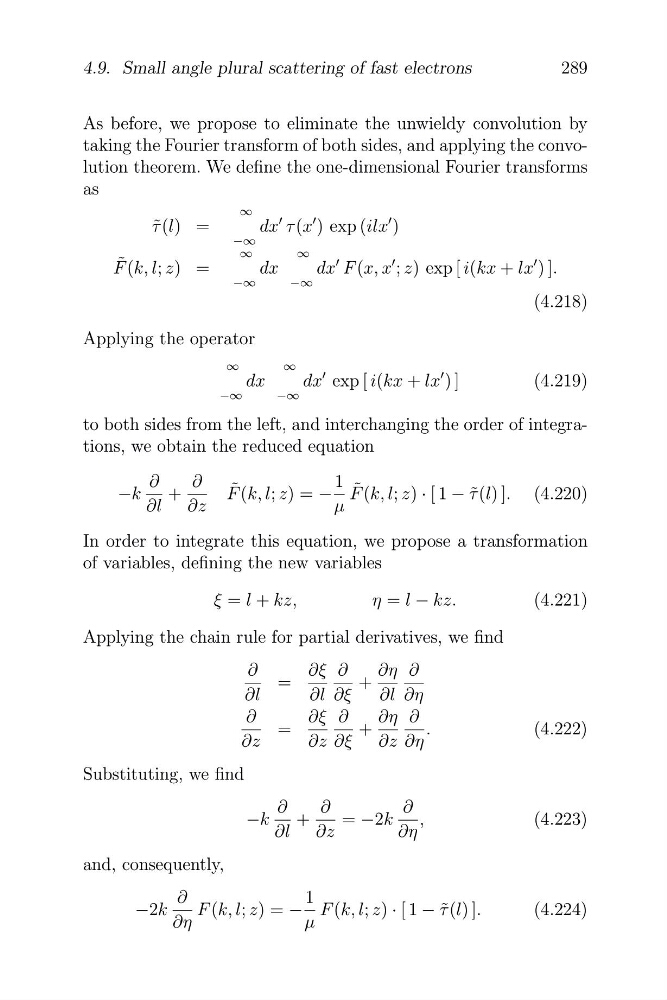
As before, we propose to eliminate the unwieldy convolution by
taking the Fourier transform of both sides, and applying the convolution theorem. We define the one-dimensional Fourier transforms
as
τ ˜(l) =
∞
dx
� τ (x
� ) exp (ilx
� )
−∞
F ˜ (k, l; z) =
∞
dx
∞
dx
� F (x, x
� ; z) exp [ i(kx + lx
� ) ].
−∞
−∞
(4.218)
Applying the operator
∞
∞
dx
dx
� exp [ i(kx + lx
� ) ]
(4.219)
−∞
−∞
to both sides from the left, and interchanging the order of integrations, we obtain the reduced equation
∂
∂
1
˜
˜
−k
+
F (k, l; z) = − F (k, l; z) · [ 1 − τ ˜(l) ]. (4.220)
∂l ∂z
µ
In order to integrate this equation, we propose a transformation
of variables, defining the new variables
ξ = l + kz,
η = l − kz.
(4.221)
Applying the chain rule for partial derivatives, we find
∂
∂ξ ∂
∂η ∂
=
+
∂l
∂l ∂ξ
∂l ∂η
∂
∂ξ ∂
∂η ∂
∂z
= ∂z ∂ξ
+ ∂z ∂η
.
(4.222)
Substituting, we find
∂
∂
∂
−k
+
= −2k ,
(4.223)
∂l ∂z
∂η
and, consequently,
∂
1
−2k
F (k, l; z) = − F (k, l; z) · [ 1 − τ ˜(l) ].
(4.224)
∂η
µ
289
4.9. Small angle plural scattering of fast electrons
�
As before, we propose to eliminate the unwieldy convolution by
taking the Fourier transform of both sides, and applying the convolution theorem. We define the one-dimensional Fourier transforms
as
τ ˜(l) =
∞
dx
� τ (x
� ) exp (ilx
� )
−∞
F ˜ (k, l; z) =
∞
dx
∞
dx
� F (x, x
� ; z) exp [ i(kx + lx
� ) ].
−∞
−∞
(4.218)
Applying the operator
∞
∞
dx
dx
� exp [ i(kx + lx
� ) ]
(4.219)
−∞
−∞
to both sides from the left, and interchanging the order of integrations, we obtain the reduced equation
∂
∂
1
˜
˜
−k
+
F (k, l; z) = − F (k, l; z) · [ 1 − τ ˜(l) ]. (4.220)
∂l ∂z
µ
In order to integrate this equation, we propose a transformation
of variables, defining the new variables
ξ = l + kz,
η = l − kz.
(4.221)
Applying the chain rule for partial derivatives, we find
∂
∂ξ ∂
∂η ∂
=
+
∂l
∂l ∂ξ
∂l ∂η
∂
∂ξ ∂
∂η ∂
∂z
= ∂z ∂ξ
+ ∂z ∂η
.
(4.222)
Substituting, we find
∂
∂
∂
−k
+
= −2k ,
(4.223)
∂l ∂z
∂η
and, consequently,
∂
1
−2k
F (k, l; z) = − F (k, l; z) · [ 1 − τ ˜(l) ].
(4.224)
∂η
µ
289
4.9. Small angle plural scattering of fast electrons