

281
4.9. Small angle plural scattering of fast electrons
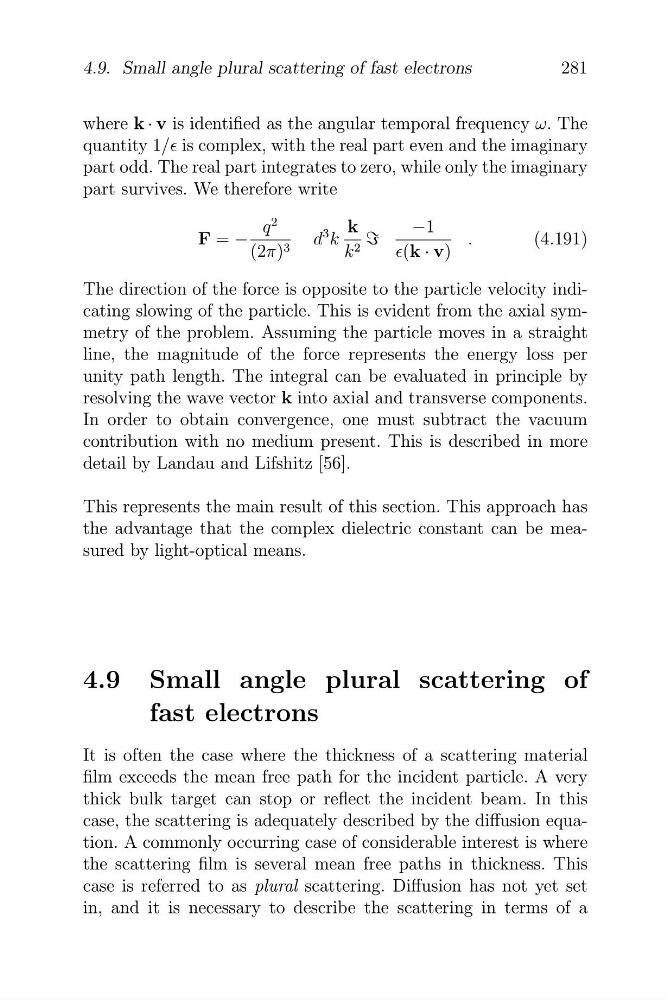
where k · v is identified as the angular temporal frequency ω. The
quantity 1/f is complex, with the real part even and the imaginary
part odd. The real part integrates to zero, while only the imaginary
part survives. We therefore write
q
2
k
−1
F = −
d
3 k
�
.
(4.191)
(2π) 3
k 2
f(k · v)
The direction of the force is opposite to the particle velocity indicating slowing of the particle. This is evident from the axial symmetry of the problem. Assuming the particle moves in a straight
line, the magnitude of the force represents the energy loss per
unity path length. The integral can be evaluated in principle by
resolving the wave vector k into axial and transverse components.
In order to obtain convergence, one must subtract the vacuum
contribution with no medium present. This is described in more
detail by Landau and Lifshitz [56].
This represents the main result of this section. This approach has
the advantage that the complex dielectric constant can be measured by light-optical means.
4.9 Small angle plural scattering of
fast electrons
It is often the case where the thickness of a scattering material
film exceeds the mean free path for the incident particle. A very
thick bulk target can stop or reflect the incident beam. In this
case, the scattering is adequately described by the diffusion equation. A commonly occurring case of considerable interest is where
the scattering film is several mean free paths in thickness. This
case is referred to as plural scattering. Diffusion has not yet set
in, and it is necessary to describe the scattering in terms of a
4.9. Small angle plural scattering of fast electrons
where k · v is identified as the angular temporal frequency ω. The
quantity 1/f is complex, with the real part even and the imaginary
part odd. The real part integrates to zero, while only the imaginary
part survives. We therefore write
q
2
k
−1
F = −
d
3 k
�
.
(4.191)
(2π) 3
k 2
f(k · v)
The direction of the force is opposite to the particle velocity indicating slowing of the particle. This is evident from the axial symmetry of the problem. Assuming the particle moves in a straight
line, the magnitude of the force represents the energy loss per
unity path length. The integral can be evaluated in principle by
resolving the wave vector k into axial and transverse components.
In order to obtain convergence, one must subtract the vacuum
contribution with no medium present. This is described in more
detail by Landau and Lifshitz [56].
This represents the main result of this section. This approach has
the advantage that the complex dielectric constant can be measured by light-optical means.
4.9 Small angle plural scattering of
fast electrons
It is often the case where the thickness of a scattering material
film exceeds the mean free path for the incident particle. A very
thick bulk target can stop or reflect the incident beam. In this
case, the scattering is adequately described by the diffusion equation. A commonly occurring case of considerable interest is where
the scattering film is several mean free paths in thickness. This
case is referred to as plural scattering. Diffusion has not yet set
in, and it is necessary to describe the scattering in terms of a