

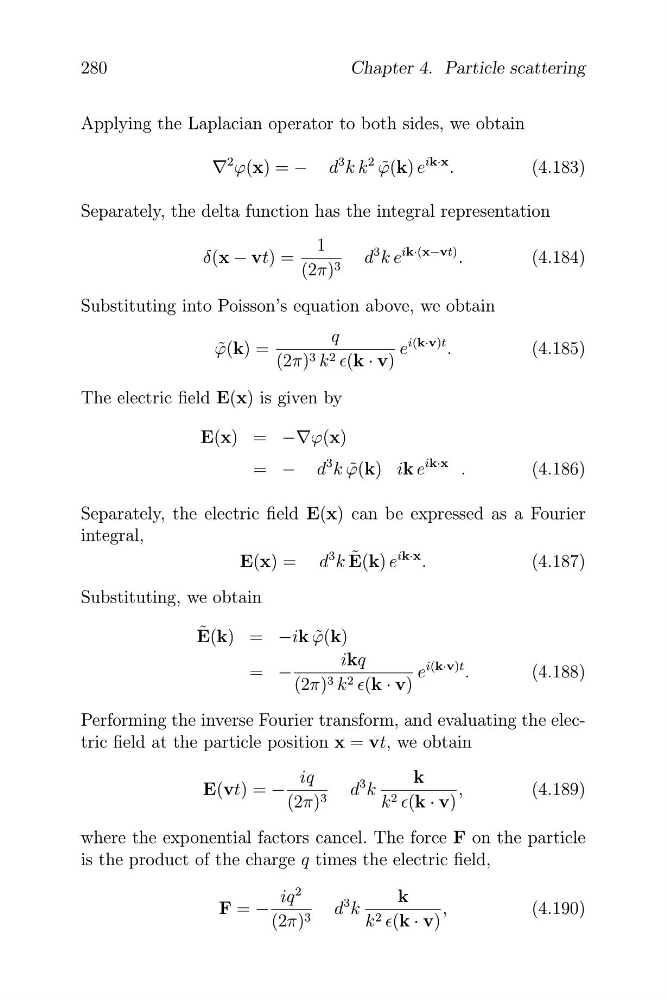
Applying the Laplacian operator to both sides, we obtain
v
2 ϕ(x) = − d
3 k k
2 ϕ ˜(k) e
ik·x .
(4.183)
Separately, the delta function has the integral representation
δ(x − vt) =
1
d
3 k e
ik·(x−vt) .
(4.184)
(2π) 3
Substituting into Poisson’s equation above, we obtain
q
i(k·v)t
ϕ ˜(k) =
e
.
(4.185)
(2π) 3 k 2 f(k · v)
The electric field E(x) is given by
E(x) = −vϕ(x)
d
3 k ˜
ik·x
= −
ϕ(k) ik e
.
(4.186)
Separately, the electric field E(x) can be expressed as a Fourier
integral,
E(x) = d
3 k E ˜ (k) e
ik·x .
(4.187)
Substituting, we obtain
˜
E(k) = −ik ϕ ˜(k)
ikq
i(k·v)t
= −
e
.
(4.188)
(2π) 3 k 2 f(k · v)
Performing the inverse Fourier transform, and evaluating the electric field at the particle position x = vt, we obtain
iq
k
E(vt) = −
d
3 k
,
(4.189)
(2π) 3
k 2 f(k · v)
where the exponential factors cancel. The force F on the particle
is the product of the charge q times the electric field,
iq
2
k
F = −
d
3 k
,
(4.190)
(2π) 3
k 2 f(k · v)
280
Chapter 4. Particle scattering
v
2 ϕ(x) = − d
3 k k
2 ϕ ˜(k) e
ik·x .
(4.183)
Separately, the delta function has the integral representation
δ(x − vt) =
1
d
3 k e
ik·(x−vt) .
(4.184)
(2π) 3
Substituting into Poisson’s equation above, we obtain
q
i(k·v)t
ϕ ˜(k) =
e
.
(4.185)
(2π) 3 k 2 f(k · v)
The electric field E(x) is given by
E(x) = −vϕ(x)
d
3 k ˜
ik·x
= −
ϕ(k) ik e
.
(4.186)
Separately, the electric field E(x) can be expressed as a Fourier
integral,
E(x) = d
3 k E ˜ (k) e
ik·x .
(4.187)
Substituting, we obtain
˜
E(k) = −ik ϕ ˜(k)
ikq
i(k·v)t
= −
e
.
(4.188)
(2π) 3 k 2 f(k · v)
Performing the inverse Fourier transform, and evaluating the electric field at the particle position x = vt, we obtain
iq
k
E(vt) = −
d
3 k
,
(4.189)
(2π) 3
k 2 f(k · v)
where the exponential factors cancel. The force F on the particle
is the product of the charge q times the electric field,
iq
2
k
F = −
d
3 k
,
(4.190)
(2π) 3
k 2 f(k · v)
280
Chapter 4. Particle scattering