

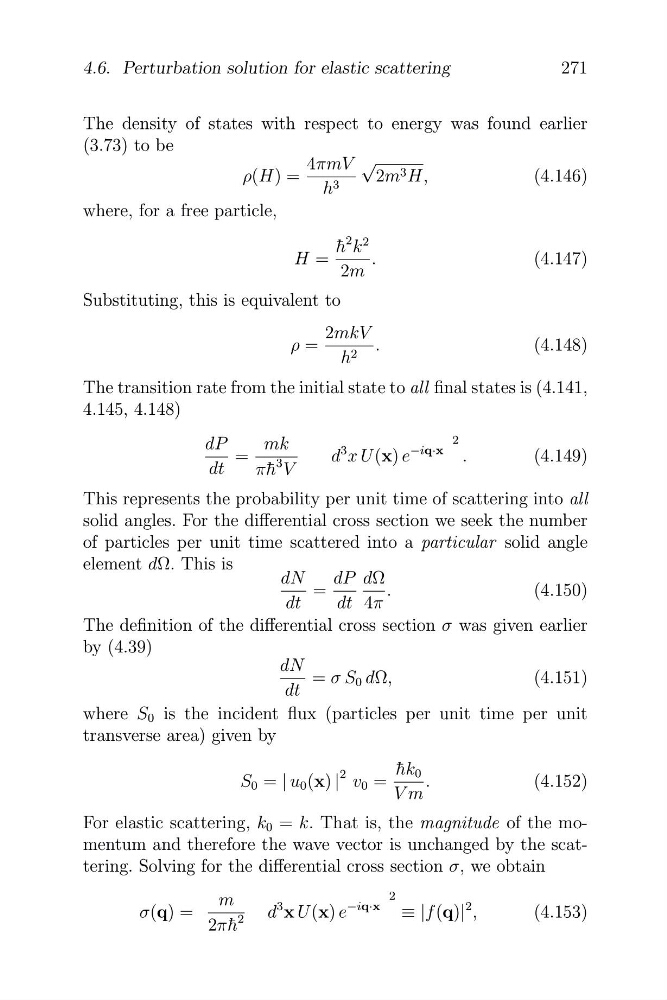
The density of states with respect to energy was found earlier
(3.73) to be
√
4πmV
ρ(H) =
2m 3 H,
(4.146)
h 3
where, for a free particle,
h
2 k
2
¯
H =
.
(4.147)
2m
Substituting, this is equivalent to
2mkV
ρ =
.
(4.148)
h 2
The transition rate from the initial state to all final states is (4.141,
4.145, 4.148)
2
dP
mk
−iq·x
=
d
3 x U (x) e
.
(4.149)
h
3
dt
π¯ V
This represents the probability per unit time of scattering into all
solid angles. For the differential cross section we seek the number
of particles per unit time scattered into a particular solid angle
element dΩ. This is
dN
dP dΩ
=
.
(4.150)
dt
dt 4π
The definition of the differential cross section σ was given earlier
by (4.39)
dN = σ S 0 dΩ,
(4.151)
dt
where S 0 is the incident flux (particles per unit time per unit
transverse area) given by
¯
hk 0
S 0 = | u 0 (x) |
2 v 0 =
.
(4.152)
V m
For elastic scattering, k 0 = k. That is, the magnitude of the momentum and therefore the wave vector is unchanged by the scattering. Solving for the differential cross section σ, we obtain
2
m
−iq·x
d
3
σ(q) =
x U (x) e
≡ |f (q)|
2 ,
(4.153)
h
2
2π¯
271
4.6. Perturbation solution for elastic scattering
(3.73) to be
√
4πmV
ρ(H) =
2m 3 H,
(4.146)
h 3
where, for a free particle,
h
2 k
2
¯
H =
.
(4.147)
2m
Substituting, this is equivalent to
2mkV
ρ =
.
(4.148)
h 2
The transition rate from the initial state to all final states is (4.141,
4.145, 4.148)
2
dP
mk
−iq·x
=
d
3 x U (x) e
.
(4.149)
h
3
dt
π¯ V
This represents the probability per unit time of scattering into all
solid angles. For the differential cross section we seek the number
of particles per unit time scattered into a particular solid angle
element dΩ. This is
dN
dP dΩ
=
.
(4.150)
dt
dt 4π
The definition of the differential cross section σ was given earlier
by (4.39)
dN = σ S 0 dΩ,
(4.151)
dt
where S 0 is the incident flux (particles per unit time per unit
transverse area) given by
¯
hk 0
S 0 = | u 0 (x) |
2 v 0 =
.
(4.152)
V m
For elastic scattering, k 0 = k. That is, the magnitude of the momentum and therefore the wave vector is unchanged by the scattering. Solving for the differential cross section σ, we obtain
2
m
−iq·x
d
3
σ(q) =
x U (x) e
≡ |f (q)|
2 ,
(4.153)
h
2
2π¯
271
4.6. Perturbation solution for elastic scattering