

270
Chapter 4. Particle scattering
4.6 Perturbation solution for elastic
scattering
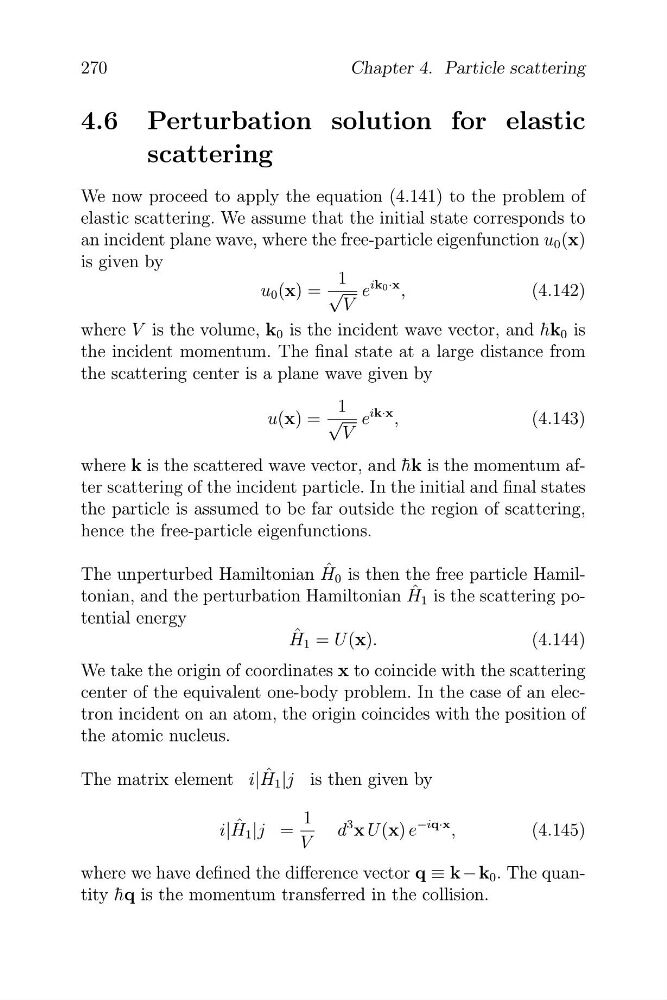
We now proceed to apply the equation (4.141) to the problem of
elastic scattering. We assume that the initial state corresponds to
an incident plane wave, where the free-particle eigenfunction u 0 (x)
is given by
1 ik 0 ·x
u 0 (x) = √ e
,
(4.142)
V
where V is the volume, k 0 is the incident wave vector, and ¯
hk 0 is
the incident momentum. The final state at a large distance from
the scattering center is a plane wave given by
1
u(x) = √ e
ik·x ,
(4.143)
V
where k is the scattered wave vector, and ¯
hk is the momentum after scattering of the incident particle. In the initial and final states
the particle is assumed to be far outside the region of scattering,
hence the free-particle eigenfunctions.
ˆ
The unperturbed Hamiltonian H 0 is then the free particle Hamiltonian, and the perturbation Hamiltonian H ˆ 1 is the scattering potential energy
ˆ
H 1 = U (x).
(4.144)
We take the origin of coordinates x to coincide with the scattering
center of the equivalent one-body problem. In the case of an electron incident on an atom, the origin coincides with the position of
the atomic nucleus.
The matrix element i|H ˆ 1 |j is then given by
1
−iq·x
i|H ˆ 1 |j =
d
3 x U (x) e
,
(4.145)
V
where we have defined the difference vector q ≡ k − k 0 . The quantity ¯
hq is the momentum transferred in the collision.
Chapter 4. Particle scattering
4.6 Perturbation solution for elastic
scattering
We now proceed to apply the equation (4.141) to the problem of
elastic scattering. We assume that the initial state corresponds to
an incident plane wave, where the free-particle eigenfunction u 0 (x)
is given by
1 ik 0 ·x
u 0 (x) = √ e
,
(4.142)
V
where V is the volume, k 0 is the incident wave vector, and ¯
hk 0 is
the incident momentum. The final state at a large distance from
the scattering center is a plane wave given by
1
u(x) = √ e
ik·x ,
(4.143)
V
where k is the scattered wave vector, and ¯
hk is the momentum after scattering of the incident particle. In the initial and final states
the particle is assumed to be far outside the region of scattering,
hence the free-particle eigenfunctions.
ˆ
The unperturbed Hamiltonian H 0 is then the free particle Hamiltonian, and the perturbation Hamiltonian H ˆ 1 is the scattering potential energy
ˆ
H 1 = U (x).
(4.144)
We take the origin of coordinates x to coincide with the scattering
center of the equivalent one-body problem. In the case of an electron incident on an atom, the origin coincides with the position of
the atomic nucleus.
The matrix element i|H ˆ 1 |j is then given by
1
−iq·x
i|H ˆ 1 |j =
d
3 x U (x) e
,
(4.145)
V
where we have defined the difference vector q ≡ k − k 0 . The quantity ¯
hq is the momentum transferred in the collision.