

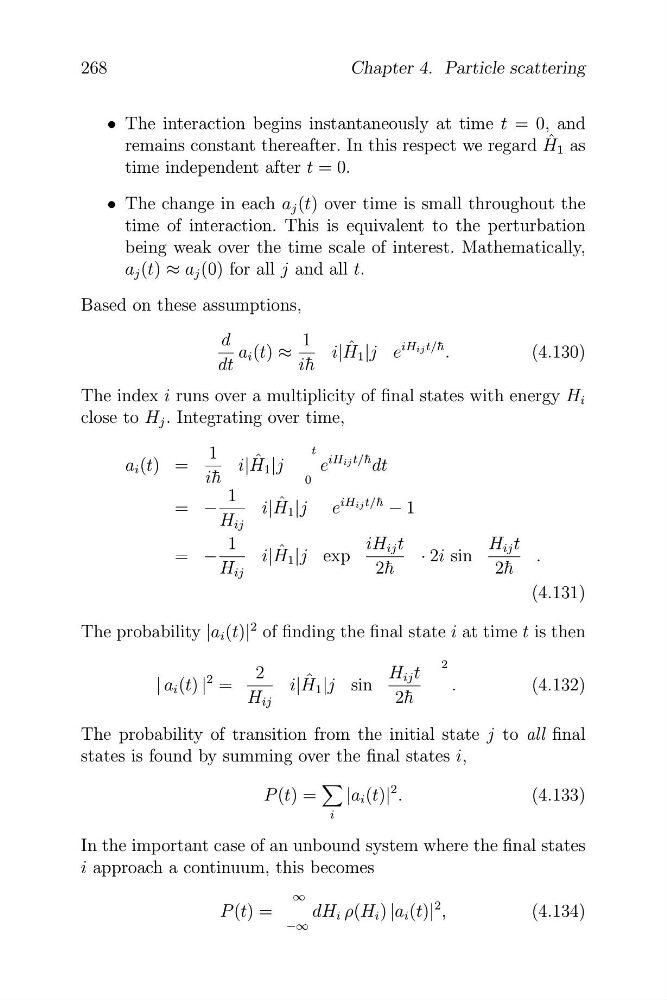
• The interaction begins instantaneously at time t = 0, and
ˆ
remains constant thereafter. In this respect we regard H 1 as
time independent after t = 0.
• The change in each a j (t) over time is small throughout the
time of interaction. This is equivalent to the perturbation
being weak over the time scale of interest. Mathematically,
a j (t) ≈ a j (0) for all j and all t.
Based on these assumptions,
d
1
iH ij t/¯ h
a i (t) ≈
i|H ˆ 1 |j e
.
(4.130)
dt
ih ¯
The index i runs over a multiplicity of final states with energy H i
close to H j . Integrating over time,
1
t
iH ij t/¯
a i (t) =
i|H ˆ 1 |j
e
h dt
ih ¯
0
1
iH ij t/¯
= − H ij
i|H ˆ 1 |j e
h − 1
1
iH ij t
H ij t
= −
i|H ˆ 1 |j exp
· 2i sin
.
H ij
2¯ h
2¯ h
(4.131)
The probability |a i (t)|
2 of finding the final state i at time t is then
2
H ij t
2
| a i (t) |
2 =
i|H ˆ 1 |j sin
.
(4.132)
H ij
2¯ h
The probability of transition from the initial state j to all final
states is found by summing over the final states i,
4
P (t) =
|a i (t)|
2 .
(4.133)
i
In the important case of an unbound system where the final states
i approach a continuum, this becomes
P (t) =
∞
dH i ρ(H i ) |a i (t)|
2 ,
(4.134)
−∞
268
Chapter 4. Particle scattering
ˆ
remains constant thereafter. In this respect we regard H 1 as
time independent after t = 0.
• The change in each a j (t) over time is small throughout the
time of interaction. This is equivalent to the perturbation
being weak over the time scale of interest. Mathematically,
a j (t) ≈ a j (0) for all j and all t.
Based on these assumptions,
d
1
iH ij t/¯ h
a i (t) ≈
i|H ˆ 1 |j e
.
(4.130)
dt
ih ¯
The index i runs over a multiplicity of final states with energy H i
close to H j . Integrating over time,
1
t
iH ij t/¯
a i (t) =
i|H ˆ 1 |j
e
h dt
ih ¯
0
1
iH ij t/¯
= − H ij
i|H ˆ 1 |j e
h − 1
1
iH ij t
H ij t
= −
i|H ˆ 1 |j exp
· 2i sin
.
H ij
2¯ h
2¯ h
(4.131)
The probability |a i (t)|
2 of finding the final state i at time t is then
2
H ij t
2
| a i (t) |
2 =
i|H ˆ 1 |j sin
.
(4.132)
H ij
2¯ h
The probability of transition from the initial state j to all final
states is found by summing over the final states i,
4
P (t) =
|a i (t)|
2 .
(4.133)
i
In the important case of an unbound system where the final states
i approach a continuum, this becomes
P (t) =
∞
dH i ρ(H i ) |a i (t)|
2 ,
(4.134)
−∞
268
Chapter 4. Particle scattering