

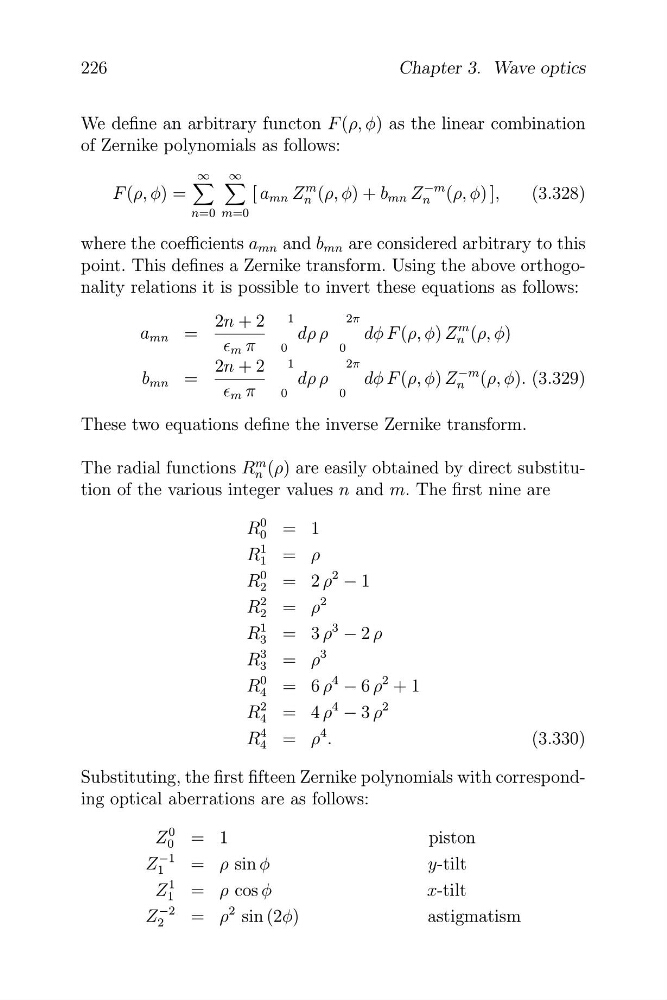
We define an arbitrary functon F (ρ, φ) as the linear combination
of Zernike polynomials as follows:
∞
∞
4 4
Z
m
Z
−m
F (ρ, φ) =
(ρ, φ) + b mn
(ρ, φ) ],
(3.328)
[ a mn n
n
n=0 m=0
where the coefficients a mn and b mn are considered arbitrary to this
point. This defines a Zernike transform. Using the above orthogonality relations it is possible to invert these equations as follows:
1
2π
2n + 2
a mn =
dρ ρ
dφ F (ρ, φ) Z n
m (ρ, φ)
f m π 0
0
1
2π
2n + 2
b mn =
dρ ρ
dφ F (ρ, φ) Z n
−m (ρ, φ). (3.329)
f m π 0
0
These two equations define the inverse Zernike transform.
The radial functions R n
m (ρ) are easily obtained by direct substitution of the various integer values n and m. The first nine are
R
0
0 = 1
R
1
1 = ρ
R
0
2 = 2 ρ
2 − 1
R
2
2 = ρ
2
R
1
3 = 3 ρ
3 − 2 ρ
R
3
3 = ρ
3
R
0
4 = 6 ρ
4 − 6 ρ
2 + 1
R
2
4 = 4 ρ
4 − 3 ρ
2
R
4
4 = ρ
4 .
(3.330)
Substituting, the first fifteen Zernike polynomials with corresponding optical aberrations are as follows:
Z
0
0 = 1
piston
Z
−1
1
= ρ sin φ
y-tilt
Z
1 = ρ cos φ
x-tilt
1
Z
−2
ρ
2
2
=
sin (2φ)
astigmatism
226
Chapter 3. Wave optics
of Zernike polynomials as follows:
∞
∞
4 4
Z
m
Z
−m
F (ρ, φ) =
(ρ, φ) + b mn
(ρ, φ) ],
(3.328)
[ a mn n
n
n=0 m=0
where the coefficients a mn and b mn are considered arbitrary to this
point. This defines a Zernike transform. Using the above orthogonality relations it is possible to invert these equations as follows:
1
2π
2n + 2
a mn =
dρ ρ
dφ F (ρ, φ) Z n
m (ρ, φ)
f m π 0
0
1
2π
2n + 2
b mn =
dρ ρ
dφ F (ρ, φ) Z n
−m (ρ, φ). (3.329)
f m π 0
0
These two equations define the inverse Zernike transform.
The radial functions R n
m (ρ) are easily obtained by direct substitution of the various integer values n and m. The first nine are
R
0
0 = 1
R
1
1 = ρ
R
0
2 = 2 ρ
2 − 1
R
2
2 = ρ
2
R
1
3 = 3 ρ
3 − 2 ρ
R
3
3 = ρ
3
R
0
4 = 6 ρ
4 − 6 ρ
2 + 1
R
2
4 = 4 ρ
4 − 3 ρ
2
R
4
4 = ρ
4 .
(3.330)
Substituting, the first fifteen Zernike polynomials with corresponding optical aberrations are as follows:
Z
0
0 = 1
piston
Z
−1
1
= ρ sin φ
y-tilt
Z
1 = ρ cos φ
x-tilt
1
Z
−2
ρ
2
2
=
sin (2φ)
astigmatism
226
Chapter 3. Wave optics