

�
the aperture radius in the equivalent confocal system. Any arbitrary function F (ρ, φ) which is defined on the unit disk 0 ≤ ρ ≤ 1
and 0 ≤ φ ≤ 2π can in principle be expanded as a linear combination of Zernike polynomials. The method is discussed below.
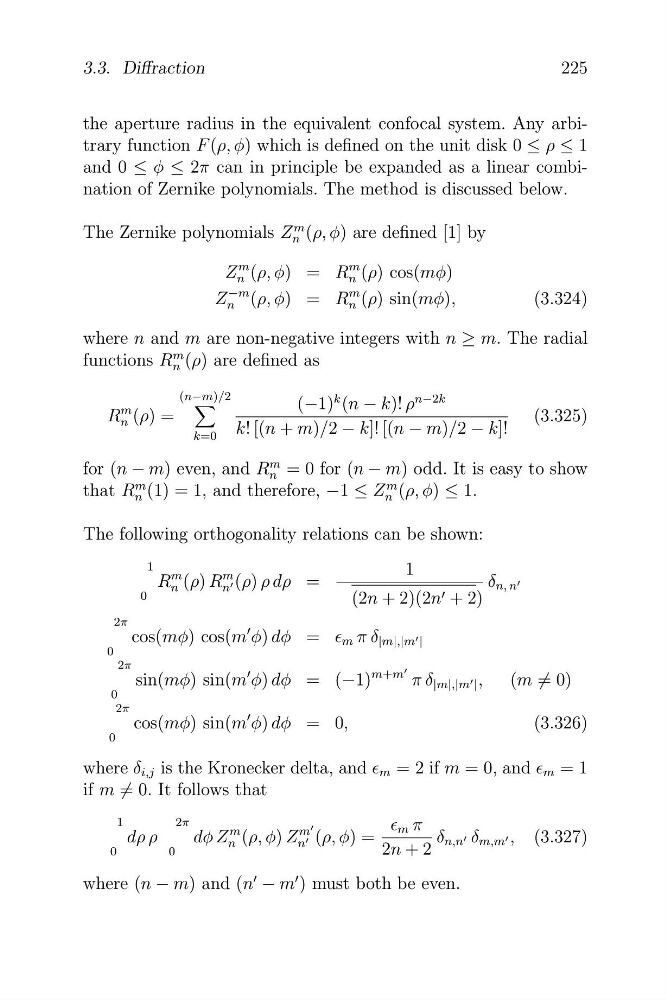
The Zernike polynomials Z n
m (ρ, φ) are defined [1] by
Z
m
R
m
n (ρ, φ) =
n (ρ) cos(mφ)
Z
−m
R
m
n (ρ, φ) =
n (ρ) sin(mφ),
(3.324)
where n and m are non-negative integers with n ≥ m. The radial
functions R n
m (ρ) are defined as
(n−m)/2
4
(−1)
k (n − k)! ρ
n−2k
R
m
n (ρ) =
(3.325)
k=0
k! [(n + m)/2 − k]! [(n − m)/2 − k]!
for (n − m) even, and R n
m = 0 for (n − m) odd. It is easy to show
that R n
m (1) = 1, and therefore, −1 ≤ Z n
m (ρ, φ) ≤ 1.
The following orthogonality relations can be shown:
1
1
R n
m (ρ) R n
m
� (ρ) ρ dρ =
δ n, n
0
(2n + 2)(2n � + 2)
2π
cos(mφ) cos(m
� φ) dφ = f m π δ |m|,|m � |
0
2π
sin(mφ) sin(m
� φ) dφ = (−1)
m+m � π δ |m|,|m � | , (m = 0)
0
2π
cos(mφ) sin(m
� φ) dφ = 0,
(3.326)
0
where δ i,j is the Kronecker delta, and f m = 2 if m = 0, and f m = 1
if m = 0. It follows that
1
2π
�
f m π
dρ ρ
dφ Z n
m (ρ, φ) Z n
m
� (ρ, φ) =
δ n,n � δ m,m � , (3.327)
0
0
2n + 2
where (n − m) and (n
� − m
� ) must both be even.
225
3.3. Diffraction
�
�
the aperture radius in the equivalent confocal system. Any arbitrary function F (ρ, φ) which is defined on the unit disk 0 ≤ ρ ≤ 1
and 0 ≤ φ ≤ 2π can in principle be expanded as a linear combination of Zernike polynomials. The method is discussed below.
The Zernike polynomials Z n
m (ρ, φ) are defined [1] by
Z
m
R
m
n (ρ, φ) =
n (ρ) cos(mφ)
Z
−m
R
m
n (ρ, φ) =
n (ρ) sin(mφ),
(3.324)
where n and m are non-negative integers with n ≥ m. The radial
functions R n
m (ρ) are defined as
(n−m)/2
4
(−1)
k (n − k)! ρ
n−2k
R
m
n (ρ) =
(3.325)
k=0
k! [(n + m)/2 − k]! [(n − m)/2 − k]!
for (n − m) even, and R n
m = 0 for (n − m) odd. It is easy to show
that R n
m (1) = 1, and therefore, −1 ≤ Z n
m (ρ, φ) ≤ 1.
The following orthogonality relations can be shown:
1
1
R n
m (ρ) R n
m
� (ρ) ρ dρ =
δ n, n
0
(2n + 2)(2n � + 2)
2π
cos(mφ) cos(m
� φ) dφ = f m π δ |m|,|m � |
0
2π
sin(mφ) sin(m
� φ) dφ = (−1)
m+m � π δ |m|,|m � | , (m = 0)
0
2π
cos(mφ) sin(m
� φ) dφ = 0,
(3.326)
0
where δ i,j is the Kronecker delta, and f m = 2 if m = 0, and f m = 1
if m = 0. It follows that
1
2π
�
f m π
dρ ρ
dφ Z n
m (ρ, φ) Z n
m
� (ρ, φ) =
δ n,n � δ m,m � , (3.327)
0
0
2n + 2
where (n − m) and (n
� − m
� ) must both be even.
225
3.3. Diffraction
�
�