

1
−i(K �� −K � +K)
d
2
·
r e
.
(3.314)
(2π) 2
We recognize the expression in square brackets as a Dirac delta
function δ(K
�� − K
� + K), in which case
J ˜ (K) =
1
d
2 K
� H ˜ (K
� ) H ˜ ∗ (K
� − K).
(3.315)
(2π) 2
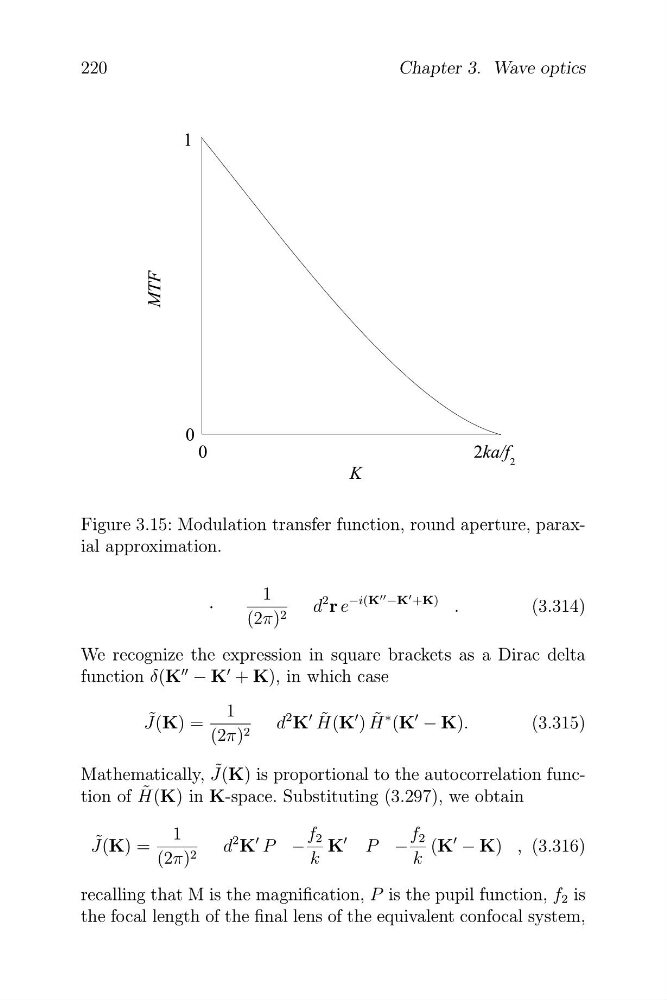
Mathematically, J ˜ (K) is proportional to the autocorrelation func˜
tion of H(K) in K-space. Substituting (3.297), we obtain
1
f 2
f 2
J ˜ (K) =
d
2 K
� P − K
�
P − (K
� − K) , (3.316)
(2π) 2
k
k
recalling that M is the magnification, P is the pupil function, f 2 is
the focal length of the final lens of the equivalent confocal system,
220
Chapter 3. Wave optics
Figure 3.15: Modulation transfer function, round aperture, paraxial approximation.
−i(K �� −K � +K)
d
2
·
r e
.
(3.314)
(2π) 2
We recognize the expression in square brackets as a Dirac delta
function δ(K
�� − K
� + K), in which case
J ˜ (K) =
1
d
2 K
� H ˜ (K
� ) H ˜ ∗ (K
� − K).
(3.315)
(2π) 2
Mathematically, J ˜ (K) is proportional to the autocorrelation func˜
tion of H(K) in K-space. Substituting (3.297), we obtain
1
f 2
f 2
J ˜ (K) =
d
2 K
� P − K
�
P − (K
� − K) , (3.316)
(2π) 2
k
k
recalling that M is the magnification, P is the pupil function, f 2 is
the focal length of the final lens of the equivalent confocal system,
220
Chapter 3. Wave optics
Figure 3.15: Modulation transfer function, round aperture, paraxial approximation.