

�
�
�
�
�
�
�
�
207
3.3. Diffraction
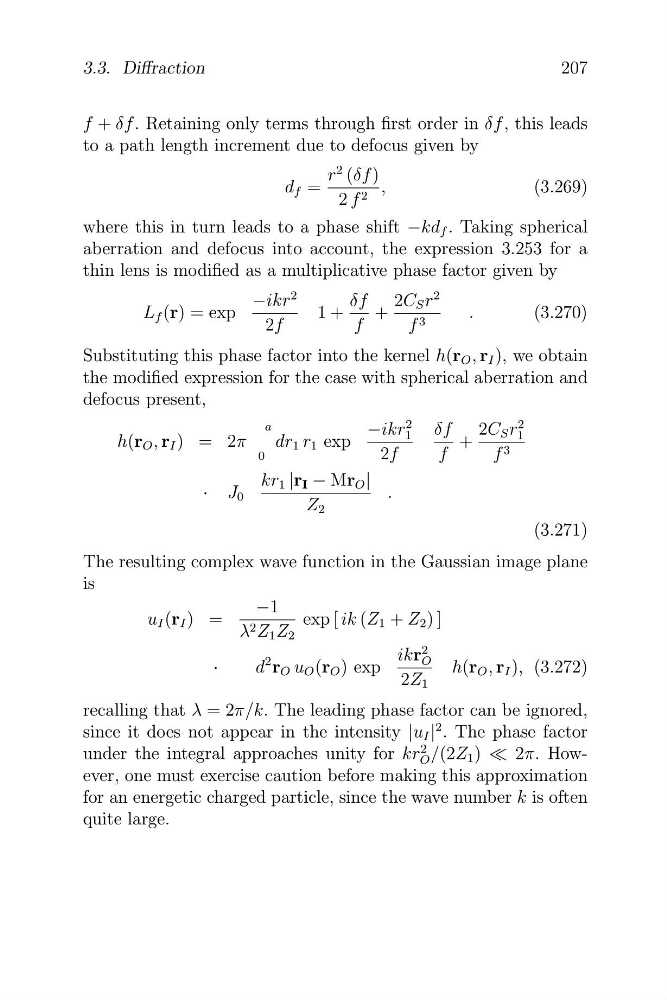
f + δf . Retaining only terms through first order in δf , this leads
to a path length increment due to defocus given by
r
2 (δf )
d f =
,
(3.269)
2 f 2
where this in turn leads to a phase shift −kd f . Taking spherical
aberration and defocus into account, the expression 3.253 for a
thin lens is modified as a multiplicative phase factor given by
−ikr
2
δf
2C S r
2
L f (r) = exp
1 +
+
.
(3.270)
2f
f
f 3
Substituting this phase factor into the kernel h(r O , r I ), we obtain
the modified expression for the case with spherical aberration and
defocus present,
a
2
−ikr
2
δf
1
2C S r 1
h(r O , r I ) = 2π
dr 1 r 1 exp
+
0
2f
f
f 3
kr 1 |r I − Mr O |
· J 0
.
Z 2
(3.271)
The resulting complex wave function in the Gaussian image plane
is
−1
u I (r I ) =
exp [ ik (Z 1 + Z 2 ) ]
λ 2 Z 1 Z 2
2
·
d
2 r O u O (r O ) exp
ikr O h(r O , r I ), (3.272)
2Z 1
recalling that λ = 2π/k. The leading phase factor can be ignored,
since it does not appear in the intensity |u I |
2 . The phase factor
under the integral approaches unity for kr
2 /(2Z 1 ) « 2π. HowO
ever, one must exercise caution before making this approximation
for an energetic charged particle, since the wave number k is often
quite large.
�
�
�
�
�
�
�
207
3.3. Diffraction
f + δf . Retaining only terms through first order in δf , this leads
to a path length increment due to defocus given by
r
2 (δf )
d f =
,
(3.269)
2 f 2
where this in turn leads to a phase shift −kd f . Taking spherical
aberration and defocus into account, the expression 3.253 for a
thin lens is modified as a multiplicative phase factor given by
−ikr
2
δf
2C S r
2
L f (r) = exp
1 +
+
.
(3.270)
2f
f
f 3
Substituting this phase factor into the kernel h(r O , r I ), we obtain
the modified expression for the case with spherical aberration and
defocus present,
a
2
−ikr
2
δf
1
2C S r 1
h(r O , r I ) = 2π
dr 1 r 1 exp
+
0
2f
f
f 3
kr 1 |r I − Mr O |
· J 0
.
Z 2
(3.271)
The resulting complex wave function in the Gaussian image plane
is
−1
u I (r I ) =
exp [ ik (Z 1 + Z 2 ) ]
λ 2 Z 1 Z 2
2
·
d
2 r O u O (r O ) exp
ikr O h(r O , r I ), (3.272)
2Z 1
recalling that λ = 2π/k. The leading phase factor can be ignored,
since it does not appear in the intensity |u I |
2 . The phase factor
under the integral approaches unity for kr
2 /(2Z 1 ) « 2π. HowO
ever, one must exercise caution before making this approximation
for an energetic charged particle, since the wave number k is often
quite large.