

� �
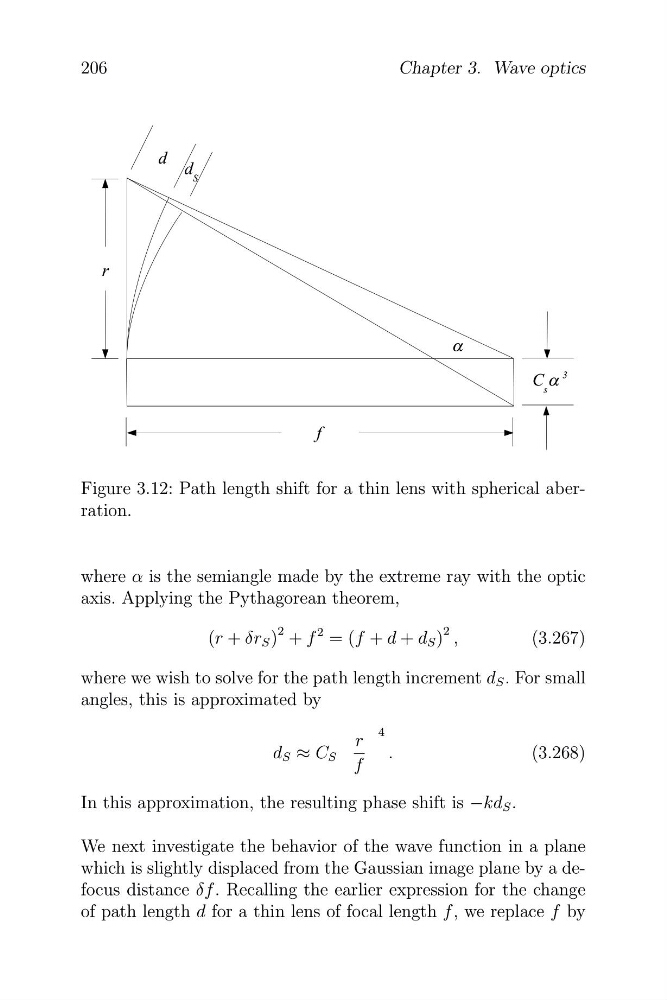
where α is the semiangle made by the extreme ray with the optic
axis. Applying the Pythagorean theorem,
(r + δr S )
2 + f
2 = (f + d + d S )
2 ,
(3.267)
where we wish to solve for the path length increment d S . For small
angles, this is approximated by
4
r
d S ≈ C S f
.
(3.268)
In this approximation, the resulting phase shift is −kd S .
We next investigate the behavior of the wave function in a plane
which is slightly displaced from the Gaussian image plane by a defocus distance δf . Recalling the earlier expression for the change
of path length d for a thin lens of focal length f , we replace f by
206
Chapter 3. Wave optics
Figure 3.12: Path length shift for a thin lens with spherical aberration.
where α is the semiangle made by the extreme ray with the optic
axis. Applying the Pythagorean theorem,
(r + δr S )
2 + f
2 = (f + d + d S )
2 ,
(3.267)
where we wish to solve for the path length increment d S . For small
angles, this is approximated by
4
r
d S ≈ C S f
.
(3.268)
In this approximation, the resulting phase shift is −kd S .
We next investigate the behavior of the wave function in a plane
which is slightly displaced from the Gaussian image plane by a defocus distance δf . Recalling the earlier expression for the change
of path length d for a thin lens of focal length f , we replace f by
206
Chapter 3. Wave optics
Figure 3.12: Path length shift for a thin lens with spherical aberration.