

�
�
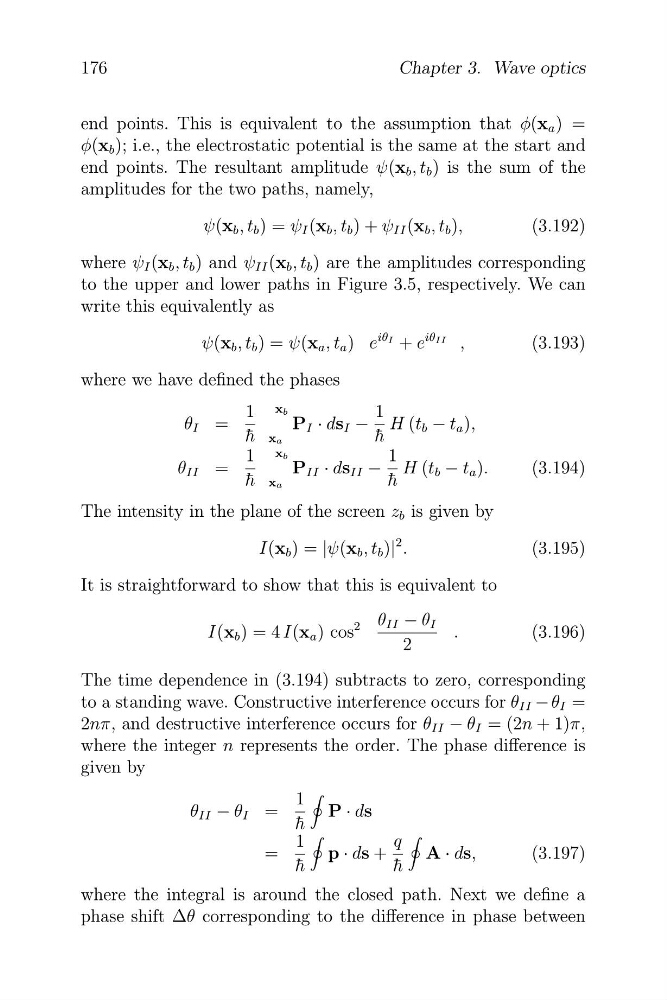
end points. This is equivalent to the assumption that φ(x a ) =
φ(x b ); i.e., the electrostatic potential is the same at the start and
end points. The resultant amplitude ψ(x b , t b ) is the sum of the
amplitudes for the two paths, namely,
ψ(x b , t b ) = ψ I (x b , t b ) + ψ II (x b , t b ),
(3.192)
where ψ I (x b , t b ) and ψ II (x b , t b ) are the amplitudes corresponding
to the upper and lower paths in Figure 3.5, respectively. We can
write this equivalently as
iθ I
iθ II
ψ(x b , t b ) = ψ(x a , t a ) e + e
,
(3.193)
where we have defined the phases
1 x b
1
θ I =
P I · ds I − H (t b − t a ),
h ¯ xa
h ¯
1 x b
1
θ II =
P II · ds II − H (t b − t a ).
(3.194)
h ¯ xa
h ¯
The intensity in the plane of the screen z b is given by
I(x b ) = |ψ(x b , t b )|
2 .
(3.195)
It is straightforward to show that this is equivalent to
θ II − θ I
I(x b ) = 4 I(x a ) cos
2
.
(3.196)
2
The time dependence in (3.194) subtracts to zero, corresponding
to a standing wave. Constructive interference occurs for θ II − θ I =
2nπ, and destructive interference occurs for θ II − θ I = (2n + 1)π,
where the integer n represents the order. The phase difference is
given by
1
�
θ II − θ I =
=
¯
h
1
¯
h
�
P · ds
p · ds +
q
¯
h
�
A · ds,
(3.197)
where the integral is around the closed path. Next we define a
phase shift Δθ corresponding to the difference in phase between
176
Chapter 3. Wave optics
�
end points. This is equivalent to the assumption that φ(x a ) =
φ(x b ); i.e., the electrostatic potential is the same at the start and
end points. The resultant amplitude ψ(x b , t b ) is the sum of the
amplitudes for the two paths, namely,
ψ(x b , t b ) = ψ I (x b , t b ) + ψ II (x b , t b ),
(3.192)
where ψ I (x b , t b ) and ψ II (x b , t b ) are the amplitudes corresponding
to the upper and lower paths in Figure 3.5, respectively. We can
write this equivalently as
iθ I
iθ II
ψ(x b , t b ) = ψ(x a , t a ) e + e
,
(3.193)
where we have defined the phases
1 x b
1
θ I =
P I · ds I − H (t b − t a ),
h ¯ xa
h ¯
1 x b
1
θ II =
P II · ds II − H (t b − t a ).
(3.194)
h ¯ xa
h ¯
The intensity in the plane of the screen z b is given by
I(x b ) = |ψ(x b , t b )|
2 .
(3.195)
It is straightforward to show that this is equivalent to
θ II − θ I
I(x b ) = 4 I(x a ) cos
2
.
(3.196)
2
The time dependence in (3.194) subtracts to zero, corresponding
to a standing wave. Constructive interference occurs for θ II − θ I =
2nπ, and destructive interference occurs for θ II − θ I = (2n + 1)π,
where the integer n represents the order. The phase difference is
given by
1
�
θ II − θ I =
=
¯
h
1
¯
h
�
P · ds
p · ds +
q
¯
h
�
A · ds,
(3.197)
where the integral is around the closed path. Next we define a
phase shift Δθ corresponding to the difference in phase between
176
Chapter 3. Wave optics