

�
�
The amplitude ψ(x b , t b ) is given in terms of the initial amplitude
ψ(x a , t a ) by (3.186)
ψ(x b , t b ) = ψ(x a , t a )
p(x a )
p(x b )
1/2
i
x b
· exp ¯
h xa
P · ds − H (t b − t a ) (3.191)
for the special case where the potentials A(x) and φ(x) have no
explicit time dependence. We assume in the following that p(x a ) =
p(x b ); i.e., the kinetic momentum is the same at the start and
3.2. Particle motion in a general electromagnetic potential 175
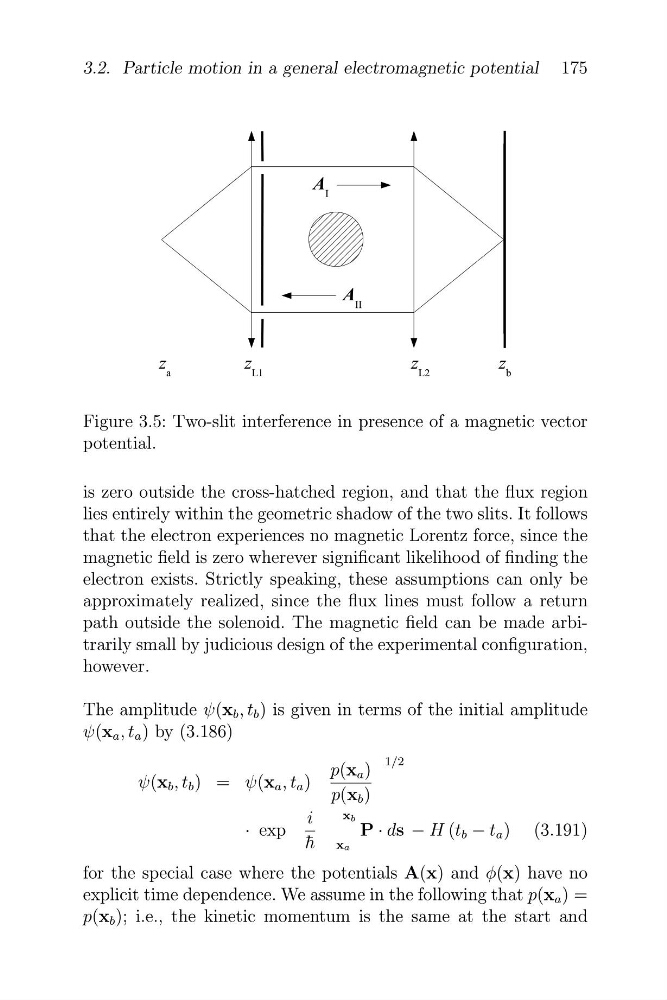
Figure 3.5: Two-slit interference in presence of a magnetic vector
potential.
is zero outside the cross-hatched region, and that the flux region
lies entirely within the geometric shadow of the two slits. It follows
that the electron experiences no magnetic Lorentz force, since the
magnetic field is zero wherever significant likelihood of finding the
electron exists. Strictly speaking, these assumptions can only be
approximately realized, since the flux lines must follow a return
path outside the solenoid. The magnetic field can be made arbitrarily small by judicious design of the experimental configuration,
however.
�
The amplitude ψ(x b , t b ) is given in terms of the initial amplitude
ψ(x a , t a ) by (3.186)
ψ(x b , t b ) = ψ(x a , t a )
p(x a )
p(x b )
1/2
i
x b
· exp ¯
h xa
P · ds − H (t b − t a ) (3.191)
for the special case where the potentials A(x) and φ(x) have no
explicit time dependence. We assume in the following that p(x a ) =
p(x b ); i.e., the kinetic momentum is the same at the start and
3.2. Particle motion in a general electromagnetic potential 175
Figure 3.5: Two-slit interference in presence of a magnetic vector
potential.
is zero outside the cross-hatched region, and that the flux region
lies entirely within the geometric shadow of the two slits. It follows
that the electron experiences no magnetic Lorentz force, since the
magnetic field is zero wherever significant likelihood of finding the
electron exists. Strictly speaking, these assumptions can only be
approximately realized, since the flux lines must follow a return
path outside the solenoid. The magnetic field can be made arbitrarily small by judicious design of the experimental configuration,
however.