

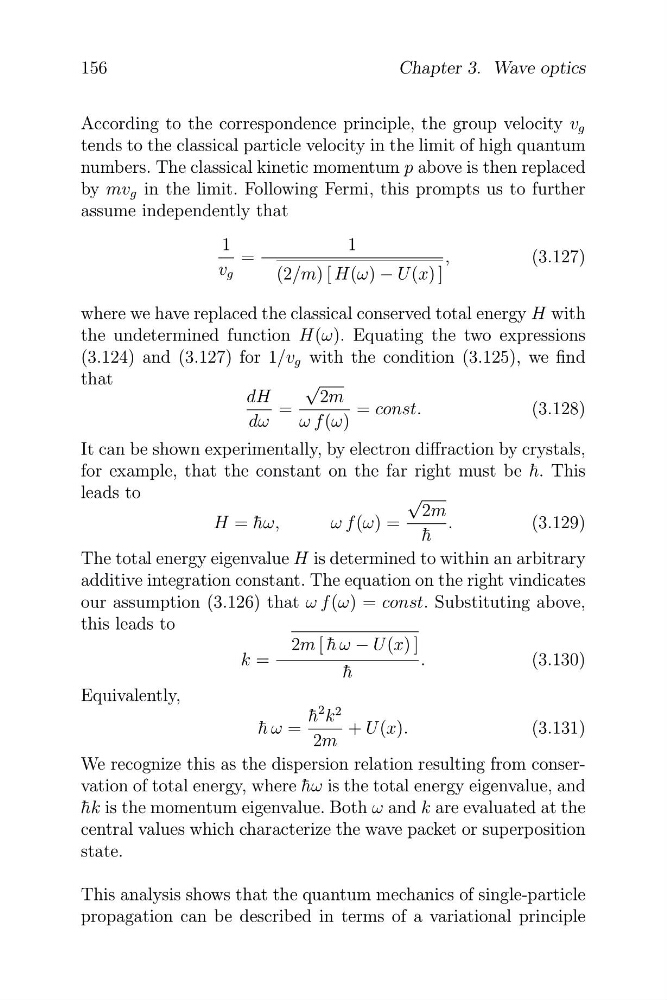
According to the correspondence principle, the group velocity v g
tends to the classical particle velocity in the limit of high quantum
numbers. The classical kinetic momentum p above is then replaced
by mv g in the limit. Following Fermi, this prompts us to further
assume independently that
1
1
=
,
(3.127)
v g
(2/m) [ H(ω) − U (x) ]
where we have replaced the classical conserved total energy H with
the undetermined function H(ω). Equating the two expressions
(3.124) and (3.127) for 1/v g with the condition (3.125), we find
that
√
dH
2m
=
= const.
(3.128)
dω
ω f (ω)
It can be shown experimentally, by electron diffraction by crystals,
for example, that the constant on the far right must be ¯
h. This
leads to
√
2m
H = ¯
hω,
ω f (ω) =
.
(3.129)
h ¯
The total energy eigenvalue H is determined to within an arbitrary
additive integration constant. The equation on the right vindicates
our assumption (3.126) that ω f (ω) = const. Substituting above,
this leads to
2m [ ¯
h ω − U (x) ]
k =
¯
h
.
(3.130)
Equivalently,
¯
h
2 k
2
¯
h ω = 2m
+ U (x).
(3.131)
We recognize this as the dispersion relation resulting from conservation of total energy, where ¯
hω is the total energy eigenvalue, and
¯
hk is the momentum eigenvalue. Both ω and k are evaluated at the
central values which characterize the wave packet or superposition
state.
This analysis shows that the quantum mechanics of single-particle
propagation can be described in terms of a variational principle
156
Chapter 3. Wave optics
tends to the classical particle velocity in the limit of high quantum
numbers. The classical kinetic momentum p above is then replaced
by mv g in the limit. Following Fermi, this prompts us to further
assume independently that
1
1
=
,
(3.127)
v g
(2/m) [ H(ω) − U (x) ]
where we have replaced the classical conserved total energy H with
the undetermined function H(ω). Equating the two expressions
(3.124) and (3.127) for 1/v g with the condition (3.125), we find
that
√
dH
2m
=
= const.
(3.128)
dω
ω f (ω)
It can be shown experimentally, by electron diffraction by crystals,
for example, that the constant on the far right must be ¯
h. This
leads to
√
2m
H = ¯
hω,
ω f (ω) =
.
(3.129)
h ¯
The total energy eigenvalue H is determined to within an arbitrary
additive integration constant. The equation on the right vindicates
our assumption (3.126) that ω f (ω) = const. Substituting above,
this leads to
2m [ ¯
h ω − U (x) ]
k =
¯
h
.
(3.130)
Equivalently,
¯
h
2 k
2
¯
h ω = 2m
+ U (x).
(3.131)
We recognize this as the dispersion relation resulting from conservation of total energy, where ¯
hω is the total energy eigenvalue, and
¯
hk is the momentum eigenvalue. Both ω and k are evaluated at the
central values which characterize the wave packet or superposition
state.
This analysis shows that the quantum mechanics of single-particle
propagation can be described in terms of a variational principle
156
Chapter 3. Wave optics