

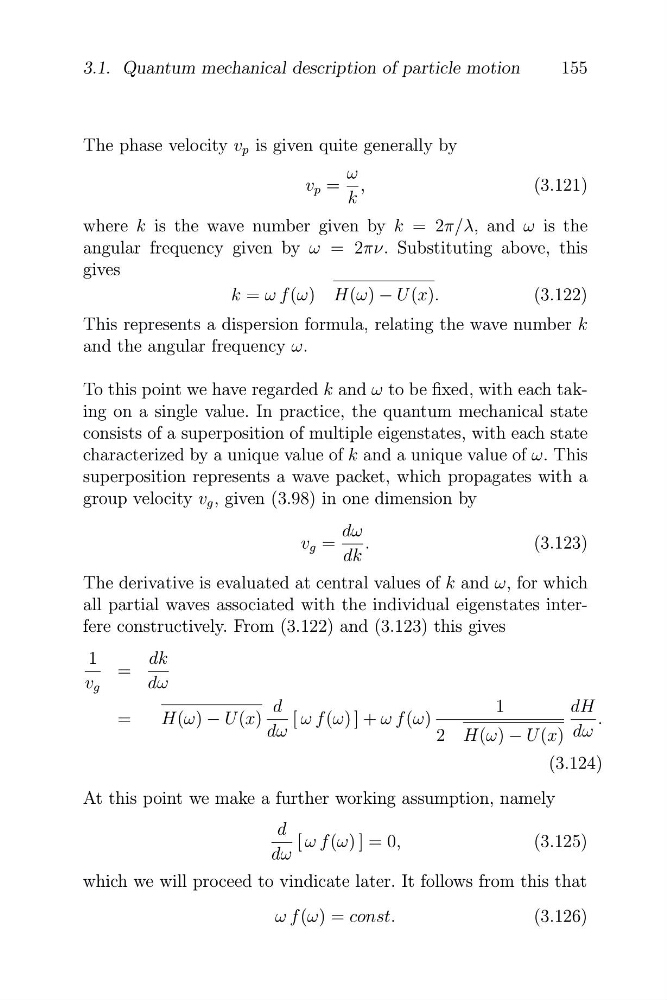
The phase velocity v p is given quite generally by
ω
v p = ,
(3.121)
k
where k is the wave number given by k = 2π/λ, and ω is the
angular frequency given by ω = 2πν. Substituting above, this
gives
k = ω f (ω) H(ω) − U (x).
(3.122)
This represents a dispersion formula, relating the wave number k
and the angular frequency ω.
To this point we have regarded k and ω to be fixed, with each taking on a single value. In practice, the quantum mechanical state
consists of a superposition of multiple eigenstates, with each state
characterized by a unique value of k and a unique value of ω. This
superposition represents a wave packet, which propagates with a
group velocity v g , given (3.98) in one dimension by
dω
v g =
.
(3.123)
dk
The derivative is evaluated at central values of k and ω, for which
all partial waves associated with the individual eigenstates interfere constructively. From (3.122) and (3.123) this gives
1
dk
=
v g
dω
d
1
dH
=
H(ω) − U (x) dω
[ ω f (ω) ] + ω f (ω)
2 H(ω) − U (x) dω
.
(3.124)
At this point we make a further working assumption, namely
d [ ω f (ω) ] = 0,
(3.125)
dω
which we will proceed to vindicate later. It follows from this that
ω f (ω) = const.
(3.126)
3.1. Quantum mechanical description of particle motion
155
ω
v p = ,
(3.121)
k
where k is the wave number given by k = 2π/λ, and ω is the
angular frequency given by ω = 2πν. Substituting above, this
gives
k = ω f (ω) H(ω) − U (x).
(3.122)
This represents a dispersion formula, relating the wave number k
and the angular frequency ω.
To this point we have regarded k and ω to be fixed, with each taking on a single value. In practice, the quantum mechanical state
consists of a superposition of multiple eigenstates, with each state
characterized by a unique value of k and a unique value of ω. This
superposition represents a wave packet, which propagates with a
group velocity v g , given (3.98) in one dimension by
dω
v g =
.
(3.123)
dk
The derivative is evaluated at central values of k and ω, for which
all partial waves associated with the individual eigenstates interfere constructively. From (3.122) and (3.123) this gives
1
dk
=
v g
dω
d
1
dH
=
H(ω) − U (x) dω
[ ω f (ω) ] + ω f (ω)
2 H(ω) − U (x) dω
.
(3.124)
At this point we make a further working assumption, namely
d [ ω f (ω) ] = 0,
(3.125)
dω
which we will proceed to vindicate later. It follows from this that
ω f (ω) = const.
(3.126)
3.1. Quantum mechanical description of particle motion
155