

�
3.1. Quantum mechanical description of particle motion
151
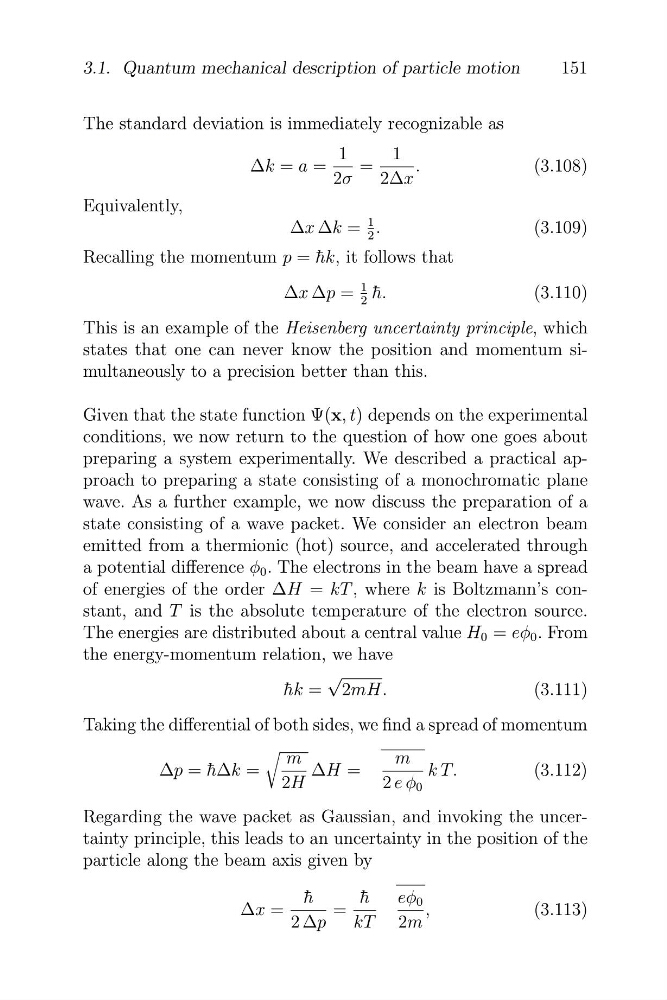
The standard deviation is immediately recognizable as
1
1
Δk = a =
=
.
(3.108)
2σ
2Δx
Equivalently,
Δx Δk =
1
2
.
(3.109)
Recalling the momentum p = ¯
hk, it follows that
Δx Δp = 2
1 ¯
(3.110)
h.
This is an example of the Heisenberg uncertainty principle, which
states that one can never know the position and momentum simultaneously to a precision better than this.
Given that the state function Ψ(x, t) depends on the experimental
conditions, we now return to the question of how one goes about
preparing a system experimentally. We described a practical approach to preparing a state consisting of a monochromatic plane
wave. As a further example, we now discuss the preparation of a
state consisting of a wave packet. We consider an electron beam
emitted from a thermionic (hot) source, and accelerated through
a potential difference φ 0 . The electrons in the beam have a spread
of energies of the order ΔH = kT , where k is Boltzmann’s constant, and T is the absolute temperature of the electron source.
The energies are distributed about a central value H 0 = eφ 0 . From
the energy-momentum relation, we have
√
hk ¯ = 2mH.
(3.111)
Taking the differential of both sides, we find a spread of momentum
m
m
Δp = ¯
hΔk =
ΔH =
k T.
(3.112)
2H
2 e φ 0
Regarding the wave packet as Gaussian, and invoking the uncertainty principle, this leads to an uncertainty in the position of the
particle along the beam axis given by
h ¯
h ¯
eφ 0
Δx =
=
,
(3.113)
2 Δp
kT 2m
3.1. Quantum mechanical description of particle motion
151
The standard deviation is immediately recognizable as
1
1
Δk = a =
=
.
(3.108)
2σ
2Δx
Equivalently,
Δx Δk =
1
2
.
(3.109)
Recalling the momentum p = ¯
hk, it follows that
Δx Δp = 2
1 ¯
(3.110)
h.
This is an example of the Heisenberg uncertainty principle, which
states that one can never know the position and momentum simultaneously to a precision better than this.
Given that the state function Ψ(x, t) depends on the experimental
conditions, we now return to the question of how one goes about
preparing a system experimentally. We described a practical approach to preparing a state consisting of a monochromatic plane
wave. As a further example, we now discuss the preparation of a
state consisting of a wave packet. We consider an electron beam
emitted from a thermionic (hot) source, and accelerated through
a potential difference φ 0 . The electrons in the beam have a spread
of energies of the order ΔH = kT , where k is Boltzmann’s constant, and T is the absolute temperature of the electron source.
The energies are distributed about a central value H 0 = eφ 0 . From
the energy-momentum relation, we have
√
hk ¯ = 2mH.
(3.111)
Taking the differential of both sides, we find a spread of momentum
m
m
Δp = ¯
hΔk =
ΔH =
k T.
(3.112)
2H
2 e φ 0
Regarding the wave packet as Gaussian, and invoking the uncertainty principle, this leads to an uncertainty in the position of the
particle along the beam axis given by
h ¯
h ¯
eφ 0
Δx =
=
,
(3.113)
2 Δp
kT 2m