

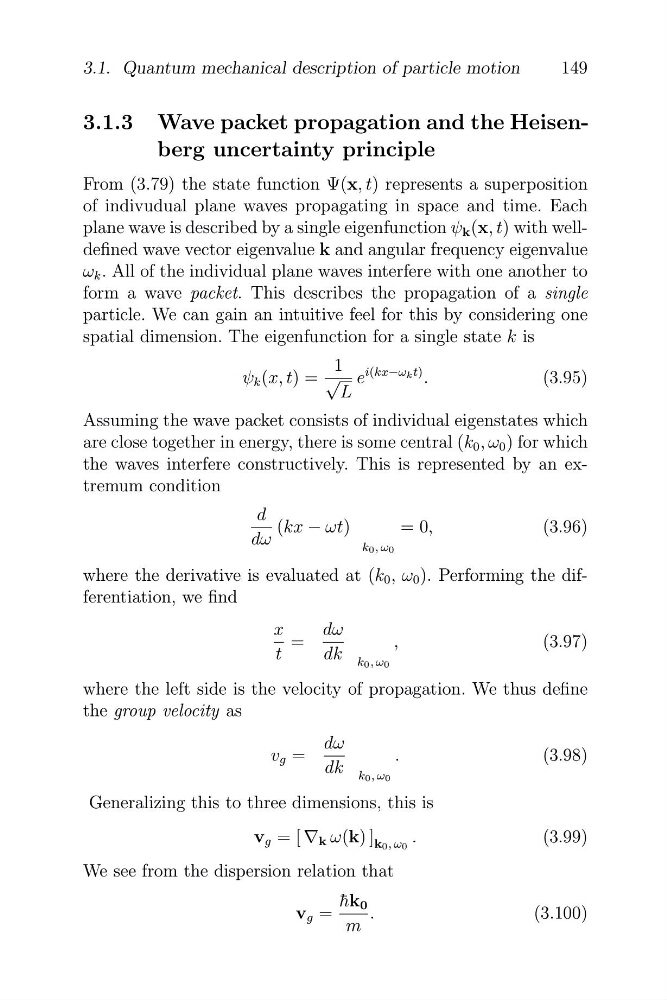
1 i(kx−ω k t)
ψ k (x, t) = √ e
.
(3.95)
L
Assuming the wave packet consists of individual eigenstates which
are close together in energy, there is some central (k 0 , ω 0 ) for which
the waves interfere constructively. This is represented by an extremum condition
d (kx − ωt)
= 0,
(3.96)
dω
k 0 , ω 0
where the derivative is evaluated at (k 0 , ω 0 ). Performing the differentiation, we find
x
dω
t
= dk k 0 , ω 0
,
(3.97)
where the left side is the velocity of propagation. We thus define
the group velocity as
dω
v g = dk k 0 , ω 0
.
(3.98)
Generalizing this to three dimensions, this is
v g = [ v k ω(k) ] k 0 , ω 0 .
(3.99)
We see from the dispersion relation that
v g =
¯
hk 0
m
.
(3.100)
3.1. Quantum mechanical description of particle motion
149
3.1.3 Wave packet propagation and the Heisenberg uncertainty principle
From (3.79) the state function Ψ(x, t) represents a superposition
of indivudual plane waves propagating in space and time. Each
plane wave is described by a single eigenfunction ψ k (x, t) with welldefined wave vector eigenvalue k and angular frequency eigenvalue
ω k . All of the individual plane waves interfere with one another to
form a wave packet. This describes the propagation of a single
particle. We can gain an intuitive feel for this by considering one
spatial dimension. The eigenfunction for a single state k is
ψ k (x, t) = √ e
.
(3.95)
L
Assuming the wave packet consists of individual eigenstates which
are close together in energy, there is some central (k 0 , ω 0 ) for which
the waves interfere constructively. This is represented by an extremum condition
d (kx − ωt)
= 0,
(3.96)
dω
k 0 , ω 0
where the derivative is evaluated at (k 0 , ω 0 ). Performing the differentiation, we find
x
dω
t
= dk k 0 , ω 0
,
(3.97)
where the left side is the velocity of propagation. We thus define
the group velocity as
dω
v g = dk k 0 , ω 0
.
(3.98)
Generalizing this to three dimensions, this is
v g = [ v k ω(k) ] k 0 , ω 0 .
(3.99)
We see from the dispersion relation that
v g =
¯
hk 0
m
.
(3.100)
3.1. Quantum mechanical description of particle motion
149
3.1.3 Wave packet propagation and the Heisenberg uncertainty principle
From (3.79) the state function Ψ(x, t) represents a superposition
of indivudual plane waves propagating in space and time. Each
plane wave is described by a single eigenfunction ψ k (x, t) with welldefined wave vector eigenvalue k and angular frequency eigenvalue
ω k . All of the individual plane waves interfere with one another to
form a wave packet. This describes the propagation of a single
particle. We can gain an intuitive feel for this by considering one
spatial dimension. The eigenfunction for a single state k is