

140
Chapter 3. Wave optics
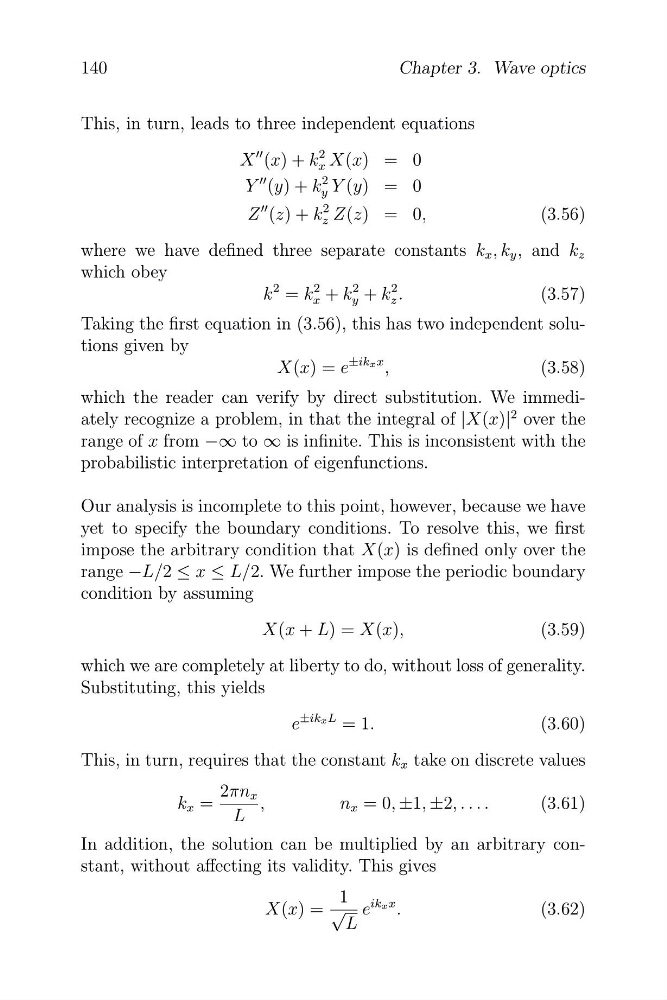
This, in turn, leads to three independent equations
X
�� (x) + k x
2 X(x) = 0
Y
�� (y) + k y
2 Y (y) = 0
Z
�� (z) + k z
2 Z(z) = 0,
(3.56)
where we have defined three separate constants k x , k y , and k z
which obey
k
2 = k
2 + k
2 + k
2 .
(3.57)
x
y
z
Taking the first equation in (3.56), this has two independent solutions given by
±ikxx
X(x) = e
,
(3.58)
which the reader can verify by direct substitution. We immediately recognize a problem, in that the integral of |X(x)|
2 over the
range of x from −∞ to ∞ is infinite. This is inconsistent with the
probabilistic interpretation of eigenfunctions.
Our analysis is incomplete to this point, however, because we have
yet to specify the boundary conditions. To resolve this, we first
impose the arbitrary condition that X(x) is defined only over the
range −L/2 ≤ x ≤ L/2. We further impose the periodic boundary
condition by assuming
X(x + L) = X(x),
(3.59)
which we are completely at liberty to do, without loss of generality.
Substituting, this yields
e
±ikxL = 1.
(3.60)
This, in turn, requires that the constant k x take on discrete values
2πn x
k x =
,
n x = 0, ±1, ±2, . . . .
(3.61)
L
In addition, the solution can be multiplied by an arbitrary constant, without affecting its validity. This gives
1
X(x) = √ e
ikxx .
(3.62)
L
Chapter 3. Wave optics
This, in turn, leads to three independent equations
X
�� (x) + k x
2 X(x) = 0
Y
�� (y) + k y
2 Y (y) = 0
Z
�� (z) + k z
2 Z(z) = 0,
(3.56)
where we have defined three separate constants k x , k y , and k z
which obey
k
2 = k
2 + k
2 + k
2 .
(3.57)
x
y
z
Taking the first equation in (3.56), this has two independent solutions given by
±ikxx
X(x) = e
,
(3.58)
which the reader can verify by direct substitution. We immediately recognize a problem, in that the integral of |X(x)|
2 over the
range of x from −∞ to ∞ is infinite. This is inconsistent with the
probabilistic interpretation of eigenfunctions.
Our analysis is incomplete to this point, however, because we have
yet to specify the boundary conditions. To resolve this, we first
impose the arbitrary condition that X(x) is defined only over the
range −L/2 ≤ x ≤ L/2. We further impose the periodic boundary
condition by assuming
X(x + L) = X(x),
(3.59)
which we are completely at liberty to do, without loss of generality.
Substituting, this yields
e
±ikxL = 1.
(3.60)
This, in turn, requires that the constant k x take on discrete values
2πn x
k x =
,
n x = 0, ±1, ±2, . . . .
(3.61)
L
In addition, the solution can be multiplied by an arbitrary constant, without affecting its validity. This gives
1
X(x) = √ e
ikxx .
(3.62)
L