

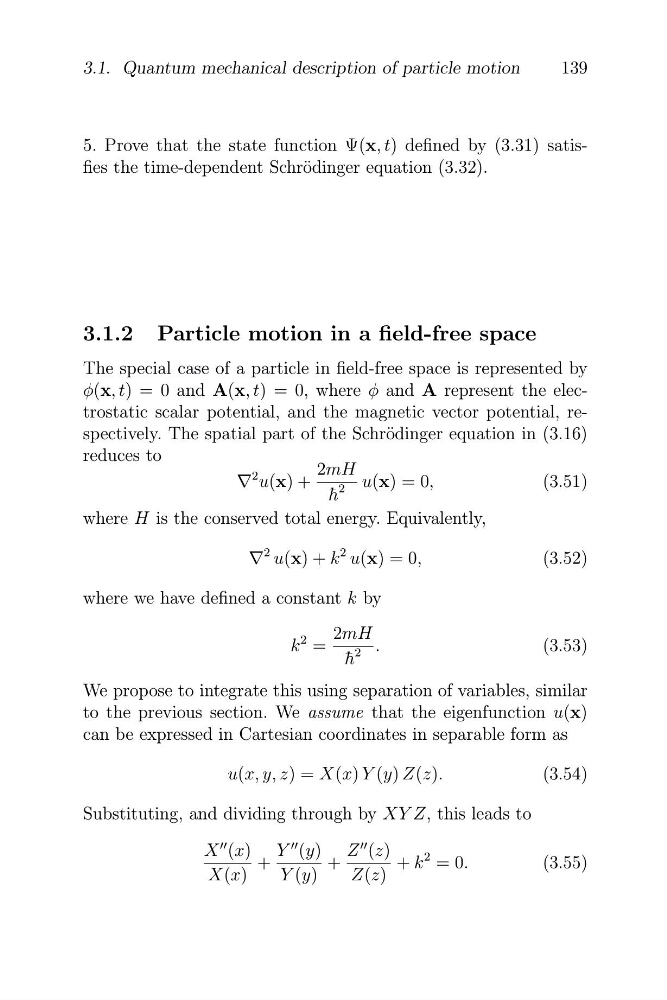
3.1.2 Particle motion in a field-free space
The special case of a particle in field-free space is represented by
φ(x, t) = 0 and A(x, t) = 0, where φ and A represent the electrostatic scalar potential, and the magnetic vector potential, respectively. The spatial part of the Schr¨ odinger equation in (3.16)
reduces to
v
2 u(x) +
2mH
¯
h
2 u(x) = 0,
(3.51)
where H is the conserved total energy. Equivalently,
v
2 u(x) + k
2 u(x) = 0,
(3.52)
where we have defined a constant k by
k
2 =
2mH
¯
h
2 .
(3.53)
We propose to integrate this using separation of variables, similar
to the previous section. We assume that the eigenfunction u(x)
can be expressed in Cartesian coordinates in separable form as
u(x, y, z) = X(x) Y (y) Z(z).
(3.54)
Substituting, and dividing through by XY Z, this leads to
X
�� (x) Y
�� (y) Z
�� (z)
+
+
+ k
2 = 0.
(3.55)
X(x)
Y (y)
Z(z)
3.1. Quantum mechanical description of particle motion
139
5. Prove that the state function Ψ(x, t) defined by (3.31) satisfies the time-dependent Schr¨ odinger equation (3.32).
The special case of a particle in field-free space is represented by
φ(x, t) = 0 and A(x, t) = 0, where φ and A represent the electrostatic scalar potential, and the magnetic vector potential, respectively. The spatial part of the Schr¨ odinger equation in (3.16)
reduces to
v
2 u(x) +
2mH
¯
h
2 u(x) = 0,
(3.51)
where H is the conserved total energy. Equivalently,
v
2 u(x) + k
2 u(x) = 0,
(3.52)
where we have defined a constant k by
k
2 =
2mH
¯
h
2 .
(3.53)
We propose to integrate this using separation of variables, similar
to the previous section. We assume that the eigenfunction u(x)
can be expressed in Cartesian coordinates in separable form as
u(x, y, z) = X(x) Y (y) Z(z).
(3.54)
Substituting, and dividing through by XY Z, this leads to
X
�� (x) Y
�� (y) Z
�� (z)
+
+
+ k
2 = 0.
(3.55)
X(x)
Y (y)
Z(z)
3.1. Quantum mechanical description of particle motion
139
5. Prove that the state function Ψ(x, t) defined by (3.31) satisfies the time-dependent Schr¨ odinger equation (3.32).