

�
�
115
2.7. Hamilton–Jacobi theory
to solve for the Q i (t); i.e., find Q i = Q i (α, β). The α i and β i are
determined by the initial conditions. This represents the solution.
The transformations generated by W and S have quite different
properties. From the third of equations (2.310) and from equation
(2.319), the two generating functions are related by
S(Q, p; t) = W (Q, p) − α 1 t
(2.326)
for the case where H has no explicit time dependence. This completes the formal solution to the dynamical problem by HamiltonJacobi theory.
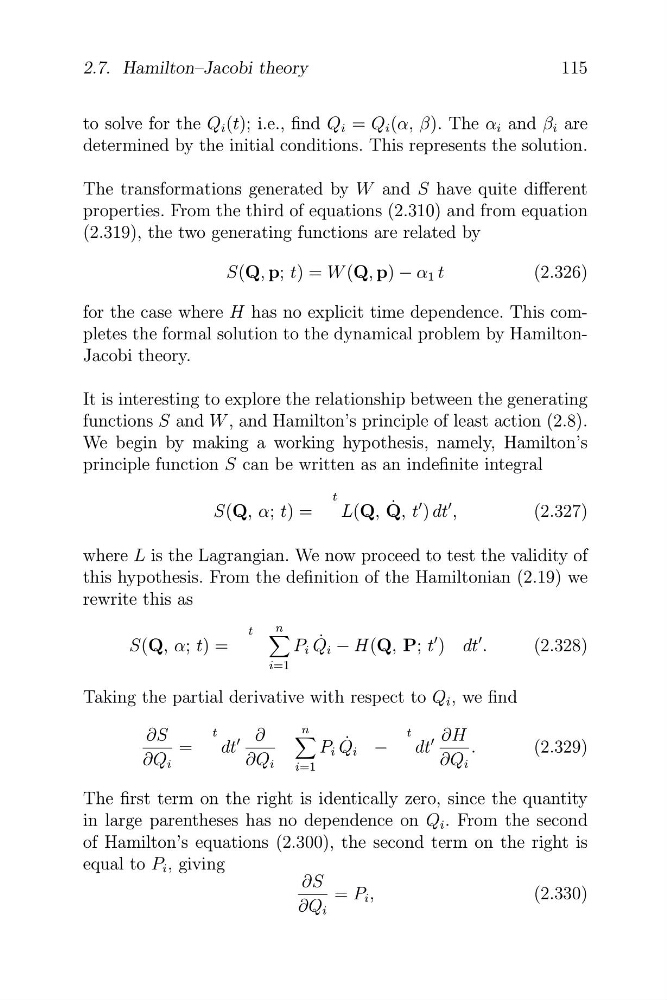
It is interesting to explore the relationship between the generating
functions S and W , and Hamilton’s principle of least action (2.8).
We begin by making a working hypothesis, namely, Hamilton’s
principle function S can be written as an indefinite integral
t
S(Q, α; t) =
L(Q, Q ˙ , t
� ) dt
� ,
(2.327)
where L is the Lagrangian. We now proceed to test the validity of
this hypothesis. From the definition of the Hamiltonian (2.19) we
rewrite this as
n
t
4
S(Q, α; t) =
P i Q ˙ i − H(Q, P; t
� ) dt
� .
(2.328)
i=1
Taking the partial derivative with respect to Q i , we find
t
4
t
∂S
∂
n
∂H
˙
=
dt
�
P i Q i −
dt
�
.
(2.329)
∂Q i
∂Q i i=1
∂Q i
The first term on the right is identically zero, since the quantity
in large parentheses has no dependence on Q i . From the second
of Hamilton’s equations (2.300), the second term on the right is
equal to P i , giving
∂S = P i ,
(2.330)
∂Q i
�
115
2.7. Hamilton–Jacobi theory
to solve for the Q i (t); i.e., find Q i = Q i (α, β). The α i and β i are
determined by the initial conditions. This represents the solution.
The transformations generated by W and S have quite different
properties. From the third of equations (2.310) and from equation
(2.319), the two generating functions are related by
S(Q, p; t) = W (Q, p) − α 1 t
(2.326)
for the case where H has no explicit time dependence. This completes the formal solution to the dynamical problem by HamiltonJacobi theory.
It is interesting to explore the relationship between the generating
functions S and W , and Hamilton’s principle of least action (2.8).
We begin by making a working hypothesis, namely, Hamilton’s
principle function S can be written as an indefinite integral
t
S(Q, α; t) =
L(Q, Q ˙ , t
� ) dt
� ,
(2.327)
where L is the Lagrangian. We now proceed to test the validity of
this hypothesis. From the definition of the Hamiltonian (2.19) we
rewrite this as
n
t
4
S(Q, α; t) =
P i Q ˙ i − H(Q, P; t
� ) dt
� .
(2.328)
i=1
Taking the partial derivative with respect to Q i , we find
t
4
t
∂S
∂
n
∂H
˙
=
dt
�
P i Q i −
dt
�
.
(2.329)
∂Q i
∂Q i i=1
∂Q i
The first term on the right is identically zero, since the quantity
in large parentheses has no dependence on Q i . From the second
of Hamilton’s equations (2.300), the second term on the right is
equal to P i , giving
∂S = P i ,
(2.330)
∂Q i