

98
Chapter 2. Geometrical optics
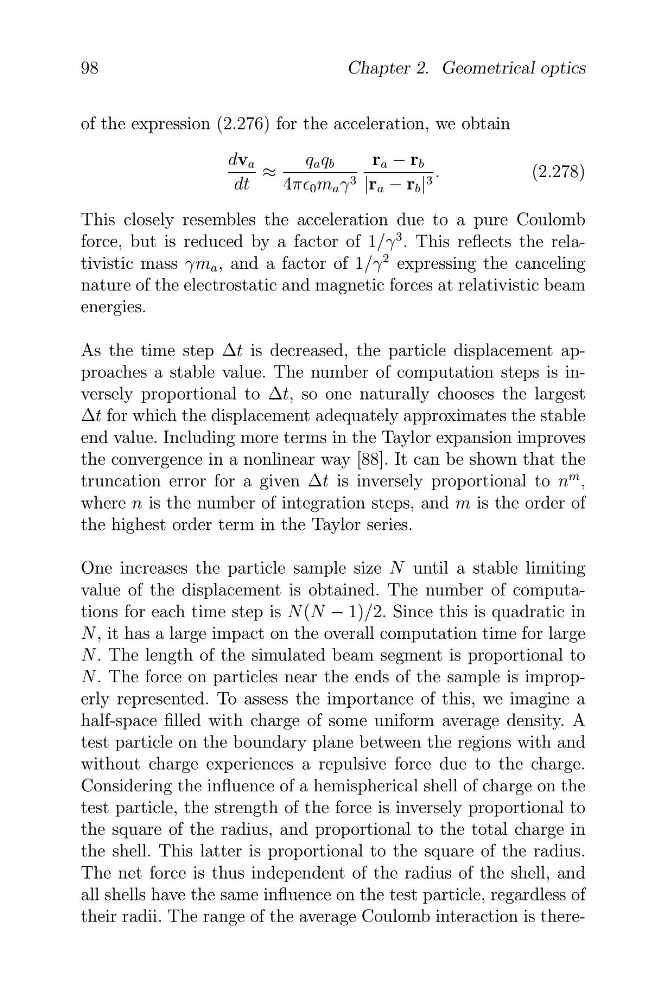
of the expression (2.276) for the acceleration, we obtain
dv a
q a q b
r a − r b
≈
.
(2.278)
dt
4πf 0 m a γ 3 |r a − r b | 3
This closely resembles the acceleration due to a pure Coulomb
force, but is reduced by a factor of 1/γ
3 . This reflects the relativistic mass γm a , and a factor of 1/γ
2 expressing the canceling
nature of the electrostatic and magnetic forces at relativistic beam
energies.
As the time step Δt is decreased, the particle displacement approaches a stable value. The number of computation steps is inversely proportional to Δt, so one naturally chooses the largest
Δt for which the displacement adequately approximates the stable
end value. Including more terms in the Taylor expansion improves
the convergence in a nonlinear way [88]. It can be shown that the
truncation error for a given Δt is inversely proportional to n
m ,
where n is the number of integration steps, and m is the order of
the highest order term in the Taylor series.
One increases the particle sample size N until a stable limiting
value of the displacement is obtained. The number of computations for each time step is N (N − 1)/2. Since this is quadratic in
N , it has a large impact on the overall computation time for large
N . The length of the simulated beam segment is proportional to
N . The force on particles near the ends of the sample is improperly represented. To assess the importance of this, we imagine a
half-space filled with charge of some uniform average density. A
test particle on the boundary plane between the regions with and
without charge experiences a repulsive force due to the charge.
Considering the influence of a hemispherical shell of charge on the
test particle, the strength of the force is inversely proportional to
the square of the radius, and proportional to the total charge in
the shell. This latter is proportional to the square of the radius.
The net force is thus independent of the radius of the shell, and
all shells have the same influence on the test particle, regardless of
their radii. The range of the average Coulomb interaction is there
Chapter 2. Geometrical optics
of the expression (2.276) for the acceleration, we obtain
dv a
q a q b
r a − r b
≈
.
(2.278)
dt
4πf 0 m a γ 3 |r a − r b | 3
This closely resembles the acceleration due to a pure Coulomb
force, but is reduced by a factor of 1/γ
3 . This reflects the relativistic mass γm a , and a factor of 1/γ
2 expressing the canceling
nature of the electrostatic and magnetic forces at relativistic beam
energies.
As the time step Δt is decreased, the particle displacement approaches a stable value. The number of computation steps is inversely proportional to Δt, so one naturally chooses the largest
Δt for which the displacement adequately approximates the stable
end value. Including more terms in the Taylor expansion improves
the convergence in a nonlinear way [88]. It can be shown that the
truncation error for a given Δt is inversely proportional to n
m ,
where n is the number of integration steps, and m is the order of
the highest order term in the Taylor series.
One increases the particle sample size N until a stable limiting
value of the displacement is obtained. The number of computations for each time step is N (N − 1)/2. Since this is quadratic in
N , it has a large impact on the overall computation time for large
N . The length of the simulated beam segment is proportional to
N . The force on particles near the ends of the sample is improperly represented. To assess the importance of this, we imagine a
half-space filled with charge of some uniform average density. A
test particle on the boundary plane between the regions with and
without charge experiences a repulsive force due to the charge.
Considering the influence of a hemispherical shell of charge on the
test particle, the strength of the force is inversely proportional to
the square of the radius, and proportional to the total charge in
the shell. This latter is proportional to the square of the radius.
The net force is thus independent of the radius of the shell, and
all shells have the same influence on the test particle, regardless of
their radii. The range of the average Coulomb interaction is there