

89
2.5. Axial symmetry
method for calculating the intensity point spread function is derived by Gallatin [32]. In this section, we give an alternative derivation which is consistent with the foregoing analysis, and leads to
the same result obtained by Gallatin.
In mathematical terms, we define the intensity point spread function I(x I ), as the two-dimensional intensity distribution in the
Gaussian image plane for an ideal point object, in the classical
limit of geometrical optics. We wish to obtain an analytic expression for I(x I ), given the aberrations and defocus. We can write
I(x I ) = d
2 P I ρ I (x I , P I ),
(2.251)
where x I = (x I , y I ) is the transverse position, in the rotated system, P I = (P Ix , P Iy ) is the transverse canonical momentum, and
ρ I (x I , P I ) is the phase space density, all defined in the Gaussian
image plane. We have integrated over all momentum components,
to obtain the intensity as a function of transverse position only.
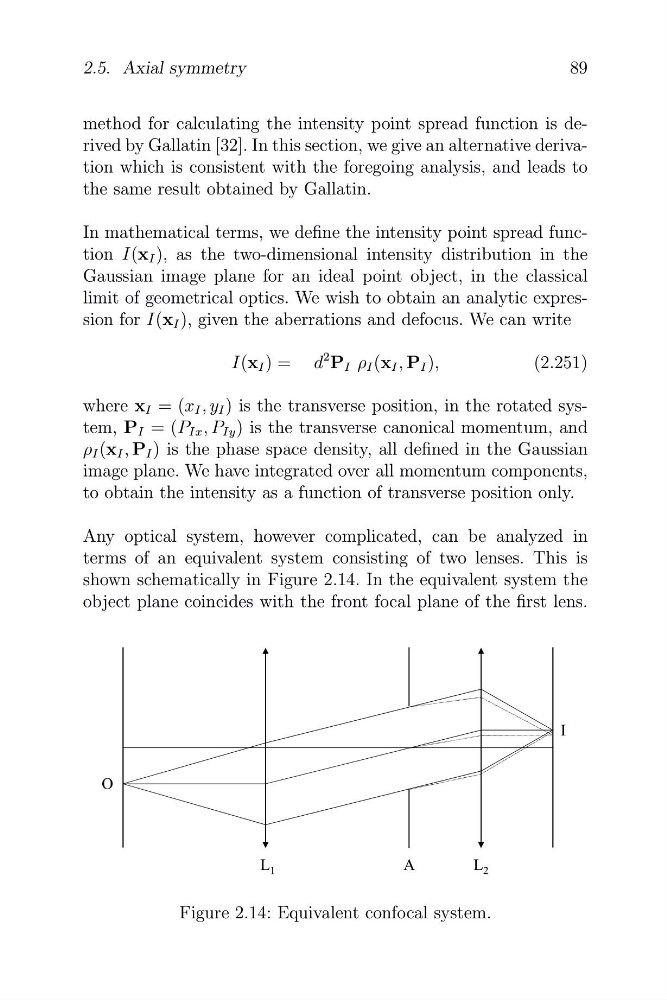
Any optical system, however complicated, can be analyzed in
terms of an equivalent system consisting of two lenses. This is
shown schematically in Figure 2.14. In the equivalent system the
object plane coincides with the front focal plane of the first lens.
2
,
/
/
$
Figure 2.14: Equivalent confocal system.
2.5. Axial symmetry
method for calculating the intensity point spread function is derived by Gallatin [32]. In this section, we give an alternative derivation which is consistent with the foregoing analysis, and leads to
the same result obtained by Gallatin.
In mathematical terms, we define the intensity point spread function I(x I ), as the two-dimensional intensity distribution in the
Gaussian image plane for an ideal point object, in the classical
limit of geometrical optics. We wish to obtain an analytic expression for I(x I ), given the aberrations and defocus. We can write
I(x I ) = d
2 P I ρ I (x I , P I ),
(2.251)
where x I = (x I , y I ) is the transverse position, in the rotated system, P I = (P Ix , P Iy ) is the transverse canonical momentum, and
ρ I (x I , P I ) is the phase space density, all defined in the Gaussian
image plane. We have integrated over all momentum components,
to obtain the intensity as a function of transverse position only.
Any optical system, however complicated, can be analyzed in
terms of an equivalent system consisting of two lenses. This is
shown schematically in Figure 2.14. In the equivalent system the
object plane coincides with the front focal plane of the first lens.
2
,
/
/
$
Figure 2.14: Equivalent confocal system.