

88
Chapter 2. Geometrical optics
By inspection, the three terms in (2.247) represent, in order, field
magnification, field rotation, and defocus. This last is independent
of field position. The chromatic aberration (2.247) is referred to
the object by substituting δv O = M
−1 δv I . In the non-relativistic
limit we substitute in (2.248) to obtain
√
1 + Φ ≈ 1,
p ≈ 2 Φ,
2 p
−2 + 1 ≈
1 .
(2.249)
Φ
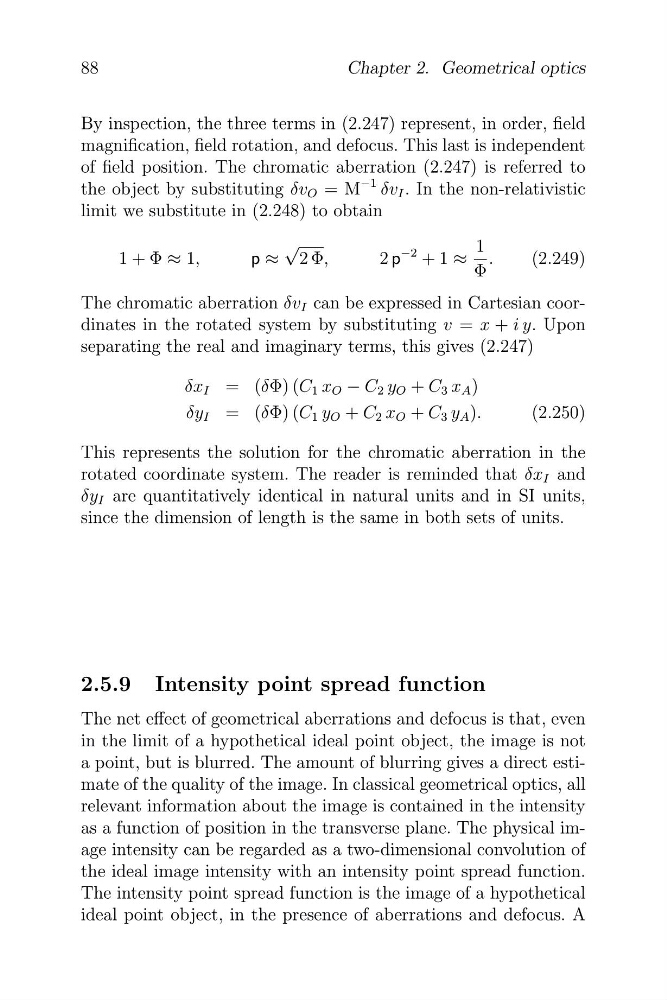
The chromatic aberration δv I can be expressed in Cartesian coordinates in the rotated system by substituting v = x + i y. Upon
separating the real and imaginary terms, this gives (2.247)
δx I = (δΦ) (C 1 x O − C 2 y O + C 3 x A )
δy I = (δΦ) (C 1 y O + C 2 x O + C 3 y A ).
(2.250)
This represents the solution for the chromatic aberration in the
rotated coordinate system. The reader is reminded that δx I and
δy I are quantitatively identical in natural units and in SI units,
since the dimension of length is the same in both sets of units.
2.5.9 Intensity point spread function
The net effect of geometrical aberrations and defocus is that, even
in the limit of a hypothetical ideal point object, the image is not
a point, but is blurred. The amount of blurring gives a direct estimate of the quality of the image. In classical geometrical optics, all
relevant information about the image is contained in the intensity
as a function of position in the transverse plane. The physical image intensity can be regarded as a two-dimensional convolution of
the ideal image intensity with an intensity point spread function.
The intensity point spread function is the image of a hypothetical
ideal point object, in the presence of aberrations and defocus. A
Chapter 2. Geometrical optics
By inspection, the three terms in (2.247) represent, in order, field
magnification, field rotation, and defocus. This last is independent
of field position. The chromatic aberration (2.247) is referred to
the object by substituting δv O = M
−1 δv I . In the non-relativistic
limit we substitute in (2.248) to obtain
√
1 + Φ ≈ 1,
p ≈ 2 Φ,
2 p
−2 + 1 ≈
1 .
(2.249)
Φ
The chromatic aberration δv I can be expressed in Cartesian coordinates in the rotated system by substituting v = x + i y. Upon
separating the real and imaginary terms, this gives (2.247)
δx I = (δΦ) (C 1 x O − C 2 y O + C 3 x A )
δy I = (δΦ) (C 1 y O + C 2 x O + C 3 y A ).
(2.250)
This represents the solution for the chromatic aberration in the
rotated coordinate system. The reader is reminded that δx I and
δy I are quantitatively identical in natural units and in SI units,
since the dimension of length is the same in both sets of units.
2.5.9 Intensity point spread function
The net effect of geometrical aberrations and defocus is that, even
in the limit of a hypothetical ideal point object, the image is not
a point, but is blurred. The amount of blurring gives a direct estimate of the quality of the image. In classical geometrical optics, all
relevant information about the image is contained in the intensity
as a function of position in the transverse plane. The physical image intensity can be regarded as a two-dimensional convolution of
the ideal image intensity with an intensity point spread function.
The intensity point spread function is the image of a hypothetical
ideal point object, in the presence of aberrations and defocus. A