

85
2.5. Axial symmetry
2.5.8 Chromatic aberration
We now turn our attention to the aberration which arises when an
individual particle has a kinetic energy which differs infinitesimally
by δΦ from the nominal kinetic energy on axis Φ(z). This arises
quite commonly, as every practical particle source emits with a
range or spread of kinetic energies at the emission surface. As the
focussing action of electric and magnetic fields depends on the particle energy, we expect an aberration, called the chromatic aberration to occur. This name originates from the analogy between
particle optics and light optics, where the color or chromaticity of
the light is directly related to the photon energy. The following
analysis is based on that of Zworykin, et. al. [94].
The problem can be stated mathematically as follows: given the
solution v(z) to the paraxial ray equation for energy Φ(z) on axis,
find the aberration δv I in the Gaussian image plane, arising from
a constant perturbation δΦ in the energy. We begin by recalling
that v(z) is the general solution (2.167) to the paraxial ray equation (2.162) in the rotated system. Expanding the first derivative
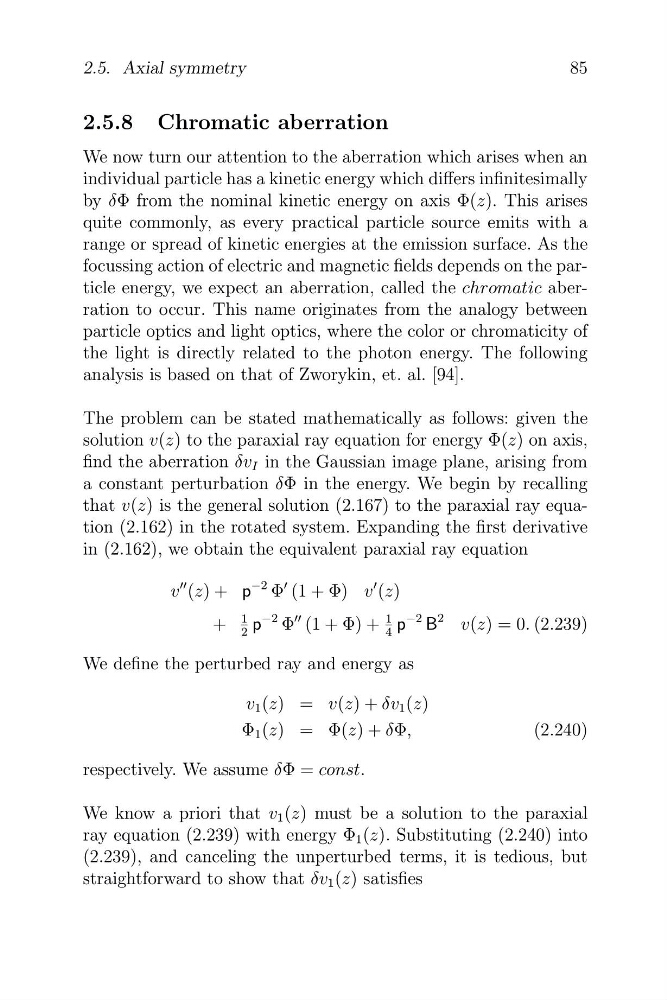
in (2.162), we obtain the equivalent paraxial ray equation
v
�� (z) + p
−2 Φ
� (1 + Φ) v
� (z)
−2 B
2
+
1
2
p
−2 Φ
�� (1 + Φ) + 4
1 p
v(z) = 0. (2.239)
We define the perturbed ray and energy as
v 1 (z) = v(z) + δv 1 (z)
Φ 1 (z) = Φ(z) + δΦ,
(2.240)
respectively. We assume δΦ = const.
We know a priori that v 1 (z) must be a solution to the paraxial
ray equation (2.239) with energy Φ 1 (z). Substituting (2.240) into
(2.239), and canceling the unperturbed terms, it is tedious, but
straightforward to show that δv 1 (z) satisfies
2.5. Axial symmetry
2.5.8 Chromatic aberration
We now turn our attention to the aberration which arises when an
individual particle has a kinetic energy which differs infinitesimally
by δΦ from the nominal kinetic energy on axis Φ(z). This arises
quite commonly, as every practical particle source emits with a
range or spread of kinetic energies at the emission surface. As the
focussing action of electric and magnetic fields depends on the particle energy, we expect an aberration, called the chromatic aberration to occur. This name originates from the analogy between
particle optics and light optics, where the color or chromaticity of
the light is directly related to the photon energy. The following
analysis is based on that of Zworykin, et. al. [94].
The problem can be stated mathematically as follows: given the
solution v(z) to the paraxial ray equation for energy Φ(z) on axis,
find the aberration δv I in the Gaussian image plane, arising from
a constant perturbation δΦ in the energy. We begin by recalling
that v(z) is the general solution (2.167) to the paraxial ray equation (2.162) in the rotated system. Expanding the first derivative
in (2.162), we obtain the equivalent paraxial ray equation
v
�� (z) + p
−2 Φ
� (1 + Φ) v
� (z)
−2 B
2
+
1
2
p
−2 Φ
�� (1 + Φ) + 4
1 p
v(z) = 0. (2.239)
We define the perturbed ray and energy as
v 1 (z) = v(z) + δv 1 (z)
Φ 1 (z) = Φ(z) + δΦ,
(2.240)
respectively. We assume δΦ = const.
We know a priori that v 1 (z) must be a solution to the paraxial
ray equation (2.239) with energy Φ 1 (z). Substituting (2.240) into
(2.239), and canceling the unperturbed terms, it is tedious, but
straightforward to show that δv 1 (z) satisfies