

26
S. J. Mukhopadhyay et al.
3 NSVE Large-Signal Model
The small-signal simulation of an IMPATT oscillator provides some preliminary idea
regarding the high-frequency performance of the source. Most popular and reliable
small-signal model for IMPATT oscillators was formulated by Gummel et al. in the
year 1967 [34]. After the pioneer work of Gummel et al. [34], several researchers
and research groups have adopted their small-signal model for predicting the highfrequency performance of microwave, mm-wave, and THz IMPATT sources based
on different semiconductor materials [35–38]. However, the small-signal simulation
models are actually based on different simplified assumptions; out of those, one of
the most important assumptions is that voltage modulation factor must be very small,
around less than 5%, which is untrue for practical free-running IMPATT oscillators.
Due to this unrealistic assumption, small-signal simulation fails to provide accurate
information regarding the conversion efficiency and power output from IMPATT
oscillators. The most realistic and very close to practical results can be achieved by
performing large-signal simulation of IMPATT oscillators.
Several researchers had developed large-signal simulation models for IMPATT
oscillators during 1968, 1969 [39, 40]. Most significant work was carried out by
Gupta et al. [41] in the year 1973; they had proposed a current excited large-signal
model for IMPATTs capable of predicting conversion efficiency and power output
of IMPATT sources with very good accuracy. In the year 2013, Acharyya et al.
proposed a NSVE large-signal model for IMPATT oscillators [42]; and later, they
had investigated the influences of band-to-band tunneling, parasitic series resistance,
skin effect, junction temperature, optical illumination, magnetic field, etc., on the
large-signal characteristics of IMPATT sources based on different semiconductor
materials as well as some potential heterostructures [33, 42–49]. Comparison with
suitable experimental data available in literature has been used to validate NSVE
large-signal simulation method [1, 5, 16, 17, 50–52].
The NSVE large-signal simulation provides complete time-domain as well as
frequency-domain information if the free-running IMPATT sources are based on any
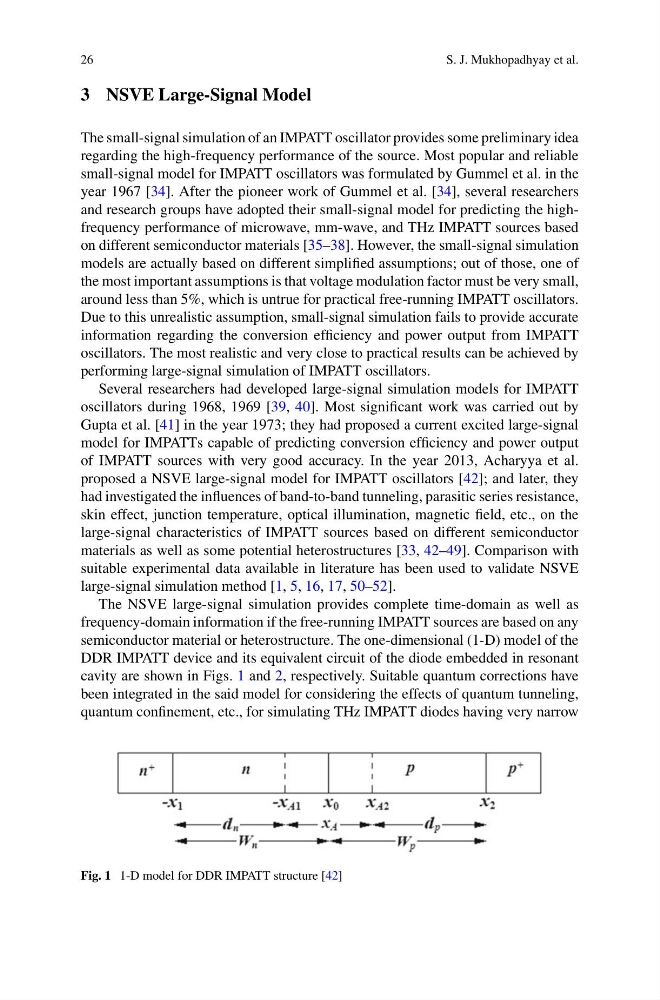
semiconductor material or heterostructure. The one-dimensional (1-D) model of the
DDR IMPATT device and its equivalent circuit of the diode embedded in resonant
cavity are shown in Figs. 1 and 2, respectively. Suitable quantum corrections have
been integrated in the said model for considering the effects of quantum tunneling,
quantum confinement, etc., for simulating THz IMPATT diodes having very narrow
Fig. 1 1-D model for DDR IMPATT structure [42]
S. J. Mukhopadhyay et al.
3 NSVE Large-Signal Model
The small-signal simulation of an IMPATT oscillator provides some preliminary idea
regarding the high-frequency performance of the source. Most popular and reliable
small-signal model for IMPATT oscillators was formulated by Gummel et al. in the
year 1967 [34]. After the pioneer work of Gummel et al. [34], several researchers
and research groups have adopted their small-signal model for predicting the highfrequency performance of microwave, mm-wave, and THz IMPATT sources based
on different semiconductor materials [35–38]. However, the small-signal simulation
models are actually based on different simplified assumptions; out of those, one of
the most important assumptions is that voltage modulation factor must be very small,
around less than 5%, which is untrue for practical free-running IMPATT oscillators.
Due to this unrealistic assumption, small-signal simulation fails to provide accurate
information regarding the conversion efficiency and power output from IMPATT
oscillators. The most realistic and very close to practical results can be achieved by
performing large-signal simulation of IMPATT oscillators.
Several researchers had developed large-signal simulation models for IMPATT
oscillators during 1968, 1969 [39, 40]. Most significant work was carried out by
Gupta et al. [41] in the year 1973; they had proposed a current excited large-signal
model for IMPATTs capable of predicting conversion efficiency and power output
of IMPATT sources with very good accuracy. In the year 2013, Acharyya et al.
proposed a NSVE large-signal model for IMPATT oscillators [42]; and later, they
had investigated the influences of band-to-band tunneling, parasitic series resistance,
skin effect, junction temperature, optical illumination, magnetic field, etc., on the
large-signal characteristics of IMPATT sources based on different semiconductor
materials as well as some potential heterostructures [33, 42–49]. Comparison with
suitable experimental data available in literature has been used to validate NSVE
large-signal simulation method [1, 5, 16, 17, 50–52].
The NSVE large-signal simulation provides complete time-domain as well as
frequency-domain information if the free-running IMPATT sources are based on any
semiconductor material or heterostructure. The one-dimensional (1-D) model of the
DDR IMPATT device and its equivalent circuit of the diode embedded in resonant
cavity are shown in Figs. 1 and 2, respectively. Suitable quantum corrections have
been integrated in the said model for considering the effects of quantum tunneling,
quantum confinement, etc., for simulating THz IMPATT diodes having very narrow
Fig. 1 1-D model for DDR IMPATT structure [42]