

THz Bandpass Filter Design Using Metamaterial-Based Defected 1D …
11
transmissivity of both the structures are calculated and graphically characterized
as a function of wavelength, where the central wavelength of passband is chosen
as 1550 nm, for the purpose of implementing the device in optical communication.
Results are computed in the presence of defect under oblique incidence and compared
with the condition of the ideal structure, i.e. the defect is absent.
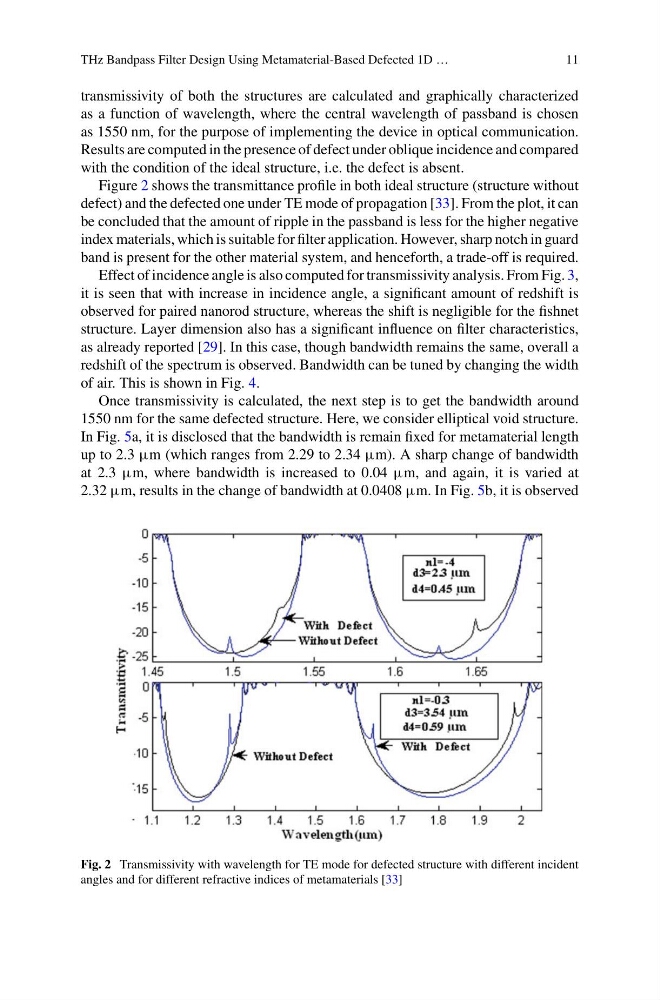
Figure 2 shows the transmittance profile in both ideal structure (structure without
defect) and the defected one under TE mode of propagation [33]. From the plot, it can
be concluded that the amount of ripple in the passband is less for the higher negative
index materials, which is suitable for filter application. However, sharp notch in guard
band is present for the other material system, and henceforth, a trade-off is required.
Effect of incidence angle is also computed for transmissivity analysis. From Fig. 3,
it is seen that with increase in incidence angle, a significant amount of redshift is
observed for paired nanorod structure, whereas the shift is negligible for the fishnet
structure. Layer dimension also has a significant influence on filter characteristics,
as already reported [29]. In this case, though bandwidth remains the same, overall a
redshift of the spectrum is observed. Bandwidth can be tuned by changing the width
of air. This is shown in Fig. 4.
Once transmissivity is calculated, the next step is to get the bandwidth around
1550 nm for the same defected structure. Here, we consider elliptical void structure.
In Fig. 5a, it is disclosed that the bandwidth is remain fixed for metamaterial length
up to 2.3 µm (which ranges from 2.29 to 2.34 µm). A sharp change of bandwidth
at 2.3 µm, where bandwidth is increased to 0.04 µm, and again, it is varied at
2.32 µm, results in the change of bandwidth at 0.0408 µm. In Fig. 5b, it is observed
Fig. 2 Transmissivity with wavelength for TE mode for defected structure with different incident
angles and for different refractive indices of metamaterials [33]
11
transmissivity of both the structures are calculated and graphically characterized
as a function of wavelength, where the central wavelength of passband is chosen
as 1550 nm, for the purpose of implementing the device in optical communication.
Results are computed in the presence of defect under oblique incidence and compared
with the condition of the ideal structure, i.e. the defect is absent.
Figure 2 shows the transmittance profile in both ideal structure (structure without
defect) and the defected one under TE mode of propagation [33]. From the plot, it can
be concluded that the amount of ripple in the passband is less for the higher negative
index materials, which is suitable for filter application. However, sharp notch in guard
band is present for the other material system, and henceforth, a trade-off is required.
Effect of incidence angle is also computed for transmissivity analysis. From Fig. 3,
it is seen that with increase in incidence angle, a significant amount of redshift is
observed for paired nanorod structure, whereas the shift is negligible for the fishnet
structure. Layer dimension also has a significant influence on filter characteristics,
as already reported [29]. In this case, though bandwidth remains the same, overall a
redshift of the spectrum is observed. Bandwidth can be tuned by changing the width
of air. This is shown in Fig. 4.
Once transmissivity is calculated, the next step is to get the bandwidth around
1550 nm for the same defected structure. Here, we consider elliptical void structure.
In Fig. 5a, it is disclosed that the bandwidth is remain fixed for metamaterial length
up to 2.3 µm (which ranges from 2.29 to 2.34 µm). A sharp change of bandwidth
at 2.3 µm, where bandwidth is increased to 0.04 µm, and again, it is varied at
2.32 µm, results in the change of bandwidth at 0.0408 µm. In Fig. 5b, it is observed
Fig. 2 Transmissivity with wavelength for TE mode for defected structure with different incident
angles and for different refractive indices of metamaterials [33]