

10
A. Deyasi and A. Sarkar
M
T
i, j =
1
t
1 r ji,i j
r ji,i j 1
(3.40)
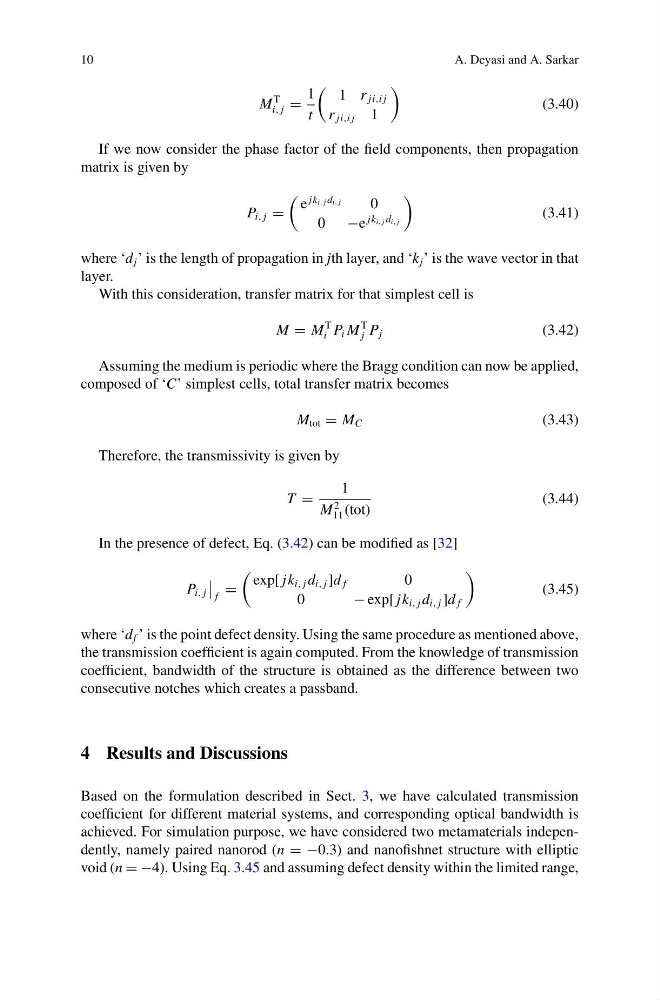
If we now consider the phase factor of the field components, then propagation
matrix is given by
P i, j =
e
jk i, j d i, j
0
0 −e
jk i, j d i, j
(3.41)
where ‘d j ’ is the length of propagation in jth layer, and ‘k j ’ is the wave vector in that
layer.
With this consideration, transfer matrix for that simplest cell is
M = M
T
i P i M
T
j P j
(3.42)
Assuming the medium is periodic where the Bragg condition can now be applied,
composed of ‘C’ simplest cells, total transfer matrix becomes
M tot = M C
(3.43)
Therefore, the transmissivity is given by
T =
1
M
2
11 (tot)
(3.44)
In the presence of defect, Eq. (3.42) can be modified as [32]
P i, j
f
=
exp[ jk i, j d i, j ]d f
0
0
− exp[ jk i, j d i, j ]d f
(3.45)
where ‘d f ’ is the point defect density. Using the same procedure as mentioned above,
the transmission coefficient is again computed. From the knowledge of transmission
coefficient, bandwidth of the structure is obtained as the difference between two
consecutive notches which creates a passband.
4 Results and Discussions
Based on the formulation described in Sect. 3, we have calculated transmission
coefficient for different material systems, and corresponding optical bandwidth is
achieved. For simulation purpose, we have considered two metamaterials independently, namely paired nanorod (n = −0.3) and nanofishnet structure with elliptic
void (n = −4). Using Eq. 3.45 and assuming defect density within the limited range,
A. Deyasi and A. Sarkar
M
T
i, j =
1
t
1 r ji,i j
r ji,i j 1
(3.40)
If we now consider the phase factor of the field components, then propagation
matrix is given by
P i, j =
e
jk i, j d i, j
0
0 −e
jk i, j d i, j
(3.41)
where ‘d j ’ is the length of propagation in jth layer, and ‘k j ’ is the wave vector in that
layer.
With this consideration, transfer matrix for that simplest cell is
M = M
T
i P i M
T
j P j
(3.42)
Assuming the medium is periodic where the Bragg condition can now be applied,
composed of ‘C’ simplest cells, total transfer matrix becomes
M tot = M C
(3.43)
Therefore, the transmissivity is given by
T =
1
M
2
11 (tot)
(3.44)
In the presence of defect, Eq. (3.42) can be modified as [32]
P i, j
f
=
exp[ jk i, j d i, j ]d f
0
0
− exp[ jk i, j d i, j ]d f
(3.45)
where ‘d f ’ is the point defect density. Using the same procedure as mentioned above,
the transmission coefficient is again computed. From the knowledge of transmission
coefficient, bandwidth of the structure is obtained as the difference between two
consecutive notches which creates a passband.
4 Results and Discussions
Based on the formulation described in Sect. 3, we have calculated transmission
coefficient for different material systems, and corresponding optical bandwidth is
achieved. For simulation purpose, we have considered two metamaterials independently, namely paired nanorod (n = −0.3) and nanofishnet structure with elliptic
void (n = −4). Using Eq. 3.45 and assuming defect density within the limited range,