

176
R. N. Kini and C. P. Vaisakh
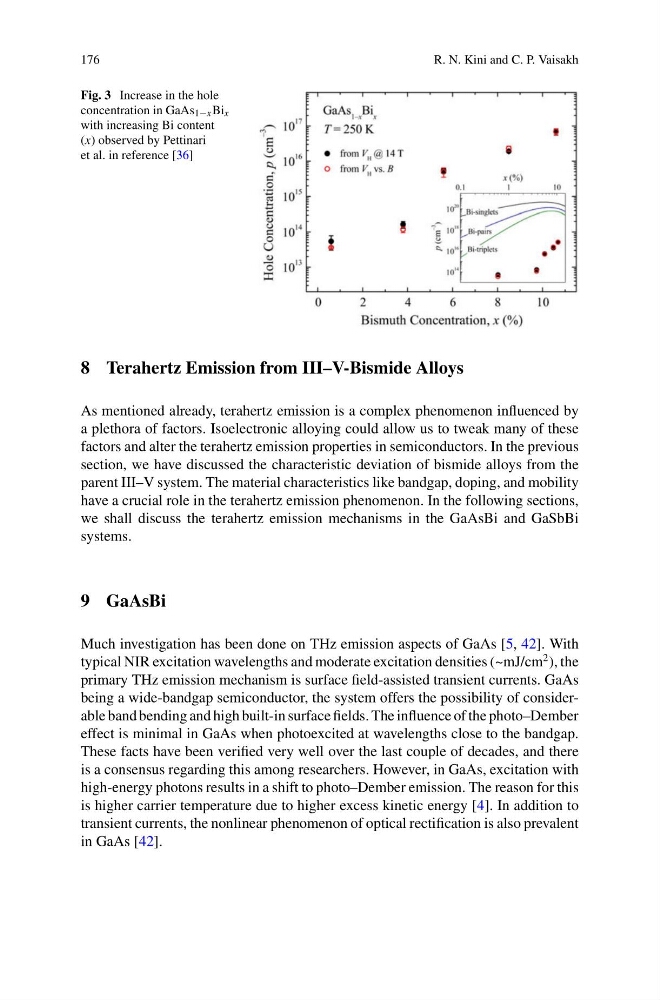
Fig. 3 Increase in the hole
concentration in GaAs 1−x Bi x
with increasing Bi content
(x) observed by Pettinari
et al. in reference [36]
8 Terahertz Emission from III–V-Bismide Alloys
As mentioned already, terahertz emission is a complex phenomenon influenced by
a plethora of factors. Isoelectronic alloying could allow us to tweak many of these
factors and alter the terahertz emission properties in semiconductors. In the previous
section, we have discussed the characteristic deviation of bismide alloys from the
parent III–V system. The material characteristics like bandgap, doping, and mobility
have a crucial role in the terahertz emission phenomenon. In the following sections,
we shall discuss the terahertz emission mechanisms in the GaAsBi and GaSbBi
systems.
9 GaAsBi
Much investigation has been done on THz emission aspects of GaAs [5, 42]. With
typical NIR excitation wavelengths and moderate excitation densities (~mJ/cm
2 ), the
primary THz emission mechanism is surface field-assisted transient currents. GaAs
being a wide-bandgap semiconductor, the system offers the possibility of considerable band bending and high built-in surface fields. The influence of the photo–Dember
effect is minimal in GaAs when photoexcited at wavelengths close to the bandgap.
These facts have been verified very well over the last couple of decades, and there
is a consensus regarding this among researchers. However, in GaAs, excitation with
high-energy photons results in a shift to photo–Dember emission. The reason for this
is higher carrier temperature due to higher excess kinetic energy [4]. In addition to
transient currents, the nonlinear phenomenon of optical rectification is also prevalent
in GaAs [42].
R. N. Kini and C. P. Vaisakh
Fig. 3 Increase in the hole
concentration in GaAs 1−x Bi x
with increasing Bi content
(x) observed by Pettinari
et al. in reference [36]
8 Terahertz Emission from III–V-Bismide Alloys
As mentioned already, terahertz emission is a complex phenomenon influenced by
a plethora of factors. Isoelectronic alloying could allow us to tweak many of these
factors and alter the terahertz emission properties in semiconductors. In the previous
section, we have discussed the characteristic deviation of bismide alloys from the
parent III–V system. The material characteristics like bandgap, doping, and mobility
have a crucial role in the terahertz emission phenomenon. In the following sections,
we shall discuss the terahertz emission mechanisms in the GaAsBi and GaSbBi
systems.
9 GaAsBi
Much investigation has been done on THz emission aspects of GaAs [5, 42]. With
typical NIR excitation wavelengths and moderate excitation densities (~mJ/cm
2 ), the
primary THz emission mechanism is surface field-assisted transient currents. GaAs
being a wide-bandgap semiconductor, the system offers the possibility of considerable band bending and high built-in surface fields. The influence of the photo–Dember
effect is minimal in GaAs when photoexcited at wavelengths close to the bandgap.
These facts have been verified very well over the last couple of decades, and there
is a consensus regarding this among researchers. However, in GaAs, excitation with
high-energy photons results in a shift to photo–Dember emission. The reason for this
is higher carrier temperature due to higher excess kinetic energy [4]. In addition to
transient currents, the nonlinear phenomenon of optical rectification is also prevalent
in GaAs [42].