

Terahertz Emission Mechanisms in III–V Semiconductors …
175
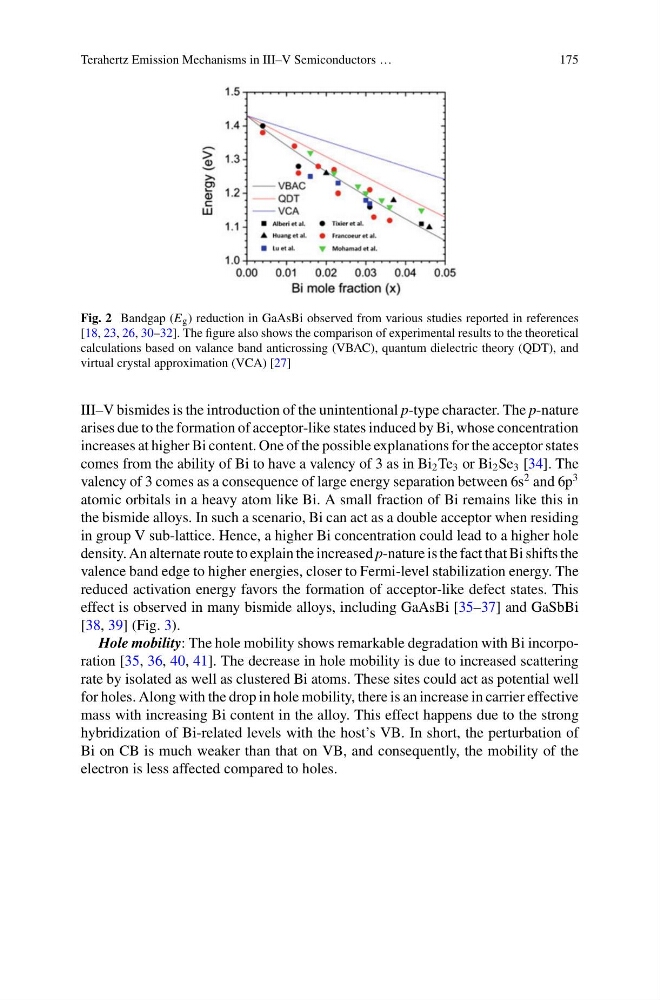
Fig. 2 Bandgap (E g ) reduction in GaAsBi observed from various studies reported in references
[18, 23, 26, 30–32]. The figure also shows the comparison of experimental results to the theoretical
calculations based on valance band anticrossing (VBAC), quantum dielectric theory (QDT), and
virtual crystal approximation (VCA) [27]
III–V bismides is the introduction of the unintentional p-type character. The p-nature
arises due to the formation of acceptor-like states induced by Bi, whose concentration
increases at higher Bi content. One of the possible explanations for the acceptor states
comes from the ability of Bi to have a valency of 3 as in Bi 2 Te 3 or Bi 2 Se 3 [34]. The
valency of 3 comes as a consequence of large energy separation between 6s
2 and 6p
3
atomic orbitals in a heavy atom like Bi. A small fraction of Bi remains like this in
the bismide alloys. In such a scenario, Bi can act as a double acceptor when residing
in group V sub-lattice. Hence, a higher Bi concentration could lead to a higher hole
density. An alternate route to explain the increased p-nature is the fact that Bi shifts the
valence band edge to higher energies, closer to Fermi-level stabilization energy. The
reduced activation energy favors the formation of acceptor-like defect states. This
effect is observed in many bismide alloys, including GaAsBi [35–37] and GaSbBi
[38, 39] (Fig. 3).
Hole mobility: The hole mobility shows remarkable degradation with Bi incorporation [35, 36, 40, 41]. The decrease in hole mobility is due to increased scattering
rate by isolated as well as clustered Bi atoms. These sites could act as potential well
for holes. Along with the drop in hole mobility, there is an increase in carrier effective
mass with increasing Bi content in the alloy. This effect happens due to the strong
hybridization of Bi-related levels with the host’s VB. In short, the perturbation of
Bi on CB is much weaker than that on VB, and consequently, the mobility of the
electron is less affected compared to holes.
175
Fig. 2 Bandgap (E g ) reduction in GaAsBi observed from various studies reported in references
[18, 23, 26, 30–32]. The figure also shows the comparison of experimental results to the theoretical
calculations based on valance band anticrossing (VBAC), quantum dielectric theory (QDT), and
virtual crystal approximation (VCA) [27]
III–V bismides is the introduction of the unintentional p-type character. The p-nature
arises due to the formation of acceptor-like states induced by Bi, whose concentration
increases at higher Bi content. One of the possible explanations for the acceptor states
comes from the ability of Bi to have a valency of 3 as in Bi 2 Te 3 or Bi 2 Se 3 [34]. The
valency of 3 comes as a consequence of large energy separation between 6s
2 and 6p
3
atomic orbitals in a heavy atom like Bi. A small fraction of Bi remains like this in
the bismide alloys. In such a scenario, Bi can act as a double acceptor when residing
in group V sub-lattice. Hence, a higher Bi concentration could lead to a higher hole
density. An alternate route to explain the increased p-nature is the fact that Bi shifts the
valence band edge to higher energies, closer to Fermi-level stabilization energy. The
reduced activation energy favors the formation of acceptor-like defect states. This
effect is observed in many bismide alloys, including GaAsBi [35–37] and GaSbBi
[38, 39] (Fig. 3).
Hole mobility: The hole mobility shows remarkable degradation with Bi incorporation [35, 36, 40, 41]. The decrease in hole mobility is due to increased scattering
rate by isolated as well as clustered Bi atoms. These sites could act as potential well
for holes. Along with the drop in hole mobility, there is an increase in carrier effective
mass with increasing Bi content in the alloy. This effect happens due to the strong
hybridization of Bi-related levels with the host’s VB. In short, the perturbation of
Bi on CB is much weaker than that on VB, and consequently, the mobility of the
electron is less affected compared to holes.