

4
A. Deyasi and A. Sarkar
where κ 0 is the propagation vector, as characteristics of the medium. The general
solution of the electric field Eq. (3.1) is given by:
E = A 1 exp(iκz) + A 2 exp(−iκz)
(3.2)
Similar procedure can be adopted for the magnetic field, which will provide almost
same solution using the Maxwell equation as
B = A 1 n exp(iκz) − A 2 n exp(−iκz)
(3.3)
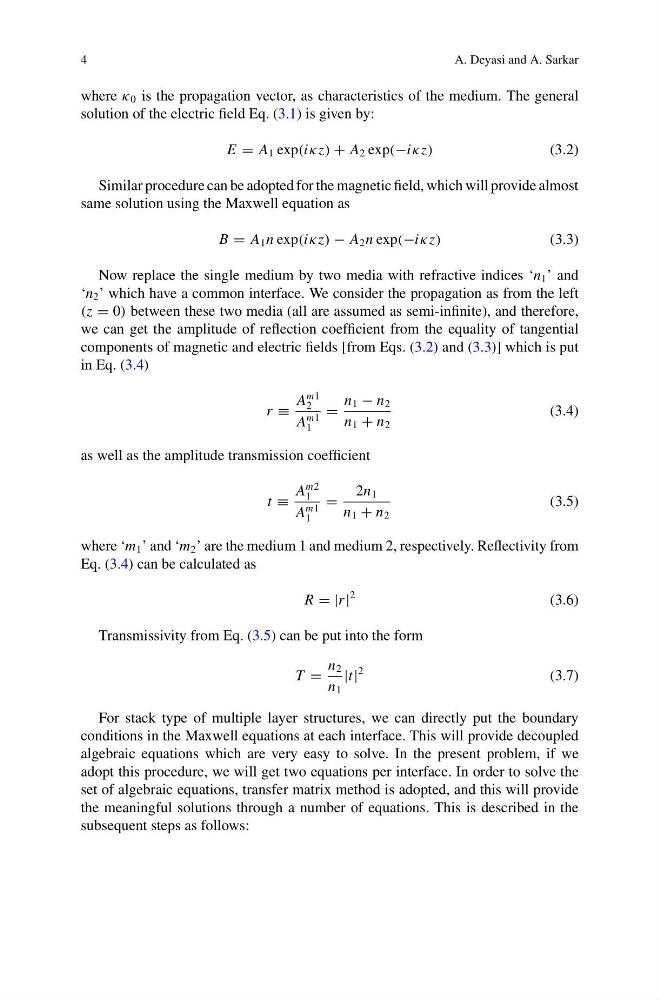
Now replace the single medium by two media with refractive indices ‘n 1 ’ and
‘n 2 ’ which have a common interface. We consider the propagation as from the left
(z = 0) between these two media (all are assumed as semi-infinite), and therefore,
we can get the amplitude of reflection coefficient from the equality of tangential
components of magnetic and electric fields [from Eqs. (3.2) and (3.3)] which is put
in Eq. (3.4)
r ≡
A
m1
2
A
m1
1
=
n 1 − n 2
n 1 + n 2
(3.4)
as well as the amplitude transmission coefficient
t ≡
A
m2
1
A
m1
1
=
2n 1
n 1 + n 2
(3.5)
where ‘m 1 ’ and ‘m 2 ’ are the medium 1 and medium 2, respectively. Reflectivity from
Eq. (3.4) can be calculated as
R = |r |
2
(3.6)
Transmissivity from Eq. (3.5) can be put into the form
T =
n 2
n 1
|t|
2
(3.7)
For stack type of multiple layer structures, we can directly put the boundary
conditions in the Maxwell equations at each interface. This will provide decoupled
algebraic equations which are very easy to solve. In the present problem, if we
adopt this procedure, we will get two equations per interface. In order to solve the
set of algebraic equations, transfer matrix method is adopted, and this will provide
the meaningful solutions through a number of equations. This is described in the
subsequent steps as follows:
A. Deyasi and A. Sarkar
where κ 0 is the propagation vector, as characteristics of the medium. The general
solution of the electric field Eq. (3.1) is given by:
E = A 1 exp(iκz) + A 2 exp(−iκz)
(3.2)
Similar procedure can be adopted for the magnetic field, which will provide almost
same solution using the Maxwell equation as
B = A 1 n exp(iκz) − A 2 n exp(−iκz)
(3.3)
Now replace the single medium by two media with refractive indices ‘n 1 ’ and
‘n 2 ’ which have a common interface. We consider the propagation as from the left
(z = 0) between these two media (all are assumed as semi-infinite), and therefore,
we can get the amplitude of reflection coefficient from the equality of tangential
components of magnetic and electric fields [from Eqs. (3.2) and (3.3)] which is put
in Eq. (3.4)
r ≡
A
m1
2
A
m1
1
=
n 1 − n 2
n 1 + n 2
(3.4)
as well as the amplitude transmission coefficient
t ≡
A
m2
1
A
m1
1
=
2n 1
n 1 + n 2
(3.5)
where ‘m 1 ’ and ‘m 2 ’ are the medium 1 and medium 2, respectively. Reflectivity from
Eq. (3.4) can be calculated as
R = |r |
2
(3.6)
Transmissivity from Eq. (3.5) can be put into the form
T =
n 2
n 1
|t|
2
(3.7)
For stack type of multiple layer structures, we can directly put the boundary
conditions in the Maxwell equations at each interface. This will provide decoupled
algebraic equations which are very easy to solve. In the present problem, if we
adopt this procedure, we will get two equations per interface. In order to solve the
set of algebraic equations, transfer matrix method is adopted, and this will provide
the meaningful solutions through a number of equations. This is described in the
subsequent steps as follows: