

Data Transmission with Terahertz Communication Systems
137
Data
In
Data
Out
QPSK/BPSK
BPF
Upconversion
PA
DA
Differenal
Encoding
QPSK/BPSK
BPF
Upconversion
PA
DA
Differenal
Encoding
300 GHz MMW signal
Fig. 6 Block diagram of SISO-QPSK/BPSK transceiver system
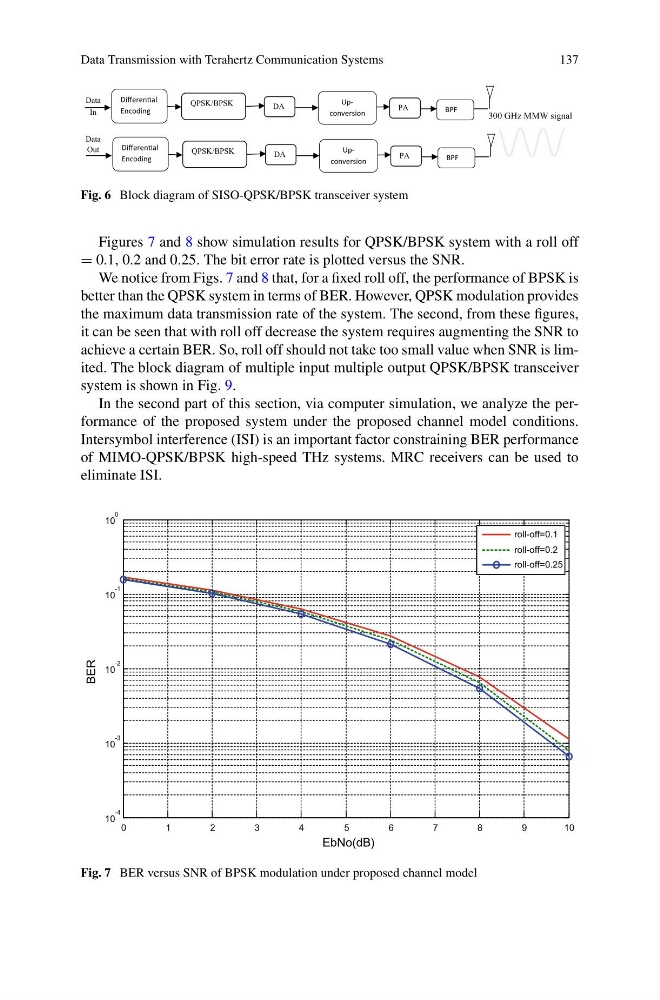
Figures 7 and 8 show simulation results for QPSK/BPSK system with a roll off
= 0.1, 0.2 and 0.25. The bit error rate is plotted versus the SNR.
We notice from Figs. 7 and 8 that, for a fixed roll off, the performance of BPSK is
better than the QPSK system in terms of BER. However, QPSK modulation provides
the maximum data transmission rate of the system. The second, from these figures,
it can be seen that with roll off decrease the system requires augmenting the SNR to
achieve a certain BER. So, roll off should not take too small value when SNR is limited. The block diagram of multiple input multiple output QPSK/BPSK transceiver
system is shown in Fig. 9.
In the second part of this section, via computer simulation, we analyze the performance of the proposed system under the proposed channel model conditions.
Intersymbol interference (ISI) is an important factor constraining BER performance
of MIMO-QPSK/BPSK high-speed THz systems. MRC receivers can be used to
eliminate ISI.
0
1
2
3
4
5
6
7
8
9
10
10
-4
10
-3
10
-2
10
-1
10
0
EbNo(dB)
BER
roll-off=0.1
roll-off=0.2
roll-off=0.25
Fig. 7 BER versus SNR of BPSK modulation under proposed channel model
137
Data
In
Data
Out
QPSK/BPSK
BPF
Upconversion
PA
DA
Differenal
Encoding
QPSK/BPSK
BPF
Upconversion
PA
DA
Differenal
Encoding
300 GHz MMW signal
Fig. 6 Block diagram of SISO-QPSK/BPSK transceiver system
Figures 7 and 8 show simulation results for QPSK/BPSK system with a roll off
= 0.1, 0.2 and 0.25. The bit error rate is plotted versus the SNR.
We notice from Figs. 7 and 8 that, for a fixed roll off, the performance of BPSK is
better than the QPSK system in terms of BER. However, QPSK modulation provides
the maximum data transmission rate of the system. The second, from these figures,
it can be seen that with roll off decrease the system requires augmenting the SNR to
achieve a certain BER. So, roll off should not take too small value when SNR is limited. The block diagram of multiple input multiple output QPSK/BPSK transceiver
system is shown in Fig. 9.
In the second part of this section, via computer simulation, we analyze the performance of the proposed system under the proposed channel model conditions.
Intersymbol interference (ISI) is an important factor constraining BER performance
of MIMO-QPSK/BPSK high-speed THz systems. MRC receivers can be used to
eliminate ISI.
0
1
2
3
4
5
6
7
8
9
10
10
-4
10
-3
10
-2
10
-1
10
0
EbNo(dB)
BER
roll-off=0.1
roll-off=0.2
roll-off=0.25
Fig. 7 BER versus SNR of BPSK modulation under proposed channel model