

126
M. El Ghzaoui and S. Das
The drawback of OOK modulation technique arises in the presence of an undesired
signal. OOK is spectrally efficient modulation, but more sensitive to noise because
of the other types of modulation such as QAM, PSK, and FSK.
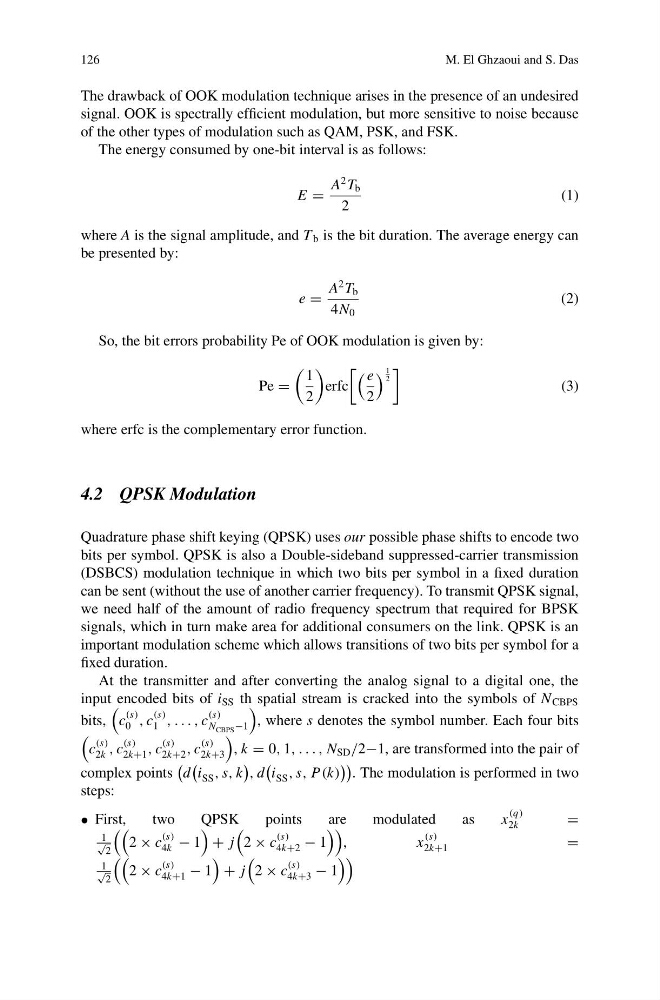
The energy consumed by one-bit interval is as follows:
E =
A
2 T b
2
(1)
where A is the signal amplitude, and T b is the bit duration. The average energy can
be presented by:
e =
A
2 T b
4N 0
(2)
So, the bit errors probability Pe of OOK modulation is given by:
Pe =
1
2
erfc
e
2
1
2
(3)
where erfc is the complementary error function.
4.2 QPSK Modulation
Quadrature phase shift keying (QPSK) uses our possible phase shifts to encode two
bits per symbol. QPSK is also a Double-sideband suppressed-carrier transmission
(DSBCS) modulation technique in which two bits per symbol in a fixed duration
can be sent (without the use of another carrier frequency). To transmit QPSK signal,
we need half of the amount of radio frequency spectrum that required for BPSK
signals, which in turn make area for additional consumers on the link. QPSK is an
important modulation scheme which allows transitions of two bits per symbol for a
fixed duration.
At the transmitter and after converting the analog signal to a digital one, the
input encoded bits of i SS th spatial stream is cracked into the symbols of N CBPS
bits,
c
(s)
0 , c
(s)
1 , . . . , c
(s)
N CBPS −1
, where s denotes the symbol number. Each four bits
c
(s)
2k , c
(s)
2k+1 , c
(s)
2k+2 , c
(s)
2k+3
, k = 0, 1, . . . , N SD /2−1, are transformed into the pair of
complex points
d
i SS , s, k
, d
i SS , s, P(k)
. The modulation is performed in two
steps:
• First,
two
QPSK
points
are
modulated
as
x
(q)
2k
=
1
√
2
2 × c
(s)
4k − 1
+ j
2 × c
(s)
4k+2 − 1
,
x
(s)
2k+1
=
1
√
2
2 × c
(s)
4k+1 − 1
+ j
2 × c
(s)
4k+3 − 1
M. El Ghzaoui and S. Das
The drawback of OOK modulation technique arises in the presence of an undesired
signal. OOK is spectrally efficient modulation, but more sensitive to noise because
of the other types of modulation such as QAM, PSK, and FSK.
The energy consumed by one-bit interval is as follows:
E =
A
2 T b
2
(1)
where A is the signal amplitude, and T b is the bit duration. The average energy can
be presented by:
e =
A
2 T b
4N 0
(2)
So, the bit errors probability Pe of OOK modulation is given by:
Pe =
1
2
erfc
e
2
1
2
(3)
where erfc is the complementary error function.
4.2 QPSK Modulation
Quadrature phase shift keying (QPSK) uses our possible phase shifts to encode two
bits per symbol. QPSK is also a Double-sideband suppressed-carrier transmission
(DSBCS) modulation technique in which two bits per symbol in a fixed duration
can be sent (without the use of another carrier frequency). To transmit QPSK signal,
we need half of the amount of radio frequency spectrum that required for BPSK
signals, which in turn make area for additional consumers on the link. QPSK is an
important modulation scheme which allows transitions of two bits per symbol for a
fixed duration.
At the transmitter and after converting the analog signal to a digital one, the
input encoded bits of i SS th spatial stream is cracked into the symbols of N CBPS
bits,
c
(s)
0 , c
(s)
1 , . . . , c
(s)
N CBPS −1
, where s denotes the symbol number. Each four bits
c
(s)
2k , c
(s)
2k+1 , c
(s)
2k+2 , c
(s)
2k+3
, k = 0, 1, . . . , N SD /2−1, are transformed into the pair of
complex points
d
i SS , s, k
, d
i SS , s, P(k)
. The modulation is performed in two
steps:
• First,
two
QPSK
points
are
modulated
as
x
(q)
2k
=
1
√
2
2 × c
(s)
4k − 1
+ j
2 × c
(s)
4k+2 − 1
,
x
(s)
2k+1
=
1
√
2
2 × c
(s)
4k+1 − 1
+ j
2 × c
(s)
4k+3 − 1