

soil and landscape on the human soul. What he described as relationship between
landscape and soul (in German, Hellpach 1939, 201 ff.) is not much different from
place identity in modern psychology (Hague and Jenkins 2005; Gifford 2014). The
psychological constitution is a product of natural and cultural aspects. It is conducted
by diverse influences including spirituality. Furthermore, traditional systems of
stewardship are obviously important for the wellbeing of native plant and animal
communities on the one hand and protection and conservation of biodiversity at local
scales on the other (Nilayangode et al. 2016; Kumar et al. 2016).
Therefore, the question to be answered is—how is our environmental consciousness influenced by events in the past, and in itself influencing the risk management?
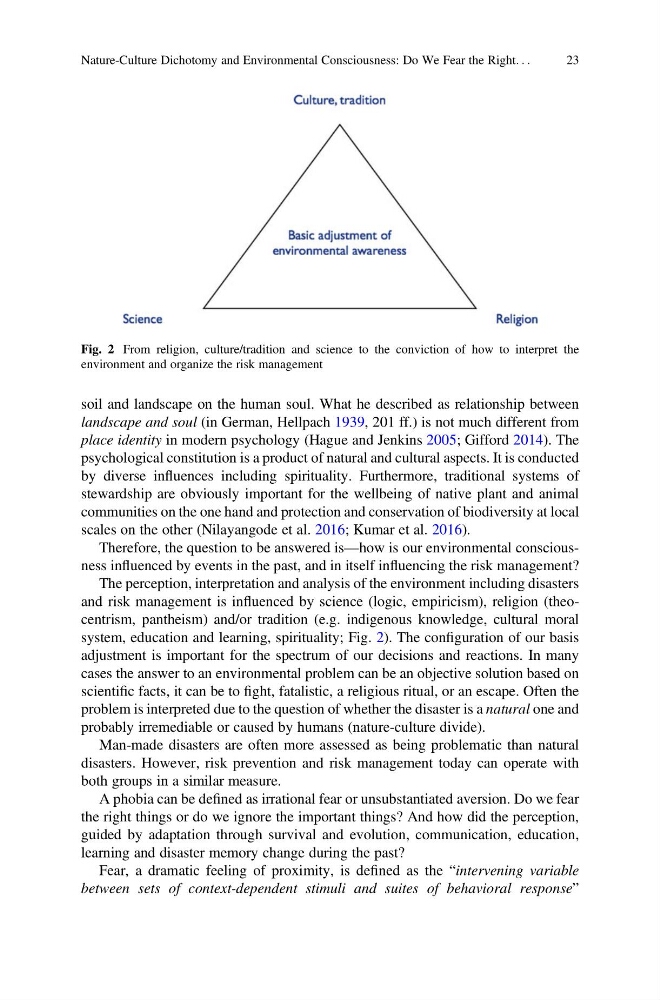
The perception, interpretation and analysis of the environment including disasters
and risk management is influenced by science (logic, empiricism), religion (theocentrism, pantheism) and/or tradition (e.g. indigenous knowledge, cultural moral
system, education and learning, spirituality; Fig. 2). The configuration of our basis
adjustment is important for the spectrum of our decisions and reactions. In many
cases the answer to an environmental problem can be an objective solution based on
scientific facts, it can be to fight, fatalistic, a religious ritual, or an escape. Often the
problem is interpreted due to the question of whether the disaster is a natural one and
probably irremediable or caused by humans (nature-culture divide).
Man-made disasters are often more assessed as being problematic than natural
disasters. However, risk prevention and risk management today can operate with
both groups in a similar measure.
A phobia can be defined as irrational fear or unsubstantiated aversion. Do we fear
the right things or do we ignore the important things? And how did the perception,
guided by adaptation through survival and evolution, communication, education,
learning and disaster memory change during the past?
Fear, a dramatic feeling of proximity, is defined as the “intervening variable
between sets of context-dependent stimuli and suites of behavioral response”
Fig. 2 From religion, culture/tradition and science to the conviction of how to interpret the
environment and organize the risk management
Nature-Culture Dichotomy and Environmental Consciousness: Do We Fear the Right. . .
23
landscape and soul (in German, Hellpach 1939, 201 ff.) is not much different from
place identity in modern psychology (Hague and Jenkins 2005; Gifford 2014). The
psychological constitution is a product of natural and cultural aspects. It is conducted
by diverse influences including spirituality. Furthermore, traditional systems of
stewardship are obviously important for the wellbeing of native plant and animal
communities on the one hand and protection and conservation of biodiversity at local
scales on the other (Nilayangode et al. 2016; Kumar et al. 2016).
Therefore, the question to be answered is—how is our environmental consciousness influenced by events in the past, and in itself influencing the risk management?
The perception, interpretation and analysis of the environment including disasters
and risk management is influenced by science (logic, empiricism), religion (theocentrism, pantheism) and/or tradition (e.g. indigenous knowledge, cultural moral
system, education and learning, spirituality; Fig. 2). The configuration of our basis
adjustment is important for the spectrum of our decisions and reactions. In many
cases the answer to an environmental problem can be an objective solution based on
scientific facts, it can be to fight, fatalistic, a religious ritual, or an escape. Often the
problem is interpreted due to the question of whether the disaster is a natural one and
probably irremediable or caused by humans (nature-culture divide).
Man-made disasters are often more assessed as being problematic than natural
disasters. However, risk prevention and risk management today can operate with
both groups in a similar measure.
A phobia can be defined as irrational fear or unsubstantiated aversion. Do we fear
the right things or do we ignore the important things? And how did the perception,
guided by adaptation through survival and evolution, communication, education,
learning and disaster memory change during the past?
Fear, a dramatic feeling of proximity, is defined as the “intervening variable
between sets of context-dependent stimuli and suites of behavioral response”
Fig. 2 From religion, culture/tradition and science to the conviction of how to interpret the
environment and organize the risk management
Nature-Culture Dichotomy and Environmental Consciousness: Do We Fear the Right. . .
23