

Europe is more than two times as large as the European Union which on the other
hand has no constant area as the number of member countries varies from time to
time. Thus, different calculations of the land cover related to the EU are not
comparable. Last but not least, definitions of the term grassland differ considerably.
These are the reasons why it is difficult to get reliable numbers on the grassland
range in Europe for both historical times and present times.
Grazing is historically much older than mowing and has a natural root also in
Europe like in most continental regions. The development and use of the sickle and
mowing is going back to neolithic or even pre-neolithic times (c. 18,000–10,000 BP;
cf. Unger-Hamilton 1985). Most traditionally mowed grassland communities are
relatively young and developed during the Middle Ages (Ellenberg 1996; Heinrich
1992; Hejcman et al. 2013; Stebler 1898). Table 3 shows general differences
between effects of grazing and mowing of grassland. Pastures normally represent a
higher environmental heterogeneity in space than meadows because of trampling
and the selection of plants that were fed by livestock. If the nature conservation
target would be to reduce biomass and productivity in a long time perspective then it
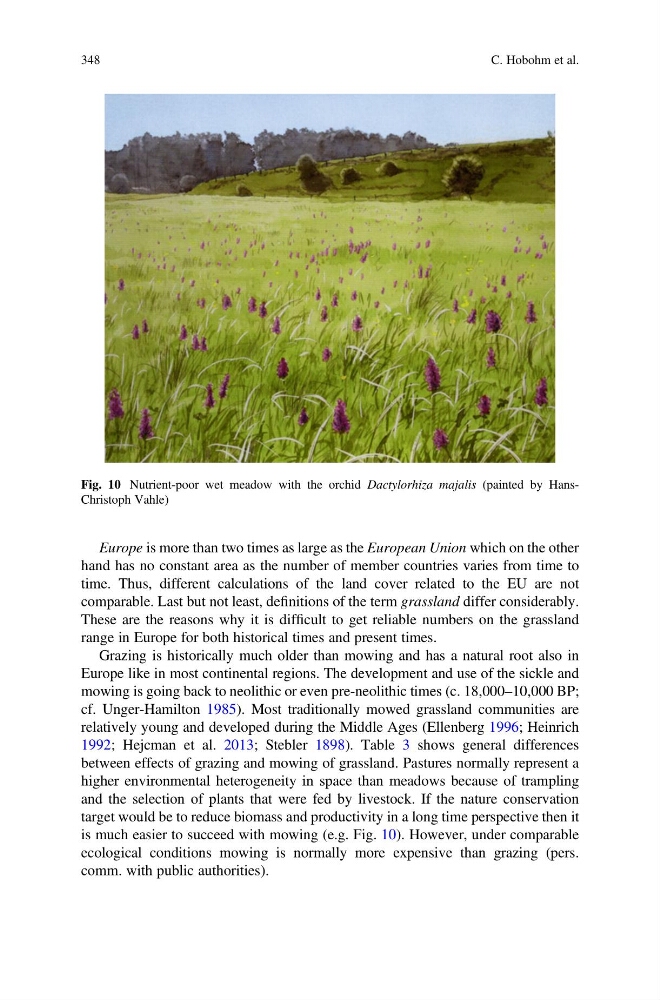
is much easier to succeed with mowing (e.g. Fig. 10). However, under comparable
ecological conditions mowing is normally more expensive than grazing (pers.
comm. with public authorities).
Fig. 10 Nutrient-poor wet meadow with the orchid Dactylorhiza majalis (painted by HansChristoph Vahle)
348
C. Hobohm et al.
hand has no constant area as the number of member countries varies from time to
time. Thus, different calculations of the land cover related to the EU are not
comparable. Last but not least, definitions of the term grassland differ considerably.
These are the reasons why it is difficult to get reliable numbers on the grassland
range in Europe for both historical times and present times.
Grazing is historically much older than mowing and has a natural root also in
Europe like in most continental regions. The development and use of the sickle and
mowing is going back to neolithic or even pre-neolithic times (c. 18,000–10,000 BP;
cf. Unger-Hamilton 1985). Most traditionally mowed grassland communities are
relatively young and developed during the Middle Ages (Ellenberg 1996; Heinrich
1992; Hejcman et al. 2013; Stebler 1898). Table 3 shows general differences
between effects of grazing and mowing of grassland. Pastures normally represent a
higher environmental heterogeneity in space than meadows because of trampling
and the selection of plants that were fed by livestock. If the nature conservation
target would be to reduce biomass and productivity in a long time perspective then it
is much easier to succeed with mowing (e.g. Fig. 10). However, under comparable
ecological conditions mowing is normally more expensive than grazing (pers.
comm. with public authorities).
Fig. 10 Nutrient-poor wet meadow with the orchid Dactylorhiza majalis (painted by HansChristoph Vahle)
348
C. Hobohm et al.