

Especially in dry years, natural and anthropogenic fires are frequent. In wet years
parts of the steppe are traditionally mowed.
7.3 European Grasslands
It is not easy to find serious numbers for the pre-industrial extent of grasslands in
Europe (cf. Table 2). This has to do with the fact that most parts of Europe are in the
forest zone. Wild herbivors have widened the open landscape for at least 1.8 million
years. During Pleistocene glaciation cycles grasslands expanded and contracted due
to cooling and warming while the range of forest changed in the opposite direction.
However, after the last glaciation period wild herbivors were increasingly repressed
and partially eliminated. During the Holocene, for example, the European Ass
(Equus hydruntinus), the Irish Elk (Megaloceros giganteus), the Wolly Mammoth
(Mammuthus primigenius), the Wolly Rhinoceros (Coelodonta antiauitatis), the
Auerochs (Bos primigenius), different subspecies of the Portuguese Ibex (Capra
pyrenaica), and the Tarpan (Equus ferus ferus) went extinct, most probably as a
result of hunting. At the end of the Pleistocene also the Saiga antelope (Saiga
tatarica) lived in Europe, even in Great Britain. During the Holocene, grasslands
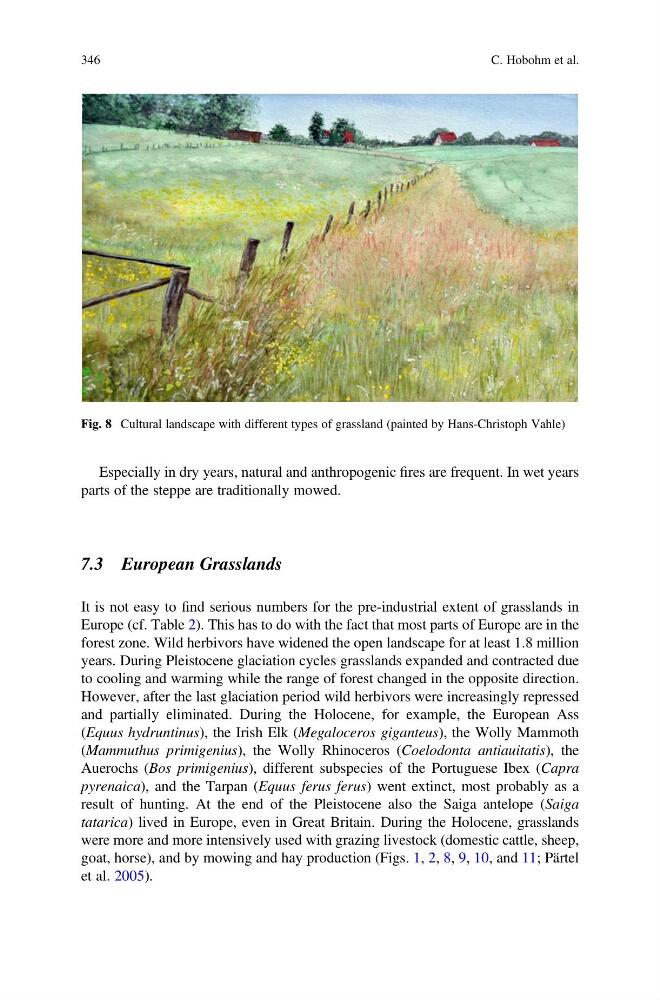
were more and more intensively used with grazing livestock (domestic cattle, sheep,
goat, horse), and by mowing and hay production (Figs. 1, 2, 8, 9, 10, and 11; Pärtel
et al. 2005).
Fig. 8 Cultural landscape with different types of grassland (painted by Hans-Christoph Vahle)
346
C. Hobohm et al.
parts of the steppe are traditionally mowed.
7.3 European Grasslands
It is not easy to find serious numbers for the pre-industrial extent of grasslands in
Europe (cf. Table 2). This has to do with the fact that most parts of Europe are in the
forest zone. Wild herbivors have widened the open landscape for at least 1.8 million
years. During Pleistocene glaciation cycles grasslands expanded and contracted due
to cooling and warming while the range of forest changed in the opposite direction.
However, after the last glaciation period wild herbivors were increasingly repressed
and partially eliminated. During the Holocene, for example, the European Ass
(Equus hydruntinus), the Irish Elk (Megaloceros giganteus), the Wolly Mammoth
(Mammuthus primigenius), the Wolly Rhinoceros (Coelodonta antiauitatis), the
Auerochs (Bos primigenius), different subspecies of the Portuguese Ibex (Capra
pyrenaica), and the Tarpan (Equus ferus ferus) went extinct, most probably as a
result of hunting. At the end of the Pleistocene also the Saiga antelope (Saiga
tatarica) lived in Europe, even in Great Britain. During the Holocene, grasslands
were more and more intensively used with grazing livestock (domestic cattle, sheep,
goat, horse), and by mowing and hay production (Figs. 1, 2, 8, 9, 10, and 11; Pärtel
et al. 2005).
Fig. 8 Cultural landscape with different types of grassland (painted by Hans-Christoph Vahle)
346
C. Hobohm et al.