

7.2 Kazakh Steppe
The temperate steppe biome of Eurasia, stretching from Central and E Europe
(Romania, Bulgaria, Ukraine) to E Asia (Mongolia, China), is the largest temperate
grassland belt on Earth (Table 2). It is composed by four main biogeographical
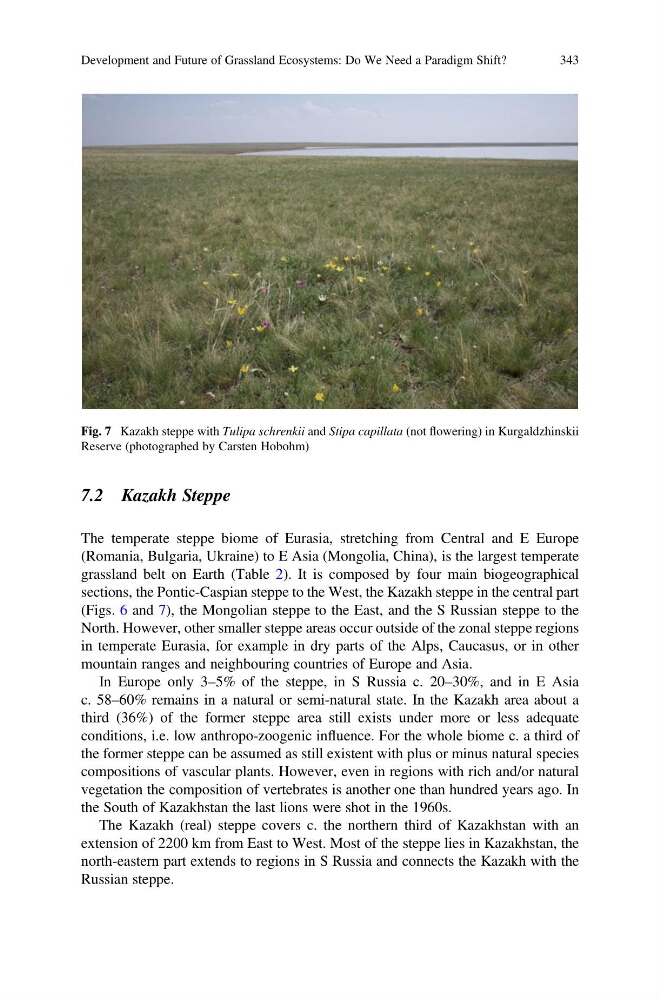
sections, the Pontic-Caspian steppe to the West, the Kazakh steppe in the central part
(Figs. 6 and 7), the Mongolian steppe to the East, and the S Russian steppe to the
North. However, other smaller steppe areas occur outside of the zonal steppe regions
in temperate Eurasia, for example in dry parts of the Alps, Caucasus, or in other
mountain ranges and neighbouring countries of Europe and Asia.
In Europe only 3–5% of the steppe, in S Russia c. 20–30%, and in E Asia
c. 58–60% remains in a natural or semi-natural state. In the Kazakh area about a
third (36%) of the former steppe area still exists under more or less adequate
conditions, i.e. low anthropo-zoogenic influence. For the whole biome c. a third of
the former steppe can be assumed as still existent with plus or minus natural species
compositions of vascular plants. However, even in regions with rich and/or natural
vegetation the composition of vertebrates is another one than hundred years ago. In
the South of Kazakhstan the last lions were shot in the 1960s.
The Kazakh (real) steppe covers c. the northern third of Kazakhstan with an
extension of 2200 km from East to West. Most of the steppe lies in Kazakhstan, the
north-eastern part extends to regions in S Russia and connects the Kazakh with the
Russian steppe.
Fig. 7 Kazakh steppe with Tulipa schrenkii and Stipa capillata (not flowering) in Kurgaldzhinskii
Reserve (photographed by Carsten Hobohm)
Development and Future of Grassland Ecosystems: Do We Need a Paradigm Shift?
343
The temperate steppe biome of Eurasia, stretching from Central and E Europe
(Romania, Bulgaria, Ukraine) to E Asia (Mongolia, China), is the largest temperate
grassland belt on Earth (Table 2). It is composed by four main biogeographical
sections, the Pontic-Caspian steppe to the West, the Kazakh steppe in the central part
(Figs. 6 and 7), the Mongolian steppe to the East, and the S Russian steppe to the
North. However, other smaller steppe areas occur outside of the zonal steppe regions
in temperate Eurasia, for example in dry parts of the Alps, Caucasus, or in other
mountain ranges and neighbouring countries of Europe and Asia.
In Europe only 3–5% of the steppe, in S Russia c. 20–30%, and in E Asia
c. 58–60% remains in a natural or semi-natural state. In the Kazakh area about a
third (36%) of the former steppe area still exists under more or less adequate
conditions, i.e. low anthropo-zoogenic influence. For the whole biome c. a third of
the former steppe can be assumed as still existent with plus or minus natural species
compositions of vascular plants. However, even in regions with rich and/or natural
vegetation the composition of vertebrates is another one than hundred years ago. In
the South of Kazakhstan the last lions were shot in the 1960s.
The Kazakh (real) steppe covers c. the northern third of Kazakhstan with an
extension of 2200 km from East to West. Most of the steppe lies in Kazakhstan, the
north-eastern part extends to regions in S Russia and connects the Kazakh with the
Russian steppe.
Fig. 7 Kazakh steppe with Tulipa schrenkii and Stipa capillata (not flowering) in Kurgaldzhinskii
Reserve (photographed by Carsten Hobohm)
Development and Future of Grassland Ecosystems: Do We Need a Paradigm Shift?
343