

7 Examples: Brazilian Cerrado, Kazakh Steppe, European
Pastures and Meadows
The examples were chosen because of a variety of reasons, e.g. their different
geographical position and evolutionary history, different climates, and different
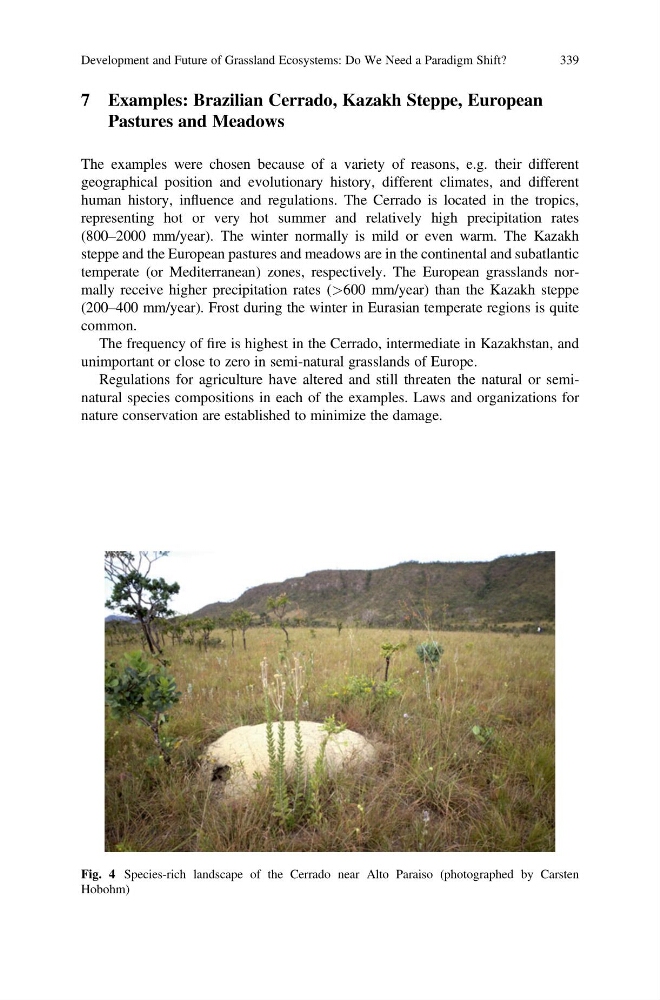
human history, influence and regulations. The Cerrado is located in the tropics,
representing hot or very hot summer and relatively high precipitation rates
(800–2000 mm/year). The winter normally is mild or even warm. The Kazakh
steppe and the European pastures and meadows are in the continental and subatlantic
temperate (or Mediterranean) zones, respectively. The European grasslands normally receive higher precipitation rates (>600 mm/year) than the Kazakh steppe
(200–400 mm/year). Frost during the winter in Eurasian temperate regions is quite
common.
The frequency of fire is highest in the Cerrado, intermediate in Kazakhstan, and
unimportant or close to zero in semi-natural grasslands of Europe.
Regulations for agriculture have altered and still threaten the natural or seminatural species compositions in each of the examples. Laws and organizations for
nature conservation are established to minimize the damage.
Fig. 4 Species-rich landscape of the Cerrado near Alto Paraiso (photographed by Carsten
Hobohm)
Development and Future of Grassland Ecosystems: Do We Need a Paradigm Shift?
339
Pastures and Meadows
The examples were chosen because of a variety of reasons, e.g. their different
geographical position and evolutionary history, different climates, and different
human history, influence and regulations. The Cerrado is located in the tropics,
representing hot or very hot summer and relatively high precipitation rates
(800–2000 mm/year). The winter normally is mild or even warm. The Kazakh
steppe and the European pastures and meadows are in the continental and subatlantic
temperate (or Mediterranean) zones, respectively. The European grasslands normally receive higher precipitation rates (>600 mm/year) than the Kazakh steppe
(200–400 mm/year). Frost during the winter in Eurasian temperate regions is quite
common.
The frequency of fire is highest in the Cerrado, intermediate in Kazakhstan, and
unimportant or close to zero in semi-natural grasslands of Europe.
Regulations for agriculture have altered and still threaten the natural or seminatural species compositions in each of the examples. Laws and organizations for
nature conservation are established to minimize the damage.
Fig. 4 Species-rich landscape of the Cerrado near Alto Paraiso (photographed by Carsten
Hobohm)
Development and Future of Grassland Ecosystems: Do We Need a Paradigm Shift?
339